


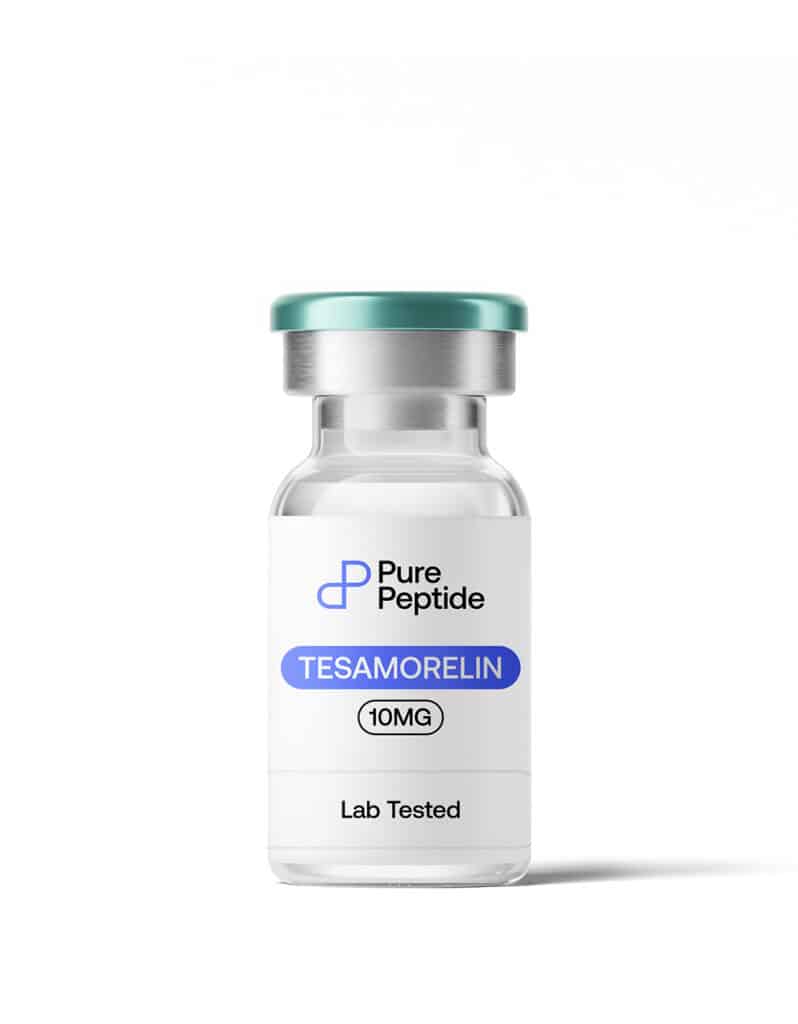
Tesamorelin reliably reduces deep visceral abdominal fat in the populations studied over 26 weeks, but it’s approved only for HIV-associated lipodystrophy, not general weight loss. It won’t move the number on your bathroom scale much. The benefit shows up on a CT scan, not a body-fat scale, and it reverses within months of stopping treatment.
TL;DR:
- Tesamorelin reduces visceral fat around the organs by approximately 15% over 26 weeks in HIV patients, but it does not significantly affect overall body weight or scale readings.
- Its effect on visceral fat is confirmed across multiple trials and sustained for up to a year with continuous use, reversing within months after stopping treatment.
- The drug is approved solely for HIV-associated lipodystrophy and has no proven safety or efficacy for general weight loss or fat reduction in non-HIV individuals.
- Treatment requires careful monitoring of IGF-1 levels and glucose, with safety concerns including injection-site reactions and the need to avoid use in active cancer, pregnancy, or uncontrolled diabetes.
- Long-term use beyond one year is not well studied, and discontinuation leads to the return of visceral fat, meaning it functions more as maintenance therapy than a permanent solution.
Table of Contents
- Does tesamorelin actually cause fat loss?
- Who is tesamorelin actually approved for?
- How does tesamorelin target visceral fat specifically?
- What dose of tesamorelin do clinical trials use?
- When do results show up, and how big is the change?
- What are the risks and who shouldn’t take it?
- What happens if you stop taking tesamorelin?
- How do you get started with tesamorelin safely?
- What quality standards matter when sourcing peptides?
- Why we think the “fat loss” framing around tesamorelin misleads people
- Sourcing tesamorelin and related supplies through Soma Peptide
- Sources
- FAQ
Does tesamorelin actually cause fat loss?
The strongest evidence comes from a pivotal randomized controlled trial published in the New England Journal of Medicine, which found that tesamorelin cut visceral adipose tissue (VAT) by 15.2% over 26 weeks in HIV patients with abdominal fat accumulation, while the placebo group saw VAT increase by 5%. That’s roughly a 20-point swing between treatment and placebo, which is why regulators took it seriously as a targeted therapy rather than a cosmetic supplement.
A separate randomized trial published in JAMA reinforced the finding, reporting a net treatment effect of VAT reduction versus placebo over six months. The same trial found modest reductions in liver fat, an important secondary signal because visceral fat and liver fat tend to travel together metabolically. Neither trial showed the kind of dramatic total-body weight loss you’d expect from an incretin drug. That’s the whole point: tesamorelin was never designed to shrink you all over.
Key numbers: Pooled phase 3 data show a relative VAT reduction at 26 weeks, with sustained effects through 52 weeks in patients who stayed on therapy. Patients switched to placebo during the extension phase saw their visceral fat begin re-accumulating, according to the pooled phase 3 analysis.
A 2026 meta-analysis pooling data across multiple randomized trials confirmed the same pattern: a statistically significant mean reduction in visceral fat and a corresponding drop in waist circumference. When several independent trials converge on the same effect size, that’s a much sturdier basis for clinical decisions than any single study, however well designed.
The metabolic secondary endpoints deserve attention too. That last detail matters because growth hormone pathway drugs have a reputation, sometimes deserved, for nudging blood sugar in the wrong direction. Tesamorelin’s trial data didn’t show that pattern at the 26-week mark.
Where the picture gets murkier is patient experience. A systematic clinical review summarizing the trial evidence noted that while VAT reductions clear clinically meaningful thresholds, improvements in quality of life and body image were inconsistent across studies. Some patients reported feeling better about their appearance; others, despite measurable fat loss on imaging, reported no meaningful change in how they felt day to day. That gap between what a CT scan shows and what a person actually notices is one of the more underappreciated findings in this drug’s research history.
What the trial evidence establishes, in short:
- A 26-week pivotal RCT showing 15.2% VAT reduction versus placebo, with improved triglycerides and cholesterol ratio
- A second RCT reporting a 16.6% net VAT reduction and modest liver-fat improvement over six months
- Pooled phase 3 data confirming roughly 15% VAT reduction sustained through 52 weeks of continuous use
- A 2026 meta-analysis independently confirming the VAT and waist-circumference effect across trials
- Inconsistent patient-reported quality-of-life gains despite consistent imaging results
Who is tesamorelin actually approved for?
Tesamorelin is approved to reduce excess abdominal fat in adults with HIV-associated lipodystrophy, a condition where antiretroviral therapy and the virus itself redistribute fat away from limbs and into the abdomen. It is not approved for general obesity, cosmetic belly-fat reduction, or as a standalone weight-loss treatment, according to Mayo Clinic’s drug reference. That distinction shapes everything about how a clinician should think about prescribing it.
The original trial populations were HIV-positive adults on stable antiretroviral therapy (ART) with clinically confirmed lipodystrophy and excess abdominal girth. Modern ART regimens have changed considerably since those trials enrolled participants, and some newer antiretrovirals carry a lower risk of the fat redistribution that older regimens caused. That shift means the trial population from over a decade ago doesn’t map perfectly onto every HIV patient walking into a clinic in 2026, a limitation the NCBI clinical review explicitly flags.
Using tesamorelin off-label for general belly fat, without the underlying lipodystrophy diagnosis, sits outside the evidence base entirely. There’s no clinical trial data showing the same effect size in HIV-negative patients without fat redistribution, and no regulatory approval covering that use. This is exactly the kind of decision that needs a clinician who understands the label, the trial population, and your specific metabolic picture, not a self-directed protocol pieced together from forum posts.
What the trial eligibility criteria generally required:
- Confirmed HIV status with stable antiretroviral therapy
- Clinically documented abdominal fat accumulation or lipodystrophy
- Baseline lab work excluding uncontrolled diabetes or active malignancy
- No pregnancy or planned pregnancy during the trial period
How does tesamorelin target visceral fat specifically?
Tesamorelin is a growth hormone-releasing hormone (GHRH) analogue. It doesn’t act as growth hormone itself; it stimulates your pituitary gland to release your own growth hormone in a more natural, pulsatile pattern, which in turn raises IGF-1 levels, according to the NCBI clinical review. That upstream mechanism is the reason its effects look so different from a typical weight-loss drug.

Visceral fat tissue appears to be particularly sensitive to growth hormone signalling, more so than subcutaneous fat. That’s the physiological basis for tesamorelin’s preferential effect on the fat surrounding your organs rather than the fat you can pinch. Imaging research has also found that tesamorelin increases fat density in the visceral compartment, a change interpreted as improved fat quality independent of any reduction in fat quantity. Denser, less inflammatory visceral fat is a meaningfully different outcome than simply having less of it, even though both changes tend to move together in the trial data.
This is worth contrasting with the incretin-based drugs dominating the weight-loss conversation right now. GLP-1 and GIP receptor agonists work primarily by suppressing appetite and slowing gastric emptying, driving total-body weight loss that can reach double digits as a percentage of starting weight. You can read more about how that dual mechanism drives weight loss with tirzepatide, or how GLP-1 mechanisms compare with semaglutide specifically. Tesamorelin doesn’t touch appetite or gastric emptying at all. A 2026 evidence summary makes the comparison explicit: tesamorelin targets visceral fat through a hormonal pathway, and it is not a substitute for obesity drugs designed to produce large total-body weight loss. These are different tools solving different problems, and conflating them sets up the wrong expectations from day one.
What dose of tesamorelin do clinical trials use?
The pivotal trials that established tesamorelin’s efficacy used a 2 mg subcutaneous injection once daily. Current product labels reflect slightly different dosing depending on formulation: one labeled product uses 1.4 mg reconstituted and injected once daily, while another uses 1.28 mg, according to Mayo Clinic’s drug information. The dosing differences reflect formulation and reconstitution changes made after the original trials, not a change in the underlying clinical target.
Monitoring in clinical practice generally follows this sequence:
- Baseline labs including fasting glucose, lipid panel, and IGF-1 level before starting therapy
- IGF-1 rechecked periodically during treatment, since tesamorelin’s mechanism directly raises this hormone and levels outside the normal range signal a dose adjustment is needed
- Glycaemic monitoring at intervals, particularly in patients with any history of insulin resistance
- Periodic reassessment of abdominal girth and, where available, imaging to track visceral fat changes
- Ongoing review of injection-site condition and any new symptoms between visits
Reconstitution matters more with this peptide than with many others, since improper mixing or storage can affect potency. Product labelling specifies exact diluent volumes and storage conditions that shouldn’t be improvised.
Pro Tip: Rotate your injection site daily, even within the abdomen, since repeated injections in the same small area are the most common cause of the localized redness and nodules reported in trial safety data.
When do results show up, and how big is the change?
The primary endpoint in every major tesamorelin trial was measured at 26 weeks, using CT-based imaging at a single vertebral slice (typically L4 to L5) to quantify visceral fat, an approach the NEJM trial established as the field standard. That detail matters because it explains why patients can feel underwhelmed if they’re tracking the wrong number.
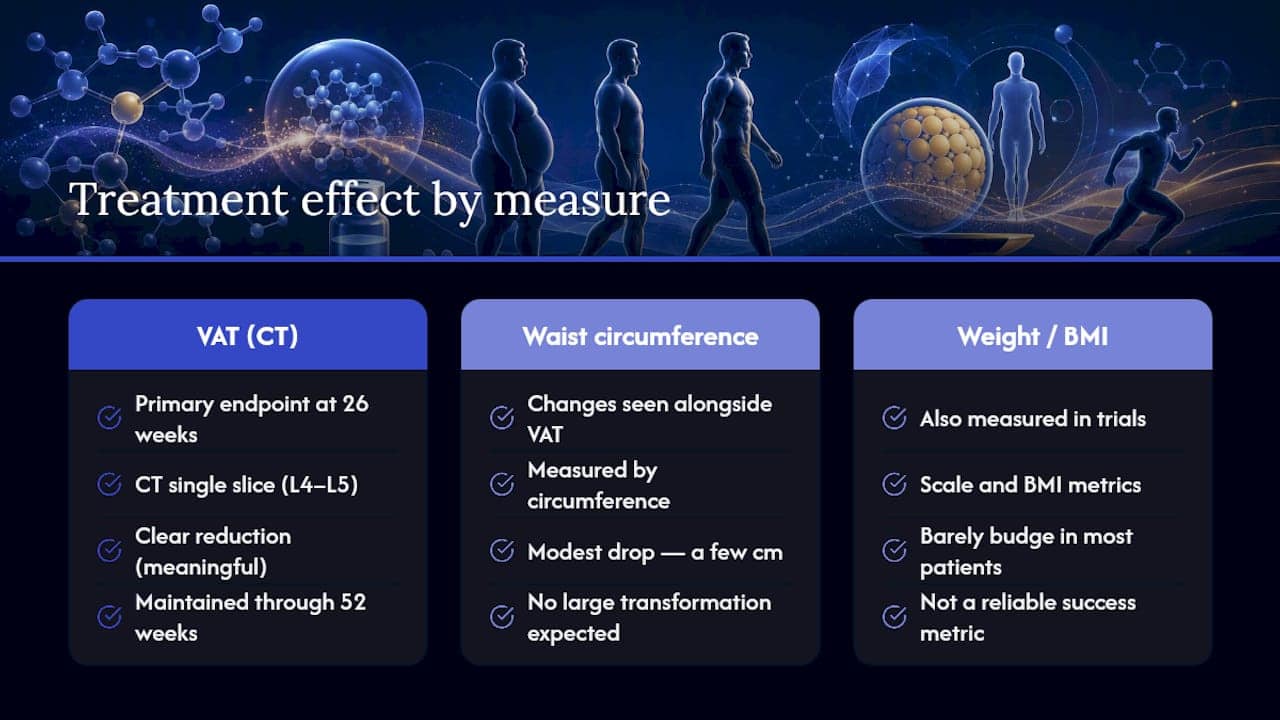
Waist circumference tends to drop modestly alongside the VAT reduction, often by a few centimetres, but total body weight and BMI barely budge in most trial participants. This isn’t a dosing failure. Growth hormone pathways can shift muscle and fat distribution in ways that partially offset each other on a scale, even while a CT scan shows a clear reduction in the fat compartment that actually drives cardiometabolic risk. If your only success metric is the number on a scale, tesamorelin will disappoint you regardless of what’s happening internally.
Patients who continued therapy into the extension phase of the pivotal trials maintained their VAT reduction through 52 weeks. That’s the practical timeline worth planning around: meaningful change by six months, sustained benefit through a year with continued use, and no realistic expectation of a dramatic before-and-after transformation you’d see in a weight-loss ad. The honest framing is a slow, targeted redistribution of internal fat, confirmed by imaging, layered on top of favourable shifts in triglycerides and cholesterol ratio.
What are the risks and who shouldn’t take it?
The adverse events reported across trials were generally mild but worth knowing before you start. Injection-site reactions, including redness, itching, and localized swelling, were among the most frequently reported issues. Joint pain, muscle aches, and peripheral swelling also appeared at higher rates than placebo in trial safety data, consistent with what you’d expect from a drug that raises growth hormone activity.
Safety signal to watch: IGF-1 elevation above the normal reference range was a consistent lab finding across trials and is the primary marker clinicians use to catch overdosing before it becomes symptomatic.
The contraindications are non-negotiable rather than judgment calls:
- Active malignancy or history of cancer is an absolute contraindication, since growth hormone pathway activity can theoretically promote tumour growth
- Pregnancy rules out tesamorelin use entirely, and it hasn’t been studied for safety during pregnancy or breastfeeding
- Hypersensitivity to tesamorelin or any component of the specific formulation prescribed
- Uncontrolled diabetes requires careful evaluation before starting, given the drug’s effect on the growth hormone and IGF-1 axis
- Disruption of the pituitary-hypothalamic axis, including prior pituitary surgery or radiation, needs specialist input before treatment begins
The FDA product labelling formalizes these warnings and should be the reference point for any prescribing decision, not a summary written by a supplement retailer. One honest gap in the evidence: most of the safety data comes from trials lasting a year or less. Long-term safety beyond that window, across many years of continuous use, hasn’t been studied with the same rigour, which is exactly why ongoing clinician oversight matters more with this peptide than with something you’d take for a week and stop.
What happens if you stop taking tesamorelin?
Visceral fat comes back. That’s the blunt version, and the extension-phase data behind it is consistent enough to plan around rather than hope around.

In the pooled phase 3 extension studies, patients who continued tesamorelin past the initial 26-week mark maintained their VAT reduction through 52 weeks. Patients who were switched to placebo during that same extension period saw their visceral fat begin re-accumulating, reversing a meaningful portion of the gains made during active treatment, according to the pooled phase 3 analysis. This isn’t a drug you take for six months and walk away from with permanent results.
Clinicians who work with tesamorelin regularly tend to frame it as a maintenance therapy from the outset rather than a finite course, according to follow-up data from extension studies. That framing changes the conversation you should be having before you ever start: this is closer to a blood pressure medication than a course of antibiotics. Stopping isn’t a failure state, but it does predictably undo the visceral fat benefit over time, and nobody should start this therapy assuming six months will produce a result that locks in permanently.
The practical implication is straightforward. If tesamorelin works for you and the underlying lipodystrophy hasn’t resolved on its own, the realistic plan is indefinite therapy with periodic monitoring, not a one-time intervention. That’s worth discussing explicitly with whoever prescribes it, including what continued treatment costs over years rather than months.
How do you get started with tesamorelin safely?
Getting tesamorelin prescribed starts with a clinical assessment, not an online order form. A prescriber needs to confirm the lipodystrophy diagnosis, review your HIV treatment history, and rule out the contraindications covered above before writing anything.
Come to that appointment prepared. A useful pre-visit checklist:
- Your full antiretroviral therapy history, including any regimen changes tied to fat redistribution symptoms
- Recent fasting glucose and lipid panel results, or a request to have them drawn at the visit
- Baseline IGF-1 level, since this becomes the reference point for monitoring dose response
- Any personal or family history of cancer, pituitary conditions, or diabetes
- A clear description of where you’ve noticed abdominal fat changes and over what timeframe
Prescriptions typically come from an endocrinologist, HIV specialist, or a primary care physician experienced with the medication, with follow-up visits scheduled around the IGF-1 and glucose monitoring intervals described earlier. Cost and insurance coverage vary considerably. Because tesamorelin’s approved indication is narrow, many private insurers require documentation of the lipodystrophy diagnosis before covering it, and out-of-pocket costs for uninsured or off-label use can be substantial over a year of continuous therapy.
Pro Tip: Ask your prescriber directly whether your insurer requires a prior authorization for tesamorelin. Lipodystrophy-specific documentation submitted upfront saves weeks of back-and-forth compared to appealing a denial after the fact.
What quality standards matter when sourcing peptides?
Peptide quality isn’t a minor detail once you’re injecting something daily for months. Purity level, third-party testing, and proper handling all affect both safety and whether you get anything close to the effect seen in trial data.
Every batch is intended to meet a consistent standard rather than the variable quality that shows up across unregulated peptide markets… Sourcing quality matters most when a peptide is meant to be used under clinician supervision, where inconsistent potency can throw off the very monitoring protocols, like IGF-1 tracking, that keep therapy safe… None of this replaces a prescriber’s judgment. It simply means that whatever a clinician decides to prescribe deserves a source that can back up its purity claims with real documentation, not marketing language.
Why we think the “fat loss” framing around tesamorelin misleads people
Calling tesamorelin a fat loss drug, full stop, does readers a disservice, and it is why so much confusion exists around what to expect. The evidence supports something narrower and, frankly, more interesting: a hormonally driven, imaging-confirmed reduction in the fat compartment most tied to cardiometabolic risk, in a specific patient population, with a mechanism entirely distinct from appetite suppression.
We think the honest comparison isn’t tesamorelin versus semaglutide or tirzepatide. Those drugs solve a different problem for a different population. The comparison that matters is tesamorelin versus doing nothing about visceral fat in HIV-associated lipodystrophy, where the trial evidence is genuinely strong. Anyone considering it outside that approved population is stepping outside where the data actually supports use, and that gap deserves a direct conversation with a qualified clinician rather than a workaround.
— Soma Peptide
Sourcing tesamorelin and related supplies through Soma Peptide
Once your clinician has decided tesamorelin or a related peptide protocol fits your situation, sourcing quality becomes the next practical question. Soma Peptide supplies high-purity research peptides, including options relevant to fat loss and metabolic health, alongside the reconstitution ancillaries, bacteriostatic water, syringes, and alcohol pads, that proper handling requires.
Soma Peptide doesn’t replace a prescriber and won’t offer medical advice. What it offers is a consistent, verifiable source for the peptide itself, so the variable you control, product quality, isn’t the weak link in a protocol your clinician is monitoring closely. If you’re exploring options beyond tesamorelin for visceral or abdominal fat, the fat loss peptides guide walks through the broader product category and what current evidence supports for each. Bring your clinician’s recommendation, and check current stock and specifications before your next appointment.
Sources
- Metabolic Effects of a Growth Hormone–Releasing Factor in Patients with HIV | New England Journal of Medicine
- Clinical review report: Tesamorelin (NCBI Bookshelf)
- Mayo Clinic: tesamorelin drug information
FAQ
Does tesamorelin decrease belly fat?
Tesamorelin reduces visceral abdominal fat, the deep fat around organs, by a significant amount in clinical trials, measured by CT scan rather than by waist size alone. It has a much smaller effect on the subcutaneous fat you can pinch.
Will tesamorelin help lose face fat?
No trial evidence supports facial fat reduction from tesamorelin; its studied mechanism and endpoints are specific to visceral abdominal fat in patients with HIV-associated lipodystrophy.
What peptide is best for fat loss?
It depends on the goal: tesamorelin has the strongest trial evidence for targeted visceral fat reduction in lipodystrophy, while GLP-1 and GIP agonists like tirzepatide produce larger total-body weight loss through a different mechanism. Soma Peptide’s evidence-based rankings guide compares options across these different goals.
Is tesamorelin safe for long-term use?
Trial safety data extends to about a year of continuous use, with IGF-1 elevation and injection-site reactions as the main monitored issues; longer-term safety requires ongoing clinician supervision since data beyond that window is limited.