



Peptides can offer real, symptom-targeted support during menopause, but they are adjuncts to foundational care and hormone therapy, not replacements. The clearest evidence sits in three areas:
- Libido: PT-141 (bremelanotide) has Phase 3 trial data for hypoactive sexual desire disorder, though those trials enrolled premenopausal women.
- Skin and collagen: Oral hydrolysed collagen peptides have randomized controlled trial support for bone mineral density and skin elasticity in postmenopausal women; topical GHK-Cu has extensive research history supporting skin remodelling.
- Bone support: A randomized controlled trial showed that daily collagen peptides improved bone mineral density in the spine and femoral neck over about a year in postmenopausal women.
Before anything else: see a menopause-literate clinician, lock in sleep, resistance training, and calcium/vitamin D, then verify any product’s certificate of analysis (COA) before you spend a dollar.
Pro Tip: If you are new to peptides, start with oral collagen or topical GHK-Cu. Both have established safety profiles and meaningful human evidence, making them the lowest-risk entry point.
Key takeaways
Peptides offer targeted, evidence-graded support for specific menopausal symptoms, but no peptide replaces HRT for core symptom management, and clinical supervision is non-negotiable for systemic use.
| Point | Details |
|---|---|
| Strongest evidence | Oral collagen peptides (bone, skin) and PT-141 (libido) have the clearest human trial data. |
| Topical-first principle | GHK-Cu topical has decades of skin evidence and low systemic risk, making it the safest starting point. |
| Safety monitoring | Systemic peptides require baseline cancer screening, liver/kidney panels, and IGF-1 testing before use. |
| Sourcing standard | Demand a COA showing >99% purity, lot number, endotoxin result, and third-party identity confirmation. |
| Soma Peptide | Supplies >99% purity, COA-backed peptides; browse the full catalogue and confirm protocols with a clinician first. |
This article is general information, not a substitute for advice from a qualified doctor. Consult a qualified healthcare professional about your own circumstances before acting on anything here.
Table of Contents
- How peptides act on the body systems that menopause disrupts
- What the evidence actually shows — and where the gaps are
- Safety, side effects, and what to monitor
- How peptides are regulated and how to access them safely
- How to evaluate a peptide product or clinic protocol
- A neutral catalogue of commonly discussed menopause peptides
- When you should see a clinician before going further
- The case for caution — and for doing this right
- Soma Peptide: quality-verified peptides with the transparency you need
- Sources
How peptides act on the body systems that menopause disrupts
Peptides are short chains of amino acids that act as signalling molecules, telling specific cells to do specific things. During menopause, several key pathways shift: collagen synthesis slows, the growth-hormone axis quiets, neuroendocrine signalling changes, and chronic low-grade inflammation can rise. Certain peptides target these pathways with a precision that broader supplements cannot match.
Here is how the most commonly discussed peptides map to menopausal symptoms:
- GHK-Cu → skin remodelling: Stimulates collagen and elastin synthesis topically; studied for skin and wound healing since the 1970s with a well-established safety record.
- PT-141 → neural desire circuits: Acts on melanocortin receptors in the brain rather than the vascular system, making it mechanistically distinct from other libido aids.
- CJC-1295/ipamorelin → GH axis: These secretagogues stimulate growth-hormone release, which tends to decline with age and menopause, potentially supporting body composition and lean mass.
- BPC-157 → tendon, joint, and gut repair: Shows consistent preclinical results for connective-tissue healing; human data in menopausal women are absent.
- Kisspeptin → neuroendocrine signalling: Sits upstream of GnRH and LH; early human work exists, but no validated clinical protocol for menopause symptoms yet.
Pro Tip: When systemic risk is a concern, topical GHK-Cu is a sensible first step. You get meaningful skin evidence with minimal absorption and no injection-site reactions.
What the evidence actually shows — and where the gaps are
The honest one-line summary: HRT has the strongest evidence for core menopausal symptoms; oral collagen peptides and PT-141 have meaningful human trial data for specific endpoints; most other peptides are investigational.
Robust human evidence
Oral hydrolysed collagen peptides are the standout. A 2018 RCT at 5 g/day showed improved spine and femoral neck bone mineral density over 12 months in postmenopausal women, with a four-year follow-up reporting sustained benefits with continued use. Skin elasticity and hydration RCTs are similarly consistent. PT-141’s RECONNECT Phase 3 trials enrolled approximately 1,247 premenopausal women with statistically significant response rates versus placebo for hypoactive sexual desire disorder.

Limited human evidence
Topical GHK-Cu has RCT and meta-analysis support for collagen and skin quality outcomes, though most trials are small. CJC-1295 and ipamorelin have human pharmacokinetic data and some body-composition signals, but no menopause-specific RCTs.
Preclinical or investigational
BPC-157 has strong, repeated animal-model results for tendon and gut repair but no human clinical trials in menopausal women and is not approved for therapeutic use. Kisspeptin remains a research-stage target. DSIP and tesamorelin have limited or mixed human data outside their approved indications.
Key research gaps that clinical commentators consistently flag:
- Dose standardisation across peptide classes
- Long-term safety data in menopausal and perimenopausal populations
- Endocrine interaction studies (peptides alongside HRT)
- RCTs of peptides specifically as HRT adjuncts
As Forbes reporting on menopause optimisation notes, clinical experts urge that peptides be used as symptom-specific adjuncts and call for more long-term research on dosing and endocrine safety.
Statistic to hold onto: PT-141’s RECONNECT trials enrolled a substantial number of premenopausal women. No peptide has completed a menopause-specific RCT as an HRT adjunct.
Safety, side effects, and what to monitor
Topical peptides like GHK-Cu carry low systemic risk. Systemic injectables, particularly GH secretagogues, require medical oversight. That distinction matters practically.
Monitoring checklist before starting systemic peptides:
- Baseline cancer screening (breast, cervical, colorectal) — GH secretagogues are contraindicated in active malignancy.
- Liver and kidney panels to confirm metabolic clearance capacity.
- IGF-1 baseline for anyone considering CJC-1295, ipamorelin, or tesamorelin.
- Sexual health screening before PT-141 use.
- Full medication interaction review, especially if you are on HRT, antidepressants, or cardiovascular medications.
Red flags — stop and consult a clinician immediately if you have:
- Personal or family history of hormone-sensitive cancers
- Uncontrolled cardiovascular disease or hypertension
- Active pregnancy or pregnancy potential without contraception
- Unexplained lumps, bleeding, or rapid weight changes after starting a peptide
Common side effects include nausea and flushing with PT-141, local injection-site reactions with any injectable, and transient water retention with GH secretagogues. Sourcing from a licensed compounding pharmacy and working with a prescribing clinician reduces contamination risk substantially. Investigative reporting from The 19th warns specifically against unregulated “research-use-only” vendors.
How peptides are regulated and how to access them safely
Most peptides discussed for menopause are not specifically approved for that indication. In Canada, access typically requires a clinician’s prescription and fulfilment through a licensed compounding pharmacy or regulated supplier.
Sourcing dos and don’ts:
- Do request a COA with purity percentage, identity test, endotoxin result, and sterility result before purchasing.
- Do use a licensed compounding pharmacy or a supplier with full lot traceability.
- Do confirm your prescriber is familiar with provincial compounding regulations.
- Don’t buy from storefronts labelling products “for research use only” as a workaround to prescription requirements.
- Don’t accept a COA without a lot number that matches the product you receive.
Pro Tip: Reading a COA takes two minutes. If any field is blank, ask why before purchasing.
How to evaluate a peptide product or clinic protocol
Quality, clinical rationale, and a monitoring plan come before price. Always.
Checklist before committing:
- COA showing >99% purity with a lot number matching your product
- Third-party testing by an independent laboratory (not just the manufacturer’s own assay)
- Clear dosing and cycle plan in writing, not verbal
- A clinician monitoring plan that includes at minimum one follow-up lab panel
- Confirmed storage conditions (most peptides require refrigeration after reconstitution)
- Provenance: country of manufacture, GMP certification where applicable
Timeline and cost expectations:
These are ranges for orientation, not guarantees. Actual costs vary by province, clinic, and compounding pharmacy.
A neutral catalogue of commonly discussed menopause peptides
This is an evidence-tiered reference, not a recommendation list. Treat it as a starting point for a clinician conversation.
| Peptide | Primary menopause application | Evidence level | Short safety note |
|---|---|---|---|
| PT-141 (bremelanotide) | Libido/sexual desire | Robust human (premenopausal HSDD) | Nausea, flushing; not studied in postmenopausal RCTs |
| Oral collagen peptides | Bone density, skin elasticity | Robust human (postmenopausal) | Well tolerated; confirm sourcing quality |
| GHK-Cu (topical) | Skin remodelling, wound healing | Moderate human | Low systemic risk via topical route |
| CJC-1295/ipamorelin | Body composition, GH axis | Limited human | Requires IGF-1 monitoring; cancer contraindication |
| BPC-157 | Joint, tendon, gut repair | Preclinical only | No human menopause data; not approved |
| Kisspeptin | Neuroendocrine/hot flash research | Investigational | No validated clinical protocol for menopause |
| DSIP | Sleep quality | Very limited human | Insufficient data for routine use |
| Tesamorelin | Visceral fat reduction | Limited human (HIV lipodystrophy) | Off-label; requires medical supervision |
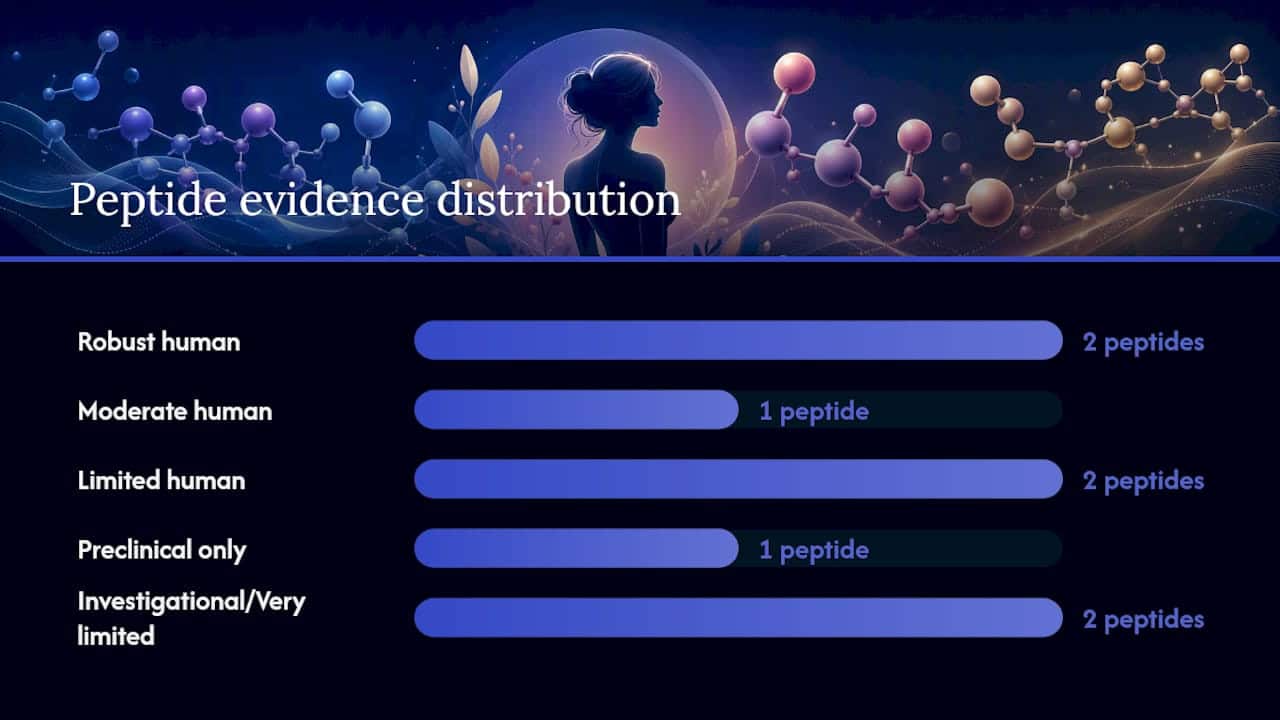
Evidence reviews confirm that no peptide is validated to replace HRT for core menopausal symptoms. Treat every entry above as an adjunct, not a primary therapy. Practitioners consistently advise starting with foundational care before adding any peptide protocol.
When you should see a clinician before going further
See a clinician before starting any systemic peptide, and before starting topical peptides if you have relevant risk factors.
Questions to bring to your appointment:
- What is the evidence for this specific peptide in women my age and stage of menopause?
- What monitoring labs do you recommend before and during use?
- Does this peptide interact with my current HRT or medications?
- What dose and cycle length are you recommending, and why?
- Where will the peptide be sourced, and can I see the COA?
- What results should I expect, and over what timeline?
- What are the stopping criteria if something goes wrong?
Decision rules:
- Active cancer or strong family history of hormone-sensitive cancer: do not start GH secretagogues or systemic peptides without oncology input.
- Uncontrolled hypertension or cardiovascular disease: PT-141 and GH secretagogues require cardiology clearance.
- Considering topical GHK-Cu only, no systemic conditions: a GP conversation is still advisable, but the risk threshold is lower.
- Already on HRT: tell your prescriber before adding any peptide; endocrine interactions are under-studied and your clinician needs the full picture.
The case for caution — and for doing this right
The peptide conversation in menopause care is genuinely exciting, and it is also genuinely early. The gap between what the science currently supports and what some wellness channels claim is wide. Oral collagen has real RCT data. PT-141 has real Phase 3 data. Most of the rest is preclinical promise dressed up as clinical certainty, and that framing does women a disservice.
What actually works is a layered approach: foundational care first (sleep, resistance training, nutrition, HRT where appropriate), then symptom-targeted peptides with verified sourcing and clinician oversight. Skipping the foundation to chase a peptide protocol is backwards. The peptides that have the best evidence, oral collagen and topical GHK-Cu, are also the safest and most accessible. That is not a coincidence; it reflects where the research has had time to mature.
Soma Peptide: quality-verified peptides with the transparency you need
For women exploring peptide options during menopause, that purity standard is not a marketing claim; it is the baseline that makes any protocol worth attempting. Unverified sourcing is where most peptide protocols fail before they start.
Browse the full peptide catalogue to review product options by symptom target, or explore the GHK-Cu product page if skin and collagen support is your starting priority. Peptides are adjuncts; clinical guidance is required. Speak with a menopause-literate clinician before purchasing systemic peptides, and bring your COA questions to that appointment.
Sources
- Peptides, Menopause And The Search For Optimization
- Peptides for Perimenopause: A Guide | PeptidesExplorer
- What are peptides — and should you try them?
- 5 Peptides Replacing HRT for Perimenopausal Women | HL Benefits