


Research-grade GLP-1 peptides can trigger the same nausea, vomiting, and gastrointestinal upset that any GLP-1 compound produces in the body. That’s the predictable part. The bigger danger is what you can’t predict: contamination and dose variability from a supply chain with no mandatory sterility testing or potency verification. Independent lab analyses have found purity ranging from roughly 5% to 75% of what the label claims, and about 25% of gray-market peptide samples contained undisclosed ingredients.
If you experience any of the following, treat it as urgent:
- Persistent vomiting that prevents fluid intake
- Severe abdominal pain, especially radiating to the back
- Fever, chills, or spreading redness at an injection site
- Fainting, confusion, or signs of severe low blood sugar
Call 911 or get to an emergency department immediately for these symptoms. For non-emergency questions about a suspected bad reaction, contact Poison Help at 1-800-222-1222. You don’t need to explain where the product came from to get treated.
Key Takeaways
GLP-1 peptide safety hinges less on the molecule itself and more on whether the vial was manufactured, tested, and labelled with any real oversight.
| Point | Details |
|---|---|
| GI effects are expected | Nausea, vomiting, diarrhea, and injection-site irritation are the predictable, mechanism-driven side effects. |
| Purity varies wildly | Independent testing found research-grade purity ranging from 5% to 75% of label claims. |
| Contamination is common | Roughly 25% of gray-market samples contained undisclosed ingredients, including endotoxins and heavy metals. |
| Severe outcomes are documented | Case reports link unregulated use to dehydration, hypoglycemia, compartment syndrome, and deep infections. |
| Emergency red flags need urgent care | Persistent vomiting, fever, spreading redness, or fainting warrant 911 or an ER visit, not a wait-and-see approach. |
| Soma Peptide documents high purity | Its COAs and educational resources let buyers verify identity and potency before use, though sterility testing still has limits. |
This article is general information, not a substitute for advice from a qualified doctor. Consult a qualified healthcare professional about your own circumstances before acting on anything here.
Table of Contents
- Common GLP-1 peptide side effects and how research-grade products change the picture
- Why contamination happens and what it does inside your body
- The serious harms and long-term unknowns of unregulated peptide use
- What to do if you experience side effects
- How to lower the risk if you’re going ahead anyway
- Soma Peptide’s quality checks: what they cover and where the limits are
- The psychological side of using performance and weight-loss peptides
- Research-grade versus pharmaceutical-grade: why the side-effect profile isn’t the same
- What’s actually happening in your body when side effects hit
- Adjusting your dose without guessing your way into a bigger problem
- Sources
- FAQ
Common GLP-1 peptide side effects and how research-grade products change the picture
The expected side effects of GLP-1 peptides overlap heavily regardless of source: nausea, vomiting, diarrhea, constipation, headache, fatigue, and irritation at the injection site. These show up because the peptide slows gastric emptying and acts on appetite centres in the brain, which is the whole point of the compound but also the source of most complaints.
Consumer health resources note these reactions are widely reported anecdotally with injectable peptides, along with a consistent caveat: robust human safety data for many of these compounds simply doesn’t exist. That’s a meaningfully different situation from an approved drug with published trial data behind its side-effect list.
Here’s what changes with a research-grade vial versus a clinically studied product:
- Unknown starting concentration. If the vial contains more or less peptide than labelled, your intended microdose becomes a guess.
- No standardized reconstitution guidance from the manufacturer. Errors in dilution math compound the potency problem.
- No pharmacovigilance system. There’s no formal channel collecting and flagging adverse events the way there is for approved medications.
A mild, predictable side-effect profile assumes a predictable product. Once potency and purity are variable, the same dose that felt fine last week can hit differently this week, and you have no COA update to warn you.
Why contamination happens and what it does inside your body
Peptides sold for research use aren’t manufactured, tested, or shipped the way injectable pharmaceuticals are. That gap is the actual root cause of most serious complications linked to gray-market use, not the peptide molecule itself.
Independent testing has repeatedly turned up problems beyond simple underdosing:
- Bacterial endotoxin contamination in sampled vials
- Heavy metals and residual solvents left over from synthesis
- Vials mislabelled entirely, containing a different peptide than what the label claims
Each of these has a distinct clinical consequence. Endotoxin and bacterial contamination cause injection-site inflammation, fever, and in serious cases systemic sepsis. Heavy metals and solvent residue accumulate and cause systemic toxicity over repeated exposures, not necessarily after a single injection. Mislabelled or truncated peptide fragments produce pharmacology nobody can predict. You might be injecting something that’s technically inert, or something considerably more potent than intended.
Statistically, purity variance and undisclosed-ingredient rates in this market aren’t rare edge cases. They’re documented at scale across multiple independent testing efforts.
Pro Tip: A certificate of analysis that only reports HPLC purity tells you nothing about endotoxin levels or heavy metals. Ask specifically whether sterility and endotoxin testing were performed, because those are separate assays from a basic identity check.
The core issue is regulatory, not just about one bad batch. Products labelled research use only are manufactured to laboratory standards, not pharmaceutical ones, and that distinction has real consequences the moment a needle is involved.
The serious harms and long-term unknowns of unregulated peptide use
Beyond routine GI upset, case reports and clinical summaries document genuinely severe outcomes tied to unregulated peptide self-administration. Intractable vomiting has led to dehydration severe enough to require hospitalization. Dosing errors from unknown potency have caused dangerous hypoglycemia. Compartment syndrome, deep tissue infections, and abscesses requiring surgical drainage have all been documented in clinical case summaries tied to unregulated injectable use.
Pancreatitis is another concern, given that GLP-1 receptor activity affects the pancreas, and an unpredictable dose amplifies that risk in ways a properly titrated pharmaceutical product does not.
The absence of formal human safety trials for research-grade peptides means the longer-term picture rests on animal studies, preclinical data, and scattered case reports rather than the kind of controlled surveillance that tracks approved medications for years after launch.
What about years down the road? Preclinical data raises plausible, unresolved questions: immune sensitization from repeated exposure to impure protein products, uncertain implications from effects on blood vessel growth, and theoretical autoimmune concerns from contaminant exposure over time. None of this is confirmed in humans using these specific research-grade products. That’s not reassurance. It’s an honest gap in the evidence, and it’s precisely why caution matters more here than with a drug that has a decade of post-market surveillance behind it.
What to do if you experience side effects
If something feels wrong after using a research-grade peptide, don’t wait to see if it passes on its own; treat it as a triage decision.
- Recognize the emergency signs. Persistent vomiting, severe abdominal pain, fever, spreading redness or swelling at an injection site, difficulty breathing, fainting, or symptoms of severe hypoglycemia (confusion, shaking, cold sweat) all warrant a call to 911 or an emergency department visit, not a wait-and-see approach.
- Bring the vial and any documentation. Keep the product, its lot number, and any certificate of analysis you have. Clinicians treating a reaction can work faster with something concrete to reference, even a partial label.
- Call Poison Help for guidance on non-emergency symptoms. The line is 1-800-222-1222, staffed around the clock, and free.
- Describe symptoms plainly. You can simply say you injected a research compound and are experiencing specific symptoms. You don’t owe anyone an explanation of sourcing to receive care.
Pro Tip: Photograph the vial label and any batch codes before you dispose of anything. If symptoms escalate, that image can help a clinician or poison control specialist narrow down what they’re dealing with.
How to lower the risk if you’re going ahead anyway
If you’ve decided to proceed with a research-grade GLP-1 peptide, a few concrete checks meaningfully cut your exposure, even though none of them eliminate risk entirely.
Before you buy:
- Request third-party identity and purity testing, not just a manufacturer’s internal certificate.
- Ask specifically for endotoxin and heavy-metal testing results, since these are separate assays a basic COA often skips.
- Confirm batch traceability and an expiry date. A vendor who can’t produce either is a signal to walk away.
- Cross-check the seller against enforcement history. Regulators have taken action against sellers marketing RUO products alongside dosing calculators and syringes, which demonstrates clear intent for human use despite the label.
On handling: home reconstitution cannot guarantee sterility no matter how careful you are. Understanding what sterility actually requires at a lab level makes clear why a kitchen counter setup falls short, and using sterile, single-use supplies for every step is the minimum, not a guarantee.
The most durable risk reduction is talking to a clinician about regulated or legally compounded alternatives, or a supervised program, especially if weight loss is your underlying goal rather than research itself. That conversation costs you nothing and closes off most of the risks discussed above.
Soma Peptide’s quality checks: what they cover and where the limits are
That’s a meaningfully higher bar than the market average, but it’s worth being precise about what a strong COA actually confirms.
A solid certificate of analysis verifies:
- Identity. Confirmation that the vial contains the peptide it claims to.
- HPLC purity. A quantitative measure of how much of the vial’s content is the target peptide versus synthesis byproducts.
What it typically does not cover on its own: full sterility testing, endotoxin limits, or comprehensive heavy-metal and solvent-residue screening, which pharmaceutical-grade injectables require as standard. Documented purity reduces the odds of receiving an underdosed or wildly mislabelled product. It does not, by itself, eliminate the procedural gaps or unresolved long-term questions inherent to research-grade compounds, and no responsible supplier should claim otherwise. Reviewing lab protocols directly on Soma Peptide’s quality standards page is a reasonable next step before you assume any product, from any source, is fully vetted.
The psychological side of using performance and weight-loss peptides
Side effects aren’t only physical. Appetite suppression, one of the primary reasons people seek out GLP-1 peptides, changes eating behaviour in ways that carry emotional weight. Some users report mood shifts, irritability, or a preoccupation with food restriction that mirrors patterns seen with other appetite-altering interventions. Rapid changes in eating patterns can also affect sleep and energy, which compounds mood effects rather than existing separately from them.
There’s also a behavioural pattern worth naming directly: uncertainty about dosing from an unregulated product tends to push people toward self-experimentation, adjusting up when results feel slow, or stacking with other compounds based on forum advice rather than clinical guidance. That impulse is understandable when you’ve paid for a product and want results, but it’s also how dosing errors and adverse events happen. The psychological pull toward “more must work better” runs directly against everything the purity and potency data says about this specific product category.
Anxiety around sourcing adds another layer. Buyers who know their product hasn’t been through pharmaceutical-grade testing sometimes report ongoing low-level worry about what they’ve injected, particularly after reading about contamination rates. That’s a rational response to a real information gap, not an overreaction, and it’s part of why verifying your source matters as much for peace of mind as for physical safety.
Research-grade versus pharmaceutical-grade: why the side-effect profile isn’t the same
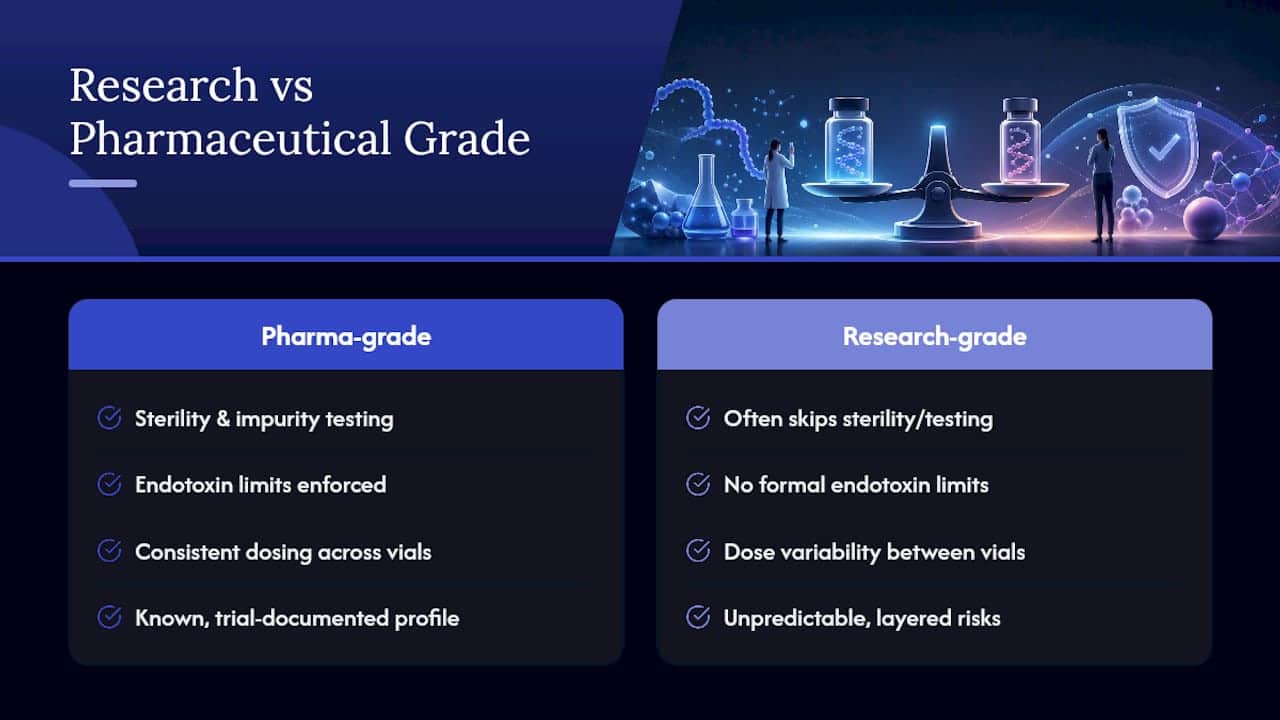
The underlying GLP-1 mechanism doesn’t change based on where a peptide was manufactured. What changes is everything surrounding it: manufacturing controls, testing requirements, and dose consistency from one vial to the next.
Pharmaceutical-grade injectable peptides go through sterility testing, endotoxin limits, and full impurity profiling before they ever reach a patient. Research-grade products typically skip all of that, because they’re manufactured and sold under a regulatory framework meant for laboratory reagents, not injectables.
Practically, that means the side-effect profile for a pharmaceutical product is a known quantity, documented across large trial populations with consistent dosing. The side-effect profile for a research-grade product is really two overlapping risks stacked on top of each other: the expected biological response to the peptide itself, plus an unpredictable layer of contamination or potency variance that has no equivalent in the pharmaceutical version. A pharmaceutical-grade patient who gets nausea knows it’s the drug. A research-grade user who gets unusually severe or unexpected symptoms genuinely can’t be sure whether it’s the peptide, the dose, or something in the vial that shouldn’t be there.
This is also why comparing anecdotal reports across the two categories is misleading. A mild GI complaint reported for an approved GLP-1 medication and a severe reaction reported from a research-grade vial aren’t drawn from the same underlying manufacturing reality, even when the molecule name looks identical on paper.
What’s actually happening in your body when side effects hit
GLP-1 receptor activity slows gastric emptying, which is why food sits in the stomach longer and triggers nausea, bloating, and sometimes vomiting when the effect is strong. The same slowed transit is what drives the appetite-suppressing benefit people are chasing, so the nausea and the intended effect come from the identical mechanism, not a separate side pathway.
Headache and fatigue are less well understood mechanistically but are commonly attributed to shifts in blood glucose regulation as GLP-1 activity influences insulin response. If a dose is higher than intended, which is a real possibility with unverified potency, that glucose effect intensifies and can tip toward hypoglycemia symptoms like shakiness, sweating, and confusion.
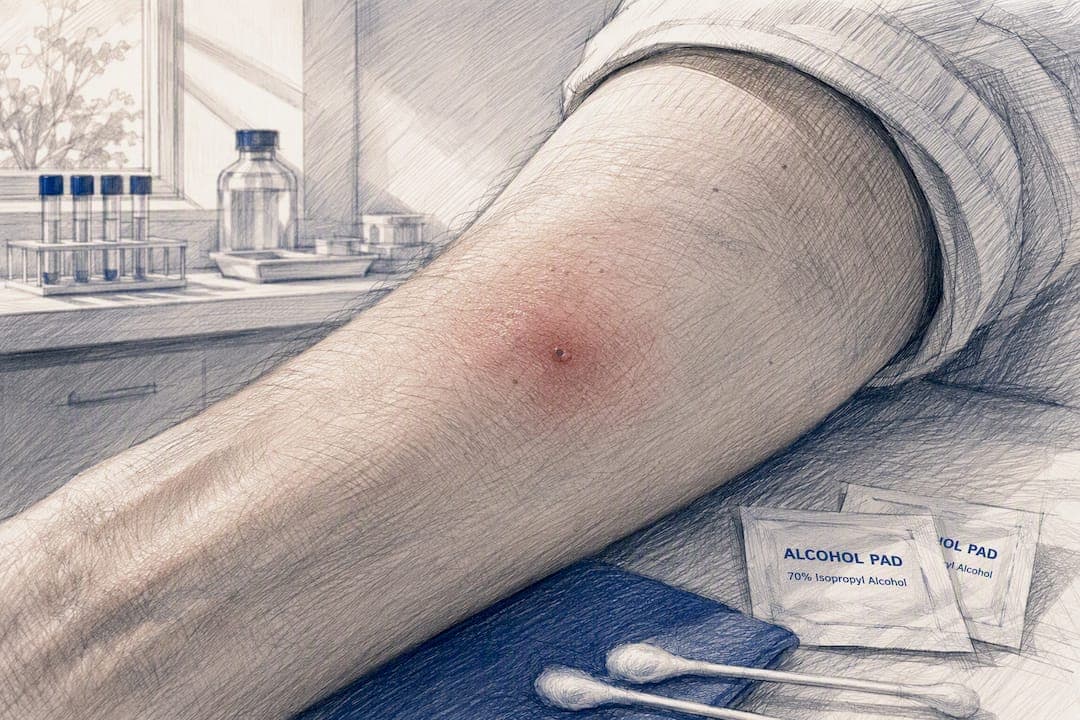
Injection-site reactions have a more direct cause: tissue irritation from the injection itself, from pH mismatches in poorly reconstituted solution, or from contaminants introduced during handling. Redness and swelling that resolve within a day or two are typically simple tissue irritation. Redness that spreads, worsens, or comes with fever points toward infection, which is a contamination issue rather than a peptide effect, and it needs medical attention rather than home management.
Understanding which mechanism is driving a given symptom helps you judge severity. A dose-related mechanism (nausea, mild hypoglycemia) tends to ease as your body adjusts or the dose is corrected. A contamination-related mechanism (spreading infection, unexplained fever) does not ease on its own and gets worse the longer it’s ignored.
Adjusting your dose without guessing your way into a bigger problem
Dose titration is the standard approach for managing GLP-1-related side effects, and the logic holds even with the added uncertainty of a research-grade product: start at the lowest plausible dose and increase slowly, watching for how your body responds at each step rather than jumping to whatever dose a forum thread recommends.
The problem specific to research-grade peptides is that “lowest plausible dose” is a moving target when actual potency might sit anywhere in that documented 5% to 75% purity range. A conservative starting dose calculated against the label claim could still deliver an unexpectedly strong effect if the vial happens to be more concentrated than stated, or barely register if it’s underdosed.
A few practical guardrails matter more here than with a verified pharmaceutical product:
- Increase dose incrementally and only after tolerating the previous level for a full cycle, not after one good day.
- Never increase dose to compensate for a perceived lack of effect without first questioning whether the product itself is underpotent.
- Stop and reassess at the first sign of an unusually strong reaction rather than assuming it will pass.
- Keep a written log of dose, timing, and symptoms, since patterns are easier to spot on paper than from memory.
None of this replaces a clinician’s input, and if you’re adjusting doses based on symptoms that feel outside the ordinary GI-upset range, that’s the signal to get medical guidance rather than self-correct further.
A publisher’s note on demand, safety, and responsibility
We understand why people pursue these peptides. Weight loss and performance goals are real, and the frustration with slow progress is real too. But no result is worth an emergency room visit caused by a contaminated vial. Soma Peptide’s approach starts with documented purity and transparency, not shortcuts. Before you inject anything, talk to a clinician and actually read the lab documentation your supplier provides.
A transparent option if you’re moving forward
If weight loss is your goal, the fat loss peptides page walks through the specific compounds, their documented purity data, and links to the certificates of analysis behind them. Review the COA, check the batch information, and ask questions before you buy anything, from any supplier. Start by browsing Soma Peptide’s full product line to compare documented purity and testing practices for yourself.
Sources
- Q&A: Should you trust trending peptide injections? (University of Virginia news)
- Harvard Health: peptides — benefits and safety concerns
- NPR coverage of risks and regulatory actions on peptides
- RethinkPeptides: research‑grade peptides and human use — regulatory lines
FAQ
What are the most common GLP-1 peptide side effects?
Nausea, vomiting, diarrhea, constipation, headache, fatigue, and injection-site irritation are the most frequently reported reactions, driven by the peptide’s effect on gastric emptying and glucose regulation.
How risky is research-grade GLP-1 peptide contamination?
Independent testing has found undisclosed ingredients in roughly 25% of gray-market samples, including bacterial endotoxins and heavy metals that a basic purity certificate wouldn’t catch.
When should I seek emergency care for peptide side effects?
Seek immediate care for persistent vomiting, severe abdominal pain, fever, spreading redness at an injection site, breathing difficulty, fainting, or signs of severe low blood sugar.
Does a high purity percentage mean a peptide is safe to inject?
No. High HPLC purity confirms identity and concentration but doesn’t guarantee sterility, since endotoxin and heavy-metal testing require separate assays most research-grade suppliers skip.
How is Soma Peptide different from typical research-grade suppliers?
What should I do if I think I received a contaminated peptide?
Stop using the product, keep the vial and any lot numbers, and contact a clinician or Poison Help at 1-800-222-1222 for non-emergency guidance on next steps.