


Peptide cycling means running a compound for a set window, then stopping to let receptors and baseline physiology reset. Whether that applies to you depends entirely on class: growth hormone secretagogues genuinely benefit from on/off scheduling, healing peptides like BPC-157 work better with goal-based windows than fixed calendars, and GLP-1 medications are designed for continuous clinical use, not casual breaks. Most schedules circulating online are practitioner-derived and lack clinical validation, so tracking baseline labs and consulting a clinician before use is advised.
TL;DR:
- Peptide cycling is primarily used to prevent receptor desensitization and limit exposure, but actual schedules lack strong clinical validation and should be guided by labs and a clinician.
- Growth hormone secretagogues typically run 8 to 12 weeks on followed by 4 to 6 weeks off, while healing peptides like BPC-157 follow goal-driven windows rather than fixed cycles.
- Receptor downregulation occurs over days to weeks, making pulsatile dosing beneficial for some peptides, especially GHRH and GHRP variants, while others like BPC-157 are less receptor-dependent.
- Continuous use of GLP-1 receptor agonists is recommended, as stopping frequently leads to weight regain, unlike secretagogues requiring scheduled breaks.
- Quality control issues persist, with up to 8% of online peptide samples contaminated or mislabeled, emphasizing the importance of sourcing from verified, high-purity providers.
Table of Contents
- Why cycle peptides in the first place?
- The pharmacology behind receptor rest periods
- Cycling guidelines by peptide class
- Compound-specific ranges people actually use
- When to stop or adjust a cycle
- Tracking your cycle for a genuinely evidence-based off-phase
- Sourcing, contamination, and the evidence gap you should know about
- How Soma Peptide approaches protocol guidance
- Editor’s take: the default cycling approach worth following
- Where to find protocol-matched peptides for your cycle
- Sources
- FAQ
Why cycle peptides in the first place?
Two separate ideas get lumped together under “peptide cycling,” and mixing them up leads to bad decisions. The first is receptor desensitization: some peptide receptors, especially in the ghrelin and GHRH pathways, respond less over sustained stimulation, so a break can restore sensitivity. The second is exposure-limiting, a precautionary stance for compounds that simply haven’t been tested long enough in humans to know what continuous use does.
The goals behind cycling usually break down into three buckets:
- Preserve efficacy by preventing receptor blunting from constant stimulation.
- Cap cumulative exposure to a compound with limited long-term human data.
- Give the body a defined window to show whether side effects are building or resolving.
Here’s the honest caveat: for most research peptides, nobody has run the trial that proves a specific on/off schedule beats continuous dosing or a different rhythm entirely. Treat these schedules as reasonable risk management, not settled pharmacology.
The pharmacology behind receptor rest periods
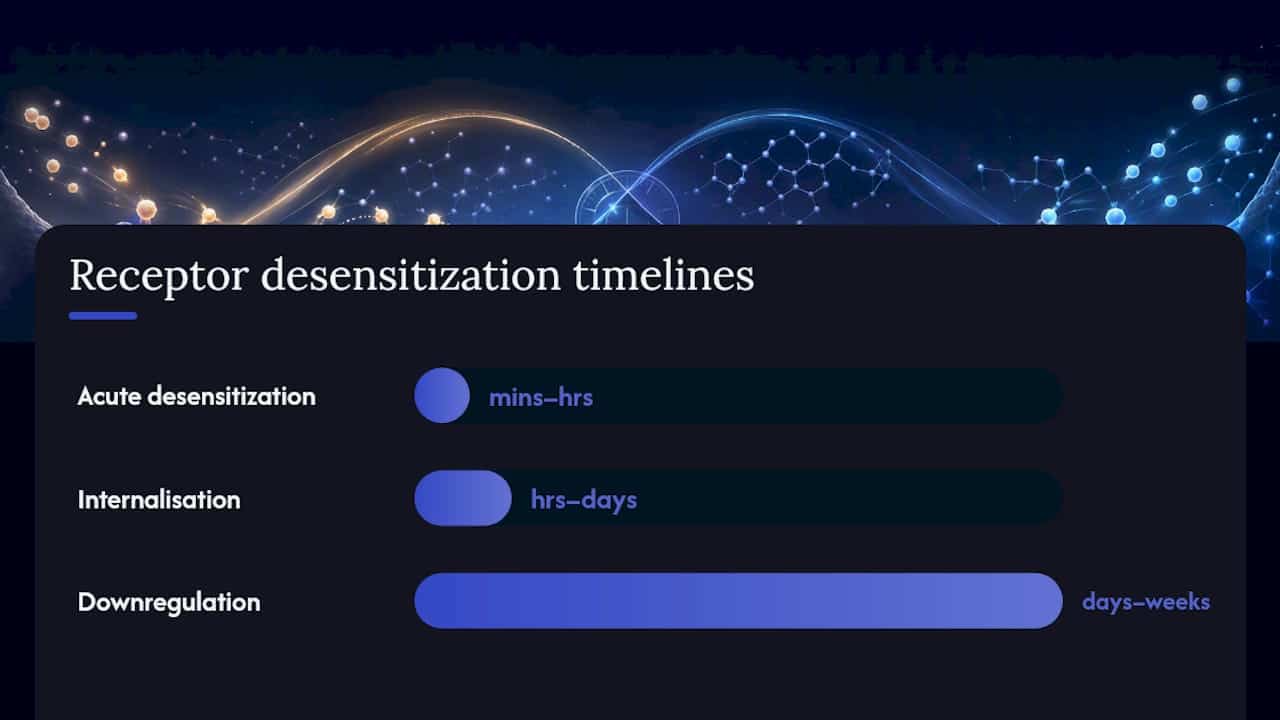
Three distinct processes get called “desensitization” in forum threads, and they don’t behave the same way. Acute desensitization happens within minutes to hours, when a receptor gets chemically modified after repeated stimulation and temporarily stops responding. Internalisation follows, with the receptor pulled inside the cell over hours to days. Downregulation is the slow one: total receptor numbers drop over days to weeks of sustained exposure, and reversal can take a comparable stretch once you stop.

This matters practically because it explains why pulsatile dosing (several small doses across a day, mimicking natural hormone release) behaves differently from a multi-week block of daily injections. A 1995 study found GH response to repeated GHRP-6 boluses dropped roughly 50% over four days of stimulation, a clean demonstration of fast receptor blunting in the ghrelin axis.
That mechanism explains the class divide:
- Ghrelin/GHRH-axis peptides (ipamorelin, CJC-1295, GHRP-6) show documented receptor downregulation with sustained use, supporting scheduled rest.
- Tissue-repair peptides (BPC-157, TB-500) don’t act primarily through the same repeatedly-stimulated receptor pathway, so the rationale for calendar-based cycling is weaker; goal completion matters more than elapsed weeks.
Cycling guidelines by peptide class
Your peptide’s mechanism should dictate the schedule, not habit copied from a forum post. Here’s how the major classes break down:
- GH secretagogues (ipamorelin, GHRP-6, CJC-1295): common practice runs 8 to 12 weeks on, 4 to 6 weeks off, though plenty of protocols use a 5-on/2-off weekly rhythm instead to mimic natural pulsatile release and avoid full downregulation.
- Healing peptides (BPC-157, TB-500): these tend to follow goal-driven windows, commonly 4 to 8 weeks tied to a specific injury or recovery target, rather than a fixed calendar cycle.
- GLP-1 receptor agonists (semaglutide, tirzepatide): built for continuous clinical therapy. Stopping commonly triggers weight regain within months, so casual on/off cycling works against the therapy’s own design.
- Melanocortin peptides and similar event-based compounds: often used in short, time-limited windows tied to a specific outcome, with safety caveats around cardiovascular and pigmentation effects that deserve monitoring regardless of schedule.
- GHK-Cu and tesamorelin: GHK-Cu is frequently used continuously or in extended topical/injectable windows for tissue and skin effects; tesamorelin has actual FDA approval for a specific indication and carries a defined dosing label, unlike most peptides on this list.
Evidence quality varies sharply across these categories, and that gap should shape how conservative you are with each one. Our HGH peptides guide covers the receptor physiology behind secretagogue cycling in more depth if you’re working with that class specifically.
Compound-specific ranges people actually use
These figures reflect common practice, not clinical prescriptions. Sourcing quality and individual response both shift what’s reasonable, so treat every number below as a conservative starting point to discuss with a clinician, not a target.
- BPC-157: often run 4 to 8 weeks per goal-based cycle, at doses varying widely by injury type. Human trial data is thin; most evidence is preclinical.
- TB-500: similar goal-based logic to BPC-157, frequently stacked with it for tissue repair; human RCT evidence is essentially absent.
- CJC-1295 (with or without DAC): the DAC version extends half-life significantly, which changes cycling logic entirely since it’s dosed less frequently but stays active longer, raising the stakes of any exposure-limiting rationale.
- Ipamorelin: commonly cycled alongside CJC-1295 in 8 to 12 week blocks; some protocols favour daily dosing without week-long breaks to preserve pulsatile signalling.
- GHRP-6: shorter cycles are more common given the faster desensitization curve documented in early receptor studies.
- GHK-Cu: often used in extended or continuous windows for skin and connective tissue support rather than strict on/off blocks.
- Tesamorelin: carries actual FDA approval for HIV-associated lipodystrophy, giving it a real prescribing label most peptides on this list lack.
- GLP-1 agonists: designed and tested for continuous use; not a cycling candidate in the same sense as the others.
For anyone stacking multiple compounds, our guide on best peptides for bodybuilding walks through how combining compounds complicates figuring out which one is actually driving a result or a side effect.
When to stop or adjust a cycle
Stop when you’ve hit the goal, plateaued, or the returns clearly aren’t worth the continued exposure. That’s the simple version. The safety version is less negotiable: injection-site infection, systemic allergic reaction, or unexplained shifts in blood glucose, blood pressure, or mood warrant an immediate stop and a call to your clinician, not a “wait and see.”
- Target met or plateaued for two or more consecutive weeks
- Injection-site redness, swelling, or discharge beyond mild irritation
- Systemic symptoms: rash, swelling, breathing changes, unusual fatigue
Pro Tip: Order baseline bloodwork before you start anything. Without a “before” number, you can’t tell whether a symptom at week six is the peptide, unrelated illness, or normal variation.
Tracking your cycle for a genuinely evidence-based off-phase
A cycle without a log is just a guess with extra steps. Keep it simple but consistent.
- Log dose, timing, and injection site daily; note sleep, appetite, pain levels, and any subjective effects weekly.
- Order baseline labs before starting, repeat at the end of the on-cycle, and again after the off-phase if you’re assessing whether effects persisted.
- At the off-phase checkpoint, compare your log and labs against your original goal to decide whether to repeat, adjust dose, or stop entirely.
Our peptides for recovery guide has a more detailed monitoring checklist if you’re running a recovery-focused protocol specifically.
Sourcing, contamination, and the evidence gap you should know about
Quality control is the safety issue that gets underplayed. Lab analyses of gray-market peptide samples have found roughly 8% testing positive for endotoxin or microbial contamination, and labelled active-ingredient content frequently doesn’t match what’s actually in the vial.
Academic medical centres have been blunt about this: peptide enthusiasm has outrun the human evidence, and unregulated products sold online carry real contamination and mislabelling risk that a clinical trial pipeline would normally screen out.
As of 2026, no published human randomised controlled trial validates the specific on/off schedules that dominate forum discussion for compounds like BPC-157 or CJC-1295. Harvard Health notes that FDA-approved peptide medicines exist and work as intended, but many injectable peptides sold online remain experimental with no regulatory oversight. Chemical modifications that extend a peptide’s half-life, as reviewed in a 2026 MDPI paper on peptide stability, also shift its pharmacology enough to change how it should be cycled in the first place.
Prefer prescription or regulated sources where they exist, disclose peptide use to your doctor, and stop immediately for any serious adverse event rather than waiting out the scheduled cycle.
How Soma Peptide approaches protocol guidance
Soma Peptide builds every protocol resource around published mechanism data and evidence tiers, not forum consensus, with formulations verified above 99% purity. Our stance stays conservative: monitor first, cycle deliberately, and treat unresolved human-trial gaps as a reason for caution rather than a technicality to ignore. Talk to a clinician before starting, and use our protocol pages as a starting reference, not a substitute.

Editor’s take: the default cycling approach worth following
Run research peptides in short, cautious windows with objective exit criteria, not calendar-only cycling. Match GH secretagogues to their receptor mechanism rather than a copied schedule, and never cycle GLP-1 therapy without direct clinician supervision, given how reliably stopping leads to regain. Get baseline labs, keep a real log, and let the off-phase data decide your next move.
— Soma Peptide
Where to find protocol-matched peptides for your cycle
Beyond the biology, the practical problem most people hit is sourcing something that actually contains what the label says. Soma Peptide’s bodybuilding and recovery peptide catalogue documents purity above 99% through third-party verified purification, which matters directly for cycling decisions since a contaminated or underdosed batch will throw off every log entry you’re tracking. For readers focused on tissue repair specifically, the peptides for healing category pairs product listings with the same evidence-tiered protocol thinking covered in this guide. If you’re curious how dietary peptide supplementation compares to injectable protocols, RankOfSupplements’ breakdown of collagen peptides is worth a read. Start by identifying your peptide’s class above, then browse the matching category page to line up a verified-purity product with your cycle plan.
Sources
- Peptides: what does the science say? | Stanford Medicine
- Peptides: what they are, potential benefits and safety concerns | Harvard Health
- MDPI review: therapeutic peptide development and chemical strategies
FAQ
How long should you cycle on peptides?
It depends on class: GH secretagogues commonly run 8 to 12 weeks on with 4 to 6 weeks off, while healing peptides like BPC-157 typically follow goal-based windows of 4 to 8 weeks instead of a fixed calendar.
What does it mean to cycle a peptide?
Cycling means running a compound for a defined period, then stopping for a rest phase to let receptor sensitivity recover and to cap cumulative exposure before reassessing.
How long should you cycle GHK-Cu?
GHK-Cu is often used in extended or continuous windows for skin and connective tissue support rather than strict on/off cycling, since its mechanism doesn’t rely on the same receptor downregulation seen with GH secretagogues.
What is the best peptide for cyclists tracking recovery goals?
There’s no single “best” peptide across the board. BPC-157 and TB-500 are the most commonly discussed for recovery-focused, goal-based cycling, though human trial data for both remains limited, so treat results as individual and unproven at the population level.
Do side effects mean you should stop a cycle immediately?
Mild, expected effects like injection-site soreness don’t necessarily require stopping, but injection-site infection, systemic allergic symptoms, or unexplained metabolic changes warrant an immediate stop and clinician review.