


Most peptides do not need steroid-style SERM therapy after you stop using them. Whether you need pharmacologic intervention depends on what you actually ran: strong SARMs and steroid stacks suppress the HPT axis and often warrant real post cycle therapy, while most GH secretagogues, repair peptides, and GLP-1 compounds just need a defined off period. The first move, regardless of what you used, is writing down the exact compounds and doses you took and scheduling bloodwork for roughly three to four weeks and eight weeks after your last dose.
TL;DR:
- Peptides that do not affect the HPT axis, such as GH secretagogues and repair peptides, typically only require a defined off period, not pharmacologic PCT.
- Strong SARMs and anabolic steroids cause actual HPT suppression, making SERM-based PCT or HCG necessary after use, confirmed by bloodwork.
- Washout times for long-ester compounds are longer than expected; timing PCT based on ester clearance, not last dose, is crucial for proper recovery.
- Blood tests measuring testosterone, LH, FSH, and other markers at three to four weeks and eight weeks post-cycle guide recovery strategies effectively.
- Maintaining training, nutrition, sleep, and stress management during the off period can support natural hormone recovery and preserve gains without unnecessary medication.
Table of Contents
- How peptide classes differ: GH axis, HPT effects, and peripheral mechanisms
- Which compounds need PCT, an off period, or nothing at all
- Timing and washout: half-lives, esters, and when to intervene
- Monitoring and bloodwork: what to test and when
- Practical recovery steps while you wait on labs
- When pharmacologic PCT is appropriate: SERMs, HCG, and enclomiphene
- The evidence, resources, and editorial limits presented here
- Legal and regulatory considerations related to peptide use
- The mechanisms behind endocrine suppression by peptide type
- Sourcing and quality control: avoiding contaminated peptides
- Our editorial view: evidence first, testing before treatment
- How Soma Peptide supports your post-cycle recovery plan
- Sources
- FAQ
How peptide classes differ: GH axis, HPT effects, and peripheral mechanisms
The word “PCT” comes from anabolic steroid culture, where exogenous testosterone shuts down the hypothalamic-pituitary-testicular (HPT) axis and a SERM is used to restart it. Peptides are a different animal, and lumping them into one PCT framework is where most guides go wrong. Recovery planning works better when it is tied to the specific compound rather than a borrowed steroid template.
GH secretagogues like ipamorelin, GHRP-2, GHRP-6, and CJC-1295 stimulate the pituitary to release growth hormone through the ghrelin receptor or GHRH receptor pathways. They don’t touch the HPT axis at all. MK-677, an oral ghrelin mimetic, works the same way but has a longer half-life that changes its washout math. What these compounds risk isn’t endocrine suppression in the steroid sense. It’s receptor desensitization, where continuous stimulation makes the pituitary less responsive over time, which is why cycling conventions exist in the first place.
IGF and GH analogues, including IGF-1 LR3 and related growth factor peptides, act more peripherally on tissue growth and repair. They don’t suppress LH or FSH production, but they can influence insulin sensitivity and glucose handling, which matters for anyone tracking metabolic markers post-cycle.
Tissue-repair peptides such as BPC-157 and TB-500 work through angiogenesis and fibroblast activity at the site of injury. Neither interacts with the HPT axis or the GH axis in any documented way. The Peptides for Recovery category covers how these compounds are typically evaluated by mechanism rather than by borrowed steroid protocols, which is the right lens for this class.
Metabolic peptides, the GLP-1 and GIP receptor agonists like semaglutide and tirzepatide, operate on appetite regulation and insulin secretion. Stopping them doesn’t suppress testosterone production. It triggers a return of appetite signalling that was being pharmacologically blunted, an entirely different phenomenon from HPT suppression.
The distinction that trips people up is receptor desensitization versus endocrine suppression. Desensitization means the receptor gets less responsive to stimulation and typically resets on its own once you stop dosing. Suppression means the gland itself has stopped producing a hormone or signal because the body sensed enough of it coming from outside. GH secretagogues risk the first. Anabolic steroids and strong SARMs cause the second. That’s why an “off period” (giving receptors time to reset) and “PCT” (pharmacologically restarting a suppressed axis) are not interchangeable concepts, even though online forums use them as if they were.
Here’s a simple way to sort what you’re dealing with:
- HPT axis suppression (needs consideration of pharmacologic PCT): anabolic steroids, strong SARMs, some heavy stacking protocols.
- Receptor desensitization (needs an off period, not PCT): GH secretagogues, MK-677.
- Peripheral/local action (typically no PCT or off period required): BPC-157, TB-500, most tissue-repair peptides.
- Metabolic rebound (needs a tapering or maintenance plan, not PCT): GLP-1 and GIP agonists.
Which compounds need PCT, an off period, or nothing at all
Sorting your post cycle plan by compound class, rather than by habit or forum tradition, keeps you from either overreacting with unnecessary pharmaceuticals or underreacting when your hormones genuinely need support.
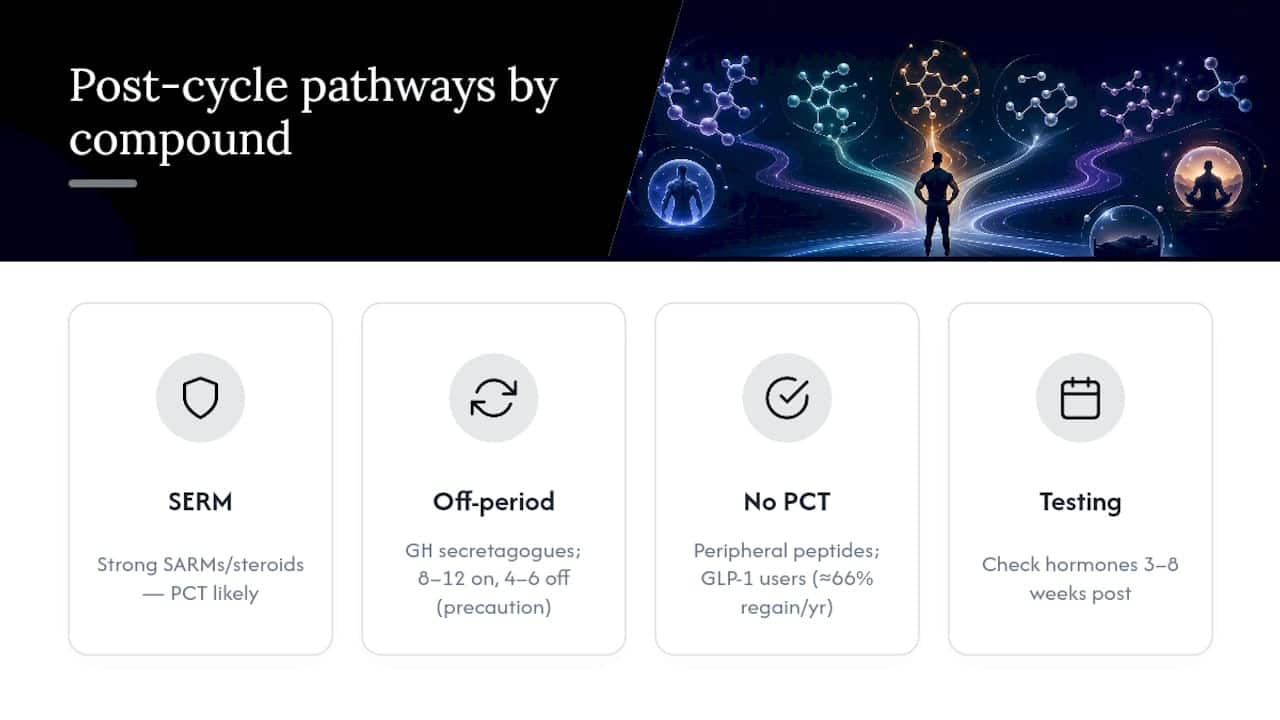
Bucket one: SERM likely needed. This applies almost exclusively to strong SARMs (RAD-140, LGD-4033, and similar compounds) and any anabolic steroid stack. These substances directly suppress endogenous testosterone production through negative feedback on the hypothalamus and pituitary. A survey of 470 men found that using post-cycle therapy after anabolic-androgenic steroid use was associated with meaningfully reduced withdrawal symptoms, which is strong evidence that PCT serves a real physiological purpose in this category, not just a psychological one.
Bucket two: off-period advised. GH secretagogues fall here as a precaution, not because of documented suppression, but because continuous receptor stimulation is thought to reduce responsiveness over time. Community and clinical guidance commonly recommends structured cycling by mechanism, often in patterns like eight to twelve weeks on and four to six weeks off, though it’s worth being direct about the evidence here.
Statistic callout: The eight to twelve weeks on, four to six weeks off convention for GH secretagogues is a precautionary guideline built on receptor biology, not a figure derived from large controlled human trials. Guidance on peptide PCT protocols is explicit that this pattern is widely recommended but not yet validated by robust clinical research, so treat it as sensible caution rather than settled science.
BPC-157 and TB-500 sit in this bucket too, mostly out of caution rather than documented mechanism, since long-term human data on continuous use is limited.
Bucket three: no PCT needed. Most peripheral repair peptides and many GLP-1 users fall here, though GLP-1 discontinuation deserves its own conversation (covered below) because stopping causes a different kind of rebound. Clinical trial data on semaglutide shows that patients regained roughly 66% of lost weight within a year of stopping treatment, which is a metabolic and appetite-driven effect, not evidence of HPT suppression. This is one of the clearest illustrations of why GLP-1 discontinuation needs a maintenance strategy rather than a PCT protocol.
Stacking raises the stakes considerably. Someone running a SARM alongside a GH secretagogue and a repair peptide needs to evaluate each compound on its own timeline rather than assuming one blanket protocol covers everything they used. This is where a lot of self-directed plans fall apart: people apply the most aggressive compound’s recovery needs to everything in the stack, or ignore the suppressive compound entirely because the peptides feel benign.
Before starting any pharmacologic PCT, confirm the need with bloodwork rather than symptoms alone. Fatigue, low libido, and mood changes overlap across dozens of causes, and guessing wrong means either taking unnecessary medication or missing a real deficiency.
Timing and washout: half-lives, esters, and when to intervene
Washout periods are almost always longer than people assume, and the reason is pharmacological, not psychological. Compounds with long-acting esters or extended half-lives keep exerting biological effects well after the “last dose” date most people mentally lock in.
Ester length matters enormously here. Testosterone undecanoate, for instance, has a release profile that stretches for weeks, meaning its suppressive effect on the HPT axis doesn’t end the day you stop injecting. Planning a SERM start based on your last injection date rather than the drug’s actual clearance timeline is one of the most common timing mistakes.
| Compound or class | Typical pharmacological tail | Practical consideration |
|---|---|---|
| Short-ester anabolic steroids | Days to about 1–2 weeks | SERM PCT can often start close to cessation |
| Long-ester anabolic steroids (e.g., undecanoate) | Several weeks | Delay PCT start until ester clearance is accounted for |
| GH secretagogues (GHRP/GHRH types) | Hours to days | Off period is about receptor rest, not clearance |
| CJC-1295 DAC | Extended, multi-day | Longer tail than non-DAC GHRH analogues |
| TB-500 | Days to roughly a couple weeks | Precautionary off period before restarting |
| GLP-1/GIP agonists | Days to over a week depending on the specific compound | Taper or maintenance planning rather than abrupt stop |
Special cases deserve extra thought. GLP-1 discontinuation isn’t a washout issue at all. It’s a maintenance issue, since appetite and glucose regulation shift back toward baseline once the drug clears, independent of any endocrine axis. That’s why the complete guide to GLP-1 peptide science frames stopping these compounds as a tapering decision rather than a recovery protocol.
Gonadorelin and pulsatile GnRH-based approaches, sometimes used to stimulate LH and FSH directly, require precise dosing schedules because getting the timing wrong can downregulate the same receptors you’re trying to stimulate. This isn’t a do-it-yourself timing calculation. It needs a clinician who understands pulsatile dosing.
Pro Tip: Plan your off period around the compound’s biological tail, not the calendar. If you stopped a long-ester compound two weeks ago and started counting your “off period” from that date, you may be several weeks behind where your body actually is.
Monitoring and bloodwork: what to test and when
Bloodwork tells you what symptoms can’t. Fatigue and low libido show up with low testosterone, high prolactin, thyroid dysfunction, and a dozen unrelated conditions, so testing removes the guesswork.
For anyone concerned about HPT axis suppression, the core panel includes:
- Total and free testosterone
- LH and FSH
- Estradiol
- SHBG (sex hormone binding globulin)
If your cycle included GH secretagogues or GLP-1/GIP compounds, add:
- IGF-1 (for GH axis activity)
- Fasting glucose and HbA1c (for metabolic tracking after GLP-1 exposure)
The timing matters as much as the panel itself. A practical schedule looks like baseline labs before you start anything if you can get them, then a follow-up at roughly three to four weeks post-cessation, and another at around eight weeks. Clinical guidance on post-cycle therapy protocol timing supports this window as the point where transient suppression and genuine axis dysfunction start to separate from each other.
A single test is a snapshot. Trends across two or three draws tell you whether your body is recovering, plateaued, or still declining, which is a very different clinical picture than one low number in isolation. Individualized, biomarker-driven decisions consistently outperform protocol mimicry because your baseline, your compounds, and your stacking history are unique to you.
Sample timing also matters for accuracy. Testosterone follows a diurnal rhythm and is highest in the morning, so draw blood before 10 AM whenever possible for a comparable baseline across visits. If your numbers stay depressed at the eight-week mark, or if you’re dealing with a stack that included strong SARMs or steroids, that’s the point to bring an endocrinologist or sports medicine clinician into the conversation rather than continuing to self-monitor.
Practical recovery steps while you wait on labs
The waiting period between stopping a compound and getting your second round of bloodwork isn’t dead time. What you do during those weeks measurably affects how your body recovers and whether you preserve the gains you made.
- Keep training intensity up. Cutting volume and load dramatically during your off period accelerates muscle and strength loss independent of any hormonal shift, and it makes it harder to tell what’s caused by biology versus what’s caused by simply doing less.
- Maintain adequate calories and protein. A caloric deficit stacked on top of a hormonal transition is a rough combination. Protein intake in particular should not drop just because you’re “off cycle.”
- Prioritize sleep. Growth hormone release and testosterone production are both tied closely to sleep architecture, and cutting sleep short during a recovery window works against you.
- Check vitamin D and zinc status. Both are cofactors in testosterone production, and deficiencies are common enough to be worth ruling out with a simple panel.
- Manage stress deliberately. Chronic cortisol elevation antagonizes the same axis you’re trying to let recover, so this isn’t a soft recommendation. It’s a direct biological lever.
- Log symptoms daily. Track energy, libido, training performance, appetite, and sleep quality in a simple notebook or app. This data, paired with your lab results, gives you a much clearer recovery picture than either one alone.
- Don’t restart early. Resuming a compound before the biologically appropriate off period is up defeats the purpose of the wait and resets the desensitization clock.
When pharmacologic PCT is appropriate: SERMs, HCG, and enclomiphene
Pharmacologic PCT belongs to a narrow set of cases: confirmed HPT axis suppression, typically from strong SARMs or anabolic steroid use, verified by bloodwork rather than assumed from symptoms.
Selective estrogen receptor modulators (SERMs) like tamoxifen and clomiphene work by blocking estrogen receptors in the hypothalamus, which tricks the brain into producing more GnRH, and downstream, more LH and FSH. This is the mechanism that restarts natural testosterone production after suppression.
Enclomiphene is drawing interest as an alternative to clomiphene because it’s the purified trans-isomer, without the zuclomiphene isomer that’s been linked to mood disturbances and visual side effects in some users. Availability varies by region and by prescriber, so it isn’t a universal substitute, but it’s worth asking a clinician about if standard clomiphene causes side effects.
HCG (human chorionic gonadotropin) mimics LH and can stimulate testicular function directly, which is sometimes used alongside or before a SERM. Its drawback is that HCG doesn’t restart the pituitary’s own signalling. It temporarily bypasses it, so relying on HCG alone without addressing upstream signalling can leave the underlying suppression unresolved once you stop.
Statistic callout: The strongest evidence for PCT’s real-world benefit comes from steroid users specifically. In the survey of 470 men referenced earlier, PCT use tracked with fewer withdrawal symptoms after anabolic-androgenic steroid cycles, a category distinct from peptide-only use.
None of these interventions should be self-prescribed. Typical dosing structures exist as general typology in clinical literature, not as a personal prescription, and starting a SERM or HCG protocol without bloodwork confirming suppression means treating a condition you haven’t verified you have.
- Most peptide-only cycles, particularly those built around GH secretagogues or repair peptides, do not warrant this category of intervention at all.
- Reserve SERMs and HCG for cases where labs confirm depressed LH, FSH, or testosterone following a suppressive compound.
- Qualitative research on performance and image enhancing drug users found that PCT functions as a genuine harm-reduction tool for this population, but also documented real access barriers, which is exactly why clinician partnership matters rather than DIY sourcing of prescription medication.
The evidence, resources, and editorial limits presented here
Every category Soma Peptide carries, including Recovery, Muscle Growth, and Anti-Aging, is built around products the company states are documented above 99% purity through third-party lab certificates of analysis. That documentation matters more in the post-cycle context than almost anywhere else, because a contaminated or mislabelled compound makes it nearly impossible to interpret your own bloodwork accurately. If your labs look off after a cycle, you want to know it’s your biology responding, not an unknown filler or underdosed batch confusing the picture.
The educational content follows an evidence-first standard emphasizing compound-specific reasoning over blanket protocols, and lab confirmation over symptom-guessing. would sit naturally alongside this kind of guidance once available, giving readers compound-level effectiveness data to pair with purity documentation.
None of this replaces clinical oversight. Soma Peptide’s resources are built to inform your conversation with a clinician, not to substitute for one, particularly when bloodwork suggests genuine HPT suppression requiring SERM or HCG intervention. belongs here too, giving readers a clearer sense of the clinical and research background behind the site’s educational content.
The goal is straightforward: give readers accurate compound information and documented purity, then point them toward lab-driven decisions rather than folklore protocols passed around forums.
Legal and regulatory considerations related to peptide use
Peptide regulation is inconsistent and evolving, which makes “is this legal” a harder question to answer with a flat yes or no. Many research peptides are sold labelled for laboratory or research use only, not for human consumption, and that labelling carries real regulatory weight in how these products can be marketed and sold. Anabolic steroids and certain SARMs, by contrast, are controlled substances in many jurisdictions, with clear restrictions on possession and distribution outside a valid prescription.
This distinction is exactly why lumping peptides and steroids into one PCT conversation is misleading, and not just biologically. The regulatory frameworks governing each category differ substantially, and the enforcement risk associated with SARMs and anabolic steroids is generally higher than for most research peptides.
Prescription medications used in pharmacologic PCT, including SERMs and HCG, require a prescription in most jurisdictions, meaning sourcing them without clinician involvement carries both a legal and a safety risk. Buying prescription-only compounds from unregulated sources removes the quality assurance and dosing guidance a prescriber provides.
If you’re uncertain where a specific compound stands in your jurisdiction, that uncertainty itself is a signal to consult a professional rather than a forum thread. Regulations shift, and what was permissible a year ago may not be today.
The mechanisms behind endocrine suppression by peptide type
Endocrine suppression isn’t a single mechanism. It’s a category of effects that different compounds produce through entirely different pathways, which is why treating all “peptides” as equally suppressive is a mistake.
GH secretagogues stimulate the pituitary through the ghrelin receptor (for GHRPs and MK-677) or the GHRH receptor (for CJC-1295 and similar analogues). Continuous stimulation is thought to reduce receptor sensitivity over time, a phenomenon closer to desensitization than to axis shutdown. The pituitary doesn’t stop producing growth hormone. It just responds less robustly to the same stimulus.
Gonadorelin and pulsatile GnRH analogues work directly on the pituitary’s GnRH receptors to stimulate LH and FSH release. Done correctly, with proper pulsatile timing, this supports the HPT axis rather than suppressing it. Done incorrectly, with continuous rather than pulsatile dosing, the same receptors can downregulate, which is the opposite of the intended effect.
True HPT suppression, the kind that actually needs SERM-based PCT, comes from exogenous testosterone or strong SARMs providing enough negative feedback to the hypothalamus and pituitary that natural LH and FSH production drops. Most peptides simply don’t operate on this axis at all. BPC-157 and TB-500 act locally on tissue repair pathways with no documented interaction with the HPT axis, and GLP-1 agonists work on entirely separate metabolic and appetite pathways.
Sourcing and quality control: avoiding contaminated peptides
Contamination risk is one of the most underdiscussed variables in post-cycle recovery, because a poorly sourced peptide can produce symptoms that look exactly like suppression or side effects when the real problem is what’s actually in the vial.
Third-party lab testing, specifically a certificate of analysis (COA) from an independent lab rather than the manufacturer’s own internal testing, is the single most reliable signal of quality. A COA should confirm both purity percentage and the absence of common contaminants like bacterial endotoxins or heavy metals.
Reconstitution matters too. Using proper bacteriostatic water, sterile syringes, and alcohol pads rather than improvised alternatives reduces contamination risk introduced after the product leaves the manufacturer, which is a step people sometimes skip once they’ve already spent money on the peptide itself.
Be skeptical of suppliers who won’t provide a COA on request, who sell at prices dramatically below market norms, or who make specific medical claims a research compound legally shouldn’t make.
Our editorial view: evidence first, testing before treatment
We think the biggest mistake in this space is borrowing steroid-era PCT habits and applying them to compounds that don’t work the same way. Most peptide cycles don’t need a SERM. What they need is a defined off period and bloodwork that actually confirms what’s happening in your body, not an assumption based on forum consensus or how someone felt last time.
We’re skeptical of routine pharmacologic PCT for peptide-only users. SERMs and HCG carry real considerations of their own, and using them without confirmed suppression trades one uncertainty for another. Partner with a clinician who can order the right panel and interpret trends, not just single numbers.
If you’re buying peptides for recovery or muscle support, purity documentation should be non-negotiable. A contaminated compound makes every downstream decision, including your bloodwork interpretation, less reliable. Evidence and lab confirmation should drive every step of this process, not habit.
— Soma Peptide
How Soma Peptide supports your post-cycle recovery plan
Soma Peptide carries Recovery and Muscle Growth categories built specifically around the compound classes covered in this guide, each backed by third-party lab certificates of analysis and formulations the company states exceed 99% purity. If you’re weighing a repair peptide like BPC-157 or TB-500 against a GH secretagogue for your recovery plan, the BPC 157 TB 500 recovery guide breaks down dosing and storage specifics you’ll want before ordering. Ancillaries, including bacteriostatic water, syringes, and alcohol pads, are also available so you’re not sourcing reconstitution supplies from separate, unverified suppliers.
None of this replaces bloodwork or a clinician relationship. Pair any product you buy with the monitoring schedule outlined earlier in this guide, and treat purity documentation as a baseline requirement rather than a bonus feature. Browse the full product range to compare categories and check current certificates of analysis before placing an order.
This article is general information, not a substitute for advice from a qualified doctor. Consult a qualified healthcare professional about your own circumstances before acting on anything here.
Sources
- The use of post-cycle therapy is associated with reduced withdrawal symptoms from anabolic-androgenic steroid use: a survey of 470 men
- Post-cycle therapy for performance and image enhancing drug users: A qualitative investigation
- DOI: 10.1186/s13011-023-00573-8
FAQ
What peptides are used in post-cycle therapy?
Most peptide-only cycles don’t require pharmacologic PCT at all. When suppression is confirmed by bloodwork, the actual treatment comes from prescription drugs like SERMs (tamoxifen, clomiphene, enclomiphene) or HCG, not from peptides themselves.
Does BPC-157 work immediately?
No. BPC-157 works through gradual tissue repair mechanisms like angiogenesis and fibroblast activity, which take time to build, and it has no known effect on the HPT axis that would require post-cycle intervention either way.
How often should you cycle off peptides?
It depends entirely on the class. GH secretagogues commonly follow precautionary cycling patterns like eight to twelve weeks on and four to six weeks off, per current research on peptide PCT protocols, while repair peptides like BPC-157 and TB-500 have much less established cycling data.
Do peptides require PCT?
Generally, no. Most peptides, including GH secretagogues, repair peptides, and GLP-1 agonists, don’t suppress the HPT axis the way anabolic steroids or strong SARMs do, so they need an off period for receptor recovery rather than SERM-based PCT.
Does Soma Peptide sell products for post-cycle recovery?
Yes. Soma Peptide’s Recovery and Muscle Growth categories include compounds relevant to post-cycle support, each backed by third-party lab certificates of analysis; current pricing is listed on the product pages.