


Peptides won’t trigger a standard workplace or clinical drug screen because those tests aren’t built to look for them. Anti-doping testing is a different story entirely. The World Anti-Doping Agency runs accredited labs that specifically hunt for peptides like GHRP-2 using LC-MS/MS, a technique sensitive enough to catch trace metabolites. Detection science keeps improving, and contaminated products can complicate an otherwise clean result.
TL;DR:
- Standard drug tests in workplaces and clinics do not detect peptides like GHRP-2 because they use immunoassays targeting small molecules, which peptides are not.
- Anti-doping labs employ LC-MS/MS techniques that identify peptide metabolites and can detect trace amounts up to about 60 hours after a dose, increasing detection windows beyond simple half-life estimates.
- Detection risk varies significantly based on the peptide’s regulation status, dose, administration route, sample timing, and potential contaminants from unverified suppliers.
- Disclosing prescribed peptide use beforehand and sourcing from verified suppliers with third-party purity certificates are key steps to reduce testing risks.
- Most anti-doping and workplace tests are unlikely to flag peptides unless specifically targeted, emphasizing the importance of understanding each testing program’s policies and maintaining transparency.
Table of Contents
- Which testing programmes actually screen for peptides and drug testing risk
- How do anti-doping labs actually catch peptides?
- What raises your personal detection risk?
- What should you actually do if you’re facing screening?
- Pure Peptide’s approach to quality and testing transparency
- How do sports bodies and employers differ on peptide policy?
- What are the legal and ethical lines around peptide use?
- Can peptide testing produce a false positive?
- A consumer-centred perspective on safety and compliance
- Where to find verified, high-purity peptides
- Sources
- FAQ
Which testing programmes actually screen for peptides and drug testing risk
The answer to “does this test catch peptides” comes down to one question: is the lab looking for drugs of abuse, or is it protecting a competition?
Standard workplace and clinical urine panels, the 5-panel, 10-panel, and 12-panel screens most employers and clinics use, run on immunoassay technology. Antibodies in these kits were built to grab small molecules like opioids, amphetamines, and cannabinoids. A peptide is a much larger molecule, and those antibodies have nothing to bind to, so peptides simply don’t register as target analytes on routine panels. This is a design limitation, not an oversight. Reconfiguring immunoassays to catch peptides would mean rebuilding the whole test.
Anti-doping testing works on the opposite logic. WADA-accredited labs exist to catch performance-enhancing substances in competitive sport, and peptides sit high on that priority list. These labs use liquid chromatography paired with tandem mass spectrometry, expensive equipment capable of identifying a peptide’s molecular fingerprint even at trace concentrations.
A few situations blur the line between these two tracks:
- Military drug testing programs sometimes add extra screening layers beyond civilian workplace panels, even when the base test doesn’t detect peptides.
- Some regulated professions (aviation, certain healthcare roles) have policies restricting substance use that go beyond what any single test can catch.
- Insurance-related medical exams occasionally screen more broadly than a typical pre-employment panel.
If you’re unsure which category applies to you, ask the testing programme directly for its analyte list or drug policy. That single phone call resolves more uncertainty than any generic clearance chart ever will.
How do anti-doping labs actually catch peptides?
Anti-doping labs don’t just look for the peptide itself. They look for what’s left behind after your body breaks it down, which is a smarter and more durable approach.
The workflow typically runs through four steps: sample enrichment to concentrate trace compounds, liquid chromatography to separate molecules by size and polarity, tandem mass spectrometry to fragment those molecules, and comparison against diagnostic transitions that act like a molecular signature. This is the same LC-MS/MS methodology documented in peer-reviewed detection studies.
One published study reported detectable urinary metabolites for up to roughly 60 hours after a single 100 microgram subcutaneous dose of GHRP-2 — a finding that matters because it shows labs aren’t just chasing the parent compound. They’re chasing metabolite fragments that stick around long after the original peptide has cleared, which is exactly why detection windows for anti-doping purposes tend to run longer than a simple half-life calculation would suggest.
Beyond direct detection, labs also use indirect methods:
- Isoform differential immunoassays that distinguish natural human growth hormone from synthetic versions.
- Biomarker panels tracking IGF-1 and P-III-NP, both of which shift measurably with growth-hormone manipulation.
- The Athlete Biological Passport, which monitors an athlete’s biological markers over time to flag suspicious patterns rather than catching one bad sample.
None of this equipment is cheap, and none of it is quick to run, which is exactly why it stays confined to specialist anti-doping facilities instead of showing up in a standard clinic.
What raises your personal detection risk?
Detection risk isn’t uniform. It shifts based on a handful of specific, measurable factors, and knowing them helps you have an informed conversation with a clinician or a testing administrator instead of guessing.
- Compound identity. Some peptides are named explicitly on prohibited-substance lists; others aren’t regulated the same way. Which one you’re using changes everything downstream.
- Dose, frequency, and route. A single low research dose behaves very differently in the body than a repeated administration schedule, and injection route affects how metabolites distribute.
- Testing matrix and timing. Urine and blood clear compounds at different rates, and hydration status or kidney function can shift how concentrated a sample is.
- Supplier quality and contaminants. Mislabelled or impure products can introduce substances you didn’t intend to take, which is its own detection risk entirely separate from the peptide itself.
- Sample storage and reanalysis. Long-term freezer storage of samples means testing programmes can revisit old samples with newer, more sensitive methods years later.
Pro Tip: Never trust a fixed “clearance time” you read online. Published detection windows are population averages from controlled studies, not guarantees for your body, your dose, or your supplier’s actual product purity.
What should you actually do if you’re facing screening?
If you use peptides and there’s any chance you’ll be screened, whether for a job, a clinical process, or competitive sport, a handful of concrete actions matter more than any amount of worrying.
Start by asking the testing programme for its actual analyte list or written drug policy. Don’t assume; confirm. If you’re on a prescribed peptide therapy, disclose it to the medical review officer or occupational health contact before testing, not after a flagged result forces the conversation. Verify your supplier provides third-party certificates of analysis. Reviewing peptide laboratory standards before buying anything is one of the simplest ways to cut contamination risk down to almost nothing. Athletes should contact their governing anti-doping organization directly and ask about Therapeutic Use Exemptions if a peptide is medically necessary. Keep documentation of any prescriptions or clinical guidance, and talk to a clinician before you assume anything about how a compound will behave in your system. Our peptide safety guide covers injection practices that also reduce contamination exposure.
| Situation | What to do |
|---|---|
| Standard workplace or clinical screen | Confirm the panel list; peptides typically aren’t tested analytes |
| Competitive sport under an anti-doping body | Contact your governing organization and ask about TUEs if medically necessary |
| Using a prescribed peptide therapy | Disclose to the medical review officer before testing, not after |
| Buying from a new supplier | Request a third-party certificate of analysis before use |
Pure Peptide’s approach to quality and testing transparency
Supplier quality is one of the few detection-risk factors you can control directly, and it starts before you ever open the vial. Pure Peptide focuses on formulations verified above 99% purity through third-party lab testing, with certificates of analysis available for review rather than taken on faith.
- Product categories spanning weight loss, muscle growth, recovery, anti-aging, and libido support.
- A dedicated peptide safety resource addressing injection practices and contamination risk.
Clean sourcing won’t change how anti-doping labs test for peptides, but it removes one entire category of risk: the one caused by what’s actually in the vial, versus what the label claims.
How do sports bodies and employers differ on peptide policy?
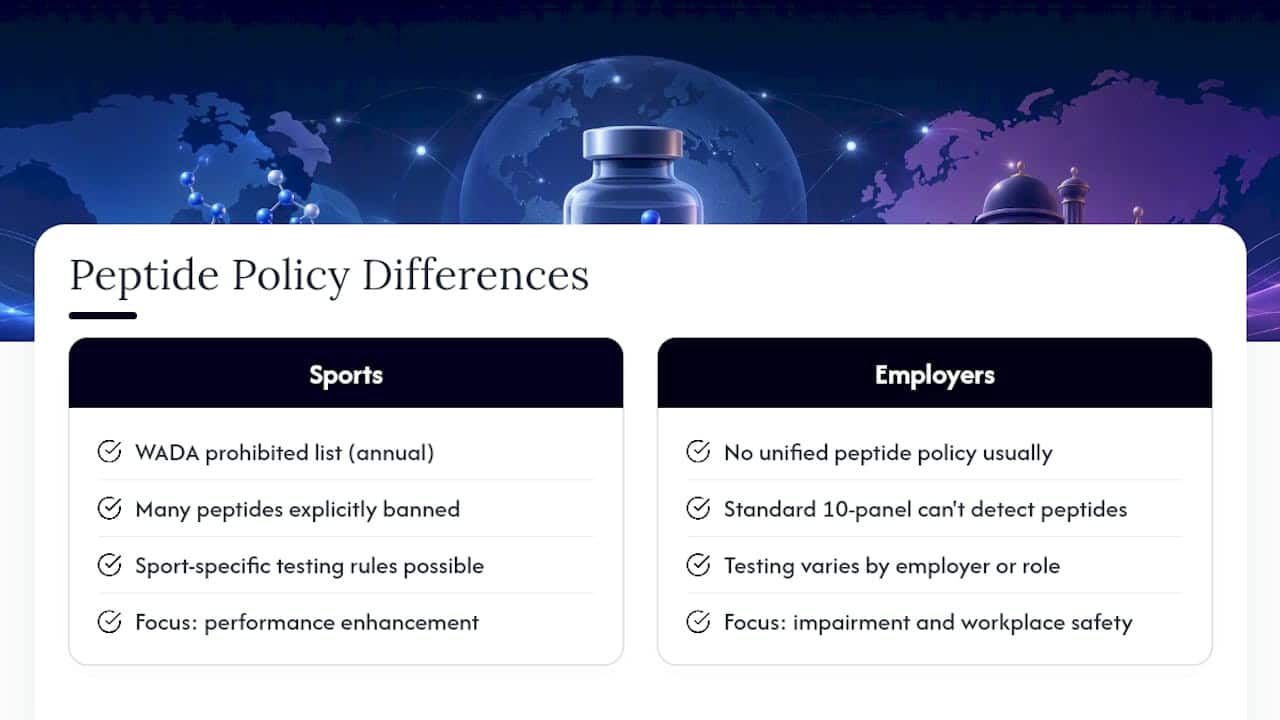
WADA-signatory sports organizations maintain a prohibited substance list that’s reviewed and updated annually, and many peptides used for growth-hormone stimulation or recovery appear on it explicitly. National anti-doping organizations under WADA’s umbrella, from cycling federations to Olympic committees, generally enforce the same core list, though sport-specific rules can add extra testing frequency or in-competition versus out-of-competition distinctions.
Employers operate under an entirely different framework, and most have no peptide policy at all because their drug-testing programs were built around impairment and workplace safety, not performance enhancement. A warehouse employer running a standard 10-panel screen has no mechanism to detect peptides and, in most cases, no policy language addressing them specifically.
The gap shows up hardest in regulated or safety-sensitive employment, aviation, transportation, some healthcare and military roles, where broader “fitness for duty” language can theoretically capture substance use that a standard panel would miss entirely. This is where written policy matters more than lab capability. A programme’s authority often comes from what its policy document says, not from what its instrumentation can detect.
If you’re moving between contexts, for instance, an amateur athlete who also works in a safety-sensitive job, don’t assume one set of rules covers both. Ask each programme separately what it tests for and what its policy says about disclosed medical use.
What are the legal and ethical lines around peptide use?
Legal status and ethical acceptability are two separate questions, and conflating them causes most of the confusion readers run into.
Legally, many peptides sold for research or personal wellness use occupy a regulatory grey zone depending on your jurisdiction and intended use. Buying from a supplier that documents purity and provides certificates of analysis doesn’t change a substance’s legal classification, but it does reduce the chance you’re unknowingly taking something mislabelled or adulterated.
Ethically, sport draws a clean line: if a compound is on your governing body’s prohibited list, using it to gain a competitive edge violates the rules you agreed to compete under, regardless of how you feel about the rule itself. Therapeutic Use Exemptions exist precisely for athletes who have a genuine medical need for an otherwise prohibited compound, and pursuing one properly, rather than using quietly and hoping, is the only defensible path.
Employment carries a softer but still real ethical dimension. Most jobs don’t test for peptides and don’t restrict their use, but safety-sensitive roles sometimes have broader conduct expectations tied to substance use generally. When in doubt, disclosure to occupational health or a medical review officer protects you far more than staying quiet ever will. Transparency with your own clinician also matters: peptide use can interact with other treatments, and hiding it from a doctor removes their ability to help you avoid a bad outcome.
Can peptide testing produce a false positive?
False positives in peptide testing are less about the lab making an error and more about what’s actually in the product you took. Cross-reactivity, where an assay reacts to a substance it wasn’t designed to detect, is a known limitation of antibody-based testing in general, though it’s rare in the highly specific LC-MS/MS methods anti-doping labs use for peptide confirmation.
The bigger real-world risk sits upstream of the lab entirely. Gray-market peptide products show documented variance between label claims and actual contents, meaning a contaminant in an unverified product can be the actual source of an unexpected result, not the peptide you thought you were taking. If a product is cut with an undisclosed compound, a test correctly flagging that compound isn’t a false positive at all. It’s an accurate reflection of what you consumed, just not what you intended to consume.
This is where supplier verification stops being a nice-to-have and becomes a genuine risk-management tool. A certificate of analysis confirming both identity and purity tells you what’s actually in the vial before it ever reaches your system. Anti-doping labs also run confirmatory testing on any initial positive specifically to rule out cross-reactivity before a result becomes official, which is one reason WADA’s process involves both a screening test and a separate confirmation step.
A consumer-centred perspective on safety and compliance
Trying to time peptide use around an estimated “clearance window” is a losing strategy, because detection methods keep advancing and yesterday’s safe margin can become tomorrow’s flagged sample. The smarter approach is transparency: disclose prescribed use to the people who need to know, work with a clinician who understands what you’re taking, and source from suppliers who document purity rather than promise it. Compliance built on evasion always breaks eventually. Compliance built on verified quality and honest disclosure holds up regardless of how the science moves.
— Pure Peptide
Where to find verified, high-purity peptides
There are other places to source peptides online, and plenty of them skip the paperwork entirely. Pure Peptide’s advantage is straightforward: every formulation is backed by third-party certificates of analysis and verified above 99% purity, so you’re not guessing at what’s actually in the vial before you ever think about testing risk. That matters more than any clearance estimate ever will, because contamination, not the peptide itself, is often the harder variable to control.
Browse the full product range across weight loss, muscle growth, recovery, and anti-aging categories, or look specifically at recovery-focused peptides if that’s your priority. Review the certificate of analysis for any product before buying, and talk to a clinician if you’re combining peptide use with an existing prescription. Start by checking which category fits your goal on the Pure Peptide product pages.
This article is general information, not a substitute for advice from a qualified doctor. Consult a qualified healthcare professional about your own circumstances before acting on anything here.
Sources
- Analytical methods / anti-doping detection of peptide metabolites (PMC article)
- Determination of limit of decision for GHRP-2 (research figure / methods)
- WADA resource documenting development of peptide screening tools
FAQ
Do peptides show up on standard drug tests?
No. Standard workplace and clinical urine panels use immunoassay technology built to detect small-molecule drugs of abuse, and peptides don’t register as target analytes on these tests. Anti-doping laboratories are the exception, since they run different, more sensitive methods specifically to catch peptides.
Are peptides banned by WADA?
Several peptides, particularly those affecting growth hormone release, appear on WADA’s prohibited substance list and are actively tested for using LC-MS/MS methods at accredited anti-doping laboratories. Status varies by specific compound, so checking your governing body’s current list is essential rather than assuming.
How long do peptides stay detectable in urine?
Detection windows vary by compound, dose, and testing sensitivity, so no fixed number applies universally. One published study found detectable urinary metabolites of GHRP-2 for up to roughly 60 hours after a single dose, though this is a research finding, not a personal guarantee.
Can a contaminated peptide product cause an unexpected positive result?
Yes. Mislabelled or impure products sourced from unverified suppliers can introduce substances beyond the intended peptide, and that contaminant, not the peptide itself, is sometimes the actual source of a flagged result. Choosing suppliers who provide third-party certificates of analysis significantly reduces this risk.
What should I do if I’m an athlete using a medically necessary peptide?
Contact your sport’s anti-doping organization directly and ask about applying for a Therapeutic Use Exemption before you use the compound, not after testing flags it. Keep documentation from your prescribing clinician on hand, since that paperwork supports the exemption process and protects you if questions arise later.