


IGF-1 LR3 carries a real, immediate risk of hypoglycaemia, and it comes with biologically plausible long-term risks that nobody can fully quantify yet. That second part matters more than most sellers admit: there is no human safety database for IGF-1 LR3 itself. Every risk estimate you’ll read, including this one, is extrapolated from mecasermin (brand name Increlex), a related but distinct IGF-1 drug with actual clinical trial data, plus animal studies of the LR3 analogue.
Here’s the short version. The acute risk you’re most likely to encounter is low blood sugar, sometimes severe enough to cause confusion, seizures, or loss of consciousness. The theoretical risks that concern researchers most are organ enlargement (organomegaly), acromegaly-like tissue growth, and the possibility that sustained elevated IGF-1 could promote existing cancer growth. None of these theoretical risks have been proven in LR3 specifically. They’re inferred from what happens when IGF-1 signalling runs high for extended periods in other contexts.
Immediate safety actions, non-negotiable:
- Do not use IGF-1 LR3 if you have active cancer, a history of certain cancers, or are pregnant.
- Check fasting glucose before you start, and monitor regularly afterward.
- Never inject on an empty stomach, and always have fast-acting carbohydrate on hand.
- Stop immediately and seek medical attention for severe headache, visual disturbance, or blurred vision. These can signal intracranial hypertension, a rare but documented complication in the mecasermin trials.
In the Increlex clinical program, hypoglycaemia occurred in 30 of 71 subjects, and intracranial hypertension appeared in 3 of 71. Those numbers come from a related drug under medical supervision, not from LR3 itself, but they’re the closest real human data anyone has.
Everything past this point explains why those risks occur, how likely they are, who should avoid LR3 altogether, and how people who choose to use it try to reduce the danger.
Key Takeaways
The most important fact about IGF-1 LR3 is that its risk profile rests entirely on mecasermin trial data and animal studies, not on human trials of LR3 itself.
| Point | Details |
|---|---|
| Hypoglycaemia is the main acute risk | Mecasermin trials showed it in 30 of 71 subjects; always eat around dosing and carry fast carbs. |
| Serious symptoms need urgent care | Severe headache or vision changes may signal intracranial hypertension, seen in 3 of 71 mecasermin subjects. |
| Long-term risks remain theoretical but plausible | Organomegaly and cancer-promotion concerns come from biological mechanism, not proven LR3 outcomes. |
| Certain people should avoid LR3 entirely | Active cancer, pregnancy, and use of insulin or sulfonylureas are firm contraindications. |
| Purity matters when data is already uncertain | Soma Peptide tests compounds to ensure purity so quality isn’t an added unknown on top of the biological risk. |
This article is general information, not a substitute for advice from a qualified doctor. Consult a qualified healthcare professional about your own circumstances before acting on anything here.
Table of Contents
- What are the common side effects of IGF-1 LR3?
- Why does IGF-1 LR3 cause these effects? The pharmacology explained
- How serious are the long-term and theoretical risks?
- Who should avoid IGF-1 LR3 entirely?
- How to monitor for side effects and reduce risk
- What does the actual clinical and research evidence show?
- Where Soma Peptide stands on safety and transparency
- Explore Soma Peptide’s IGF-1 LR3 resources
- Sources
- FAQ
What are the common side effects of IGF-1 LR3?
The side effects reported most often with IGF-1 LR3 fall into two buckets: things tied to blood sugar, and things tied to fluid and tissue changes at the injection site or systemically. Almost none of this comes from controlled human trials of LR3. It comes from mecasermin data, animal research, and self-reported accounts pooled across forums and harm-reduction guides. Treat that distinction as load-bearing, not a footnote.
Hypoglycaemia is the side effect you’ll hear about first, and for good reason. IGF-1 shares enough structural similarity with insulin that it can activate insulin receptors directly, pulling glucose out of the bloodstream faster than your body expects. Symptoms typically show up within one to three hours of an injection: sweating, shakiness, sudden hunger, confusion, irritability, and in more severe cases, slurred speech or loss of coordination. In the mecasermin clinical program, hypoglycaemia was common enough that manufacturer guidance explicitly recommends eating a meal or snack within 20 minutes of dosing, every time, no exceptions. Several subjects in that cohort experienced severe hypoglycaemic events, including seizures. There’s no reason to assume LR3, which is engineered to stay active longer than native IGF-1, would be gentler on blood sugar. If anything, the extended action window is the concerning part.

Injection site reactions and lipohypertrophy come next on the frequency list. Redness, swelling, and localized pain after injection are common with any subcutaneous peptide, but repeated injections into the same small area can cause lipohypertrophy, a lumpy thickening of fat tissue under the skin. It’s not dangerous on its own, but it changes how the drug absorbs from that site going forward, which throws off dosing consistency. Rotating injection sites systematically, and mapping them so you’re not hitting the same quarter-inch of tissue every time, is one of the simplest and most overlooked ways to reduce this risk.

Fluid retention and joint or muscle aches show up in a meaningful share of users, particularly early in a cycle or at higher doses. This tracks with what’s known about growth hormone and IGF-1 pathways more broadly: both can cause the body to hold onto sodium and water, which shows up as puffiness, joint stiffness, or a dull ache in the hands and feet. The pharmacology literature on anabolic use of growth hormone, IGF-1, and insulin documents peripheral oedema as a recurring complaint. The good news is that this effect is generally dose-dependent and reversible. It tends to ease within days of lowering the dose or stopping altogether.
Fatigue, headache, nausea, and dizziness round out the common list, but they’re not all the same problem wearing different masks. Fatigue and dizziness paired with sweating and shakiness usually point back to hypoglycaemia. A standalone headache with no other symptoms is more likely a separate, milder reaction, though any headache that’s severe, sudden, or paired with vision changes needs to be treated as a potential red flag rather than a normal side effect (more on that shortly).
Pro Tip: Keep a simple log for the first two weeks: time of injection, dose, what you ate beforehand, and any symptoms with a timestamp. Patterns show up fast, and that log is the single most useful thing you can hand a doctor if something goes wrong.
Why does IGF-1 LR3 cause these effects? The pharmacology explained
Understanding the mechanism behind IGF-1 LR3’s side effects helps you judge which risks are plausible, which are overstated, and which depend heavily on dose.
Native IGF-1 in your body is tightly controlled by six binding proteins (IGFBPs) that latch onto most of the circulating hormone and limit how much is “free” and active at any given moment. LR3 was engineered specifically to resist that binding. Its modified amino acid sequence (the Long Arg3 substitution that gives it its name) reduces its affinity for IGFBPs dramatically, which means a much higher fraction of it stays active in circulation compared with the same dose of native IGF-1. That’s the entire point of the analogue for the people who use it: more free hormone, longer window of activity, a stronger training-adaptation signal. It’s also exactly why the side-effect profile is a genuine concern rather than a theoretical one.
That extended free-hormone exposure interacts with two receptor systems in ways worth separating clearly:
- Insulin receptor cross-reactivity: IGF-1 and insulin receptors are structurally related enough that IGF-1, especially at the elevated free concentrations LR3 produces, can activate insulin receptors directly. This triggers the same PI3K/Akt signalling cascade that moves glucose transporters (GLUT4) to the cell surface, pulling sugar out of the blood. That’s the direct mechanical explanation for why hypoglycaemia is the most reliable and immediate side effect, not a rare edge case.
- IGF-1 receptor signalling: separately from the insulin crossover, sustained activation of the IGF-1 receptor itself drives cell growth and division. That’s a normal, healthy process in childhood development. In an adult body with fully closed growth plates, prolonged elevated signalling through this pathway is what underlies concerns about tissue overgrowth, organ enlargement, and, more seriously, the biological plausibility of tumour promotion in existing cancer cells.
The half-life question ties both of these together. Native IGF-1 in the body is cleared relatively quickly once it’s bound and processed by IGFBPs, giving your endocrine system natural braking power. LR3’s resistance to that binding extends its half-life substantially, which means a single injection keeps signalling through both pathways for longer than an equivalent dose of unmodified IGF-1 would. Longer exposure per dose is precisely why dosing conservatively and monitoring glucose regularly matters more with LR3 than it would with a shorter-acting compound. The mechanism isn’t exotic. The risk is just harder to shut off once it’s started.
How serious are the long-term and theoretical risks?
The rare risks are the ones that deserve the most caution, precisely because rare doesn’t mean mild. When something does go wrong at this end of the spectrum, it tends to be a genuine emergency or a slow-building, potentially irreversible problem rather than a passing inconvenience.
Intracranial hypertension is the most acute of the serious risks. It’s a build-up of pressure inside the skull, and in the Increlex clinical program, it was documented in 3 of 71 subjects. Symptoms to treat as an emergency: severe or worsening headache, blurred or double vision, nausea unrelated to eating, and in advanced cases, papilloedema (swelling of the optic nerve, visible only via eye exam). This is not a “wait and see” symptom set. If a headache is unlike your usual headaches, or comes with visual changes, that warrants urgent medical evaluation, not a dose adjustment.
Organomegaly and acromegaloid features represent the slower-building concern. Chronic, elevated growth-factor signalling is what drives the visible changes seen in acromegaly: thickened features, enlarged hands and feet, organ growth. Preclinical rodent studies of LR3 have documented disproportionate growth of the gut, spleen, and kidney under chronic exposure, which is a meaningful preclinical signal even though rodent physiology doesn’t map cleanly onto human dosing. The concerning part is that some tissue changes associated with prolonged GH/IGF excess in humans, once established, don’t fully reverse even after the exposure stops.
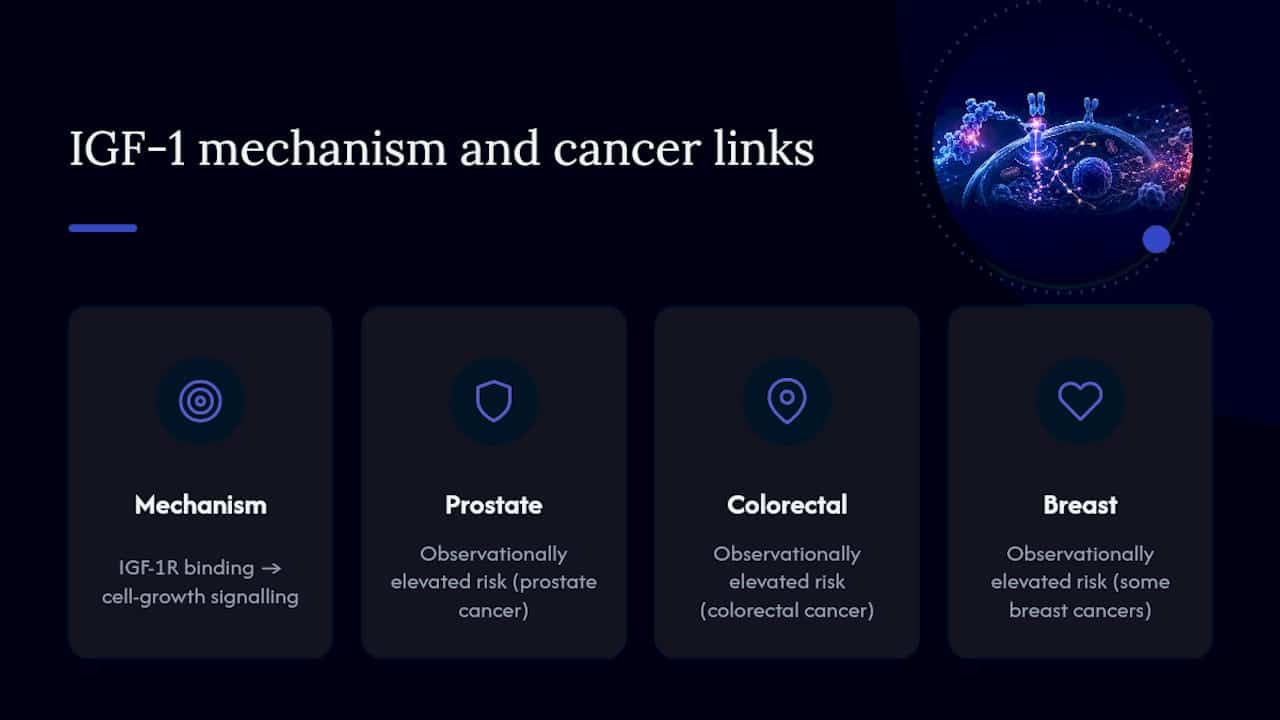
Cancer-promotion risk is the theoretical concern that gets the most attention, and it deserves a precise framing rather than a scary headline. Pooled observational research consistently finds that people with higher circulating IGF-1 have elevated risk for certain cancers, including prostate, colorectal, and some breast cancers, and the biological mechanism (IGF-1 receptor activation driving cell proliferation) is well understood at the molecular level. What that evidence does not show is that IGF-1 LR3 causes cancer in a previously healthy person. What it does show, clearly enough to act on, is that anyone with an active cancer diagnosis or a strong personal or family history of hormone-sensitive cancers should treat LR3 as contraindicated rather than merely “risky.”
It’s worth being honest about where the uncertainty actually sits. Plausible mechanism and proven long-term causal outcome are two different things, and almost all of the alarm around LR3 lives in the gap between them. The mechanism is real. The dose, duration, and individual risk factors that would turn that mechanism into an actual bad outcome in a specific person are not mapped out anywhere in human trial data, because that trial doesn’t exist yet.
Who should avoid IGF-1 LR3 entirely?
Some risk factors don’t just raise the odds of a side effect. They turn a manageable risk into one that isn’t worth taking at all. Four categories stand out clearly from the available evidence.
- Active cancer or strong cancer history. Given the biologically plausible link between elevated IGF-1 signalling and tumour growth promotion, anyone with a current cancer diagnosis, a recent cancer history, or a strong family pattern of hormone-sensitive cancers should treat LR3 as off the table, not just a discussion point for a doctor.
- Pregnancy. Growth-factor signalling during pregnancy is a tightly regulated system, and there is no safety data supporting elective use of an IGF-1 analogue during gestation. This one isn’t debatable.
- Existing diabetes, insulin resistance, or cardiovascular and renal disease. People already managing blood sugar have less physiological buffer against a hypoglycaemic event, and fluid retention effects from IGF-1 can put added strain on hearts and kidneys that are already compromised.
- Anyone on insulin, sulfonylureas, or meglitinides. These medications lower blood sugar through overlapping mechanisms. Stacking any of them with LR3 substantially raises the odds of a severe hypoglycaemic event, and this combination should be avoided outright rather than “monitored closely.”
A few behavioural patterns compound the danger even in otherwise lower-risk people. Fasted injections remove your body’s glucose buffer right when LR3 is pushing glucose down hardest. Dosing right before sleep is particularly risky, because early hypoglycaemia symptoms (sweating, confusion) can go unnoticed while you’re unconscious. And stacking LR3 with other anabolic compounds multiplies the number of variables affecting blood sugar, fluid balance, and cardiovascular load at once, making it much harder to isolate what’s actually causing a symptom if one appears.
How to monitor for side effects and reduce risk
If you’re going to use IGF-1 LR3 despite the open questions in the research, treat monitoring as mandatory infrastructure, not an optional add-on. Here’s a practical sequence based on the closest available clinical guidance and consistent harm-reduction conventions.
- Get baseline bloodwork before your first dose. Fasting glucose and HbA1c are the minimum. A basic metabolic panel is worth adding if you have any personal or family history of metabolic or kidney issues. This gives you a reference point, so a change three weeks in actually means something.
- Recheck glucose regularly, not sporadically. A common cadence in both clinical and community guidance is checking fasting glucose and general symptoms at baseline and again every four to six weeks, with tighter checks during the first couple of weeks while you’re still learning how your body responds to a given dose.
- Never inject fasted. Eat something with carbohydrate before or immediately around dosing, and keep 20 to 50 grams of fast-acting carbs (juice, glucose tablets, regular soda) physically within reach every single time you inject.
- Avoid dosing right before sleep. Early hypoglycaemia symptoms are much easier to catch, and act on, while you’re awake and alert.
- Rotate injection sites on a fixed pattern. Map out a rotation across the abdomen, thigh, and other approved sites, and don’t return to the same exact spot for at least several days. This is the single most effective way to prevent lipohypertrophy.
- Know the emergency response for hypoglycaemia. Mild symptoms (shakiness, sweating, hunger) call for immediate fast-acting carbohydrate, followed by a slower-digesting snack once you stabilize. Severe symptoms (confusion, seizure, loss of consciousness) require someone else to call emergency services immediately. This is not a situation to manage solo.
Pro Tip: If you live alone, tell one person your injection schedule and what a hypoglycaemic episode looks like. A five-minute conversation is the cheapest insurance you’ll ever buy against a solo emergency going unnoticed.
Watch for the same red-flag symptoms discussed earlier, severe headache, visual disturbance, unusual swelling, and treat any of them as a reason to stop and get evaluated, not a reason to wait for your next scheduled check.
What does the actual clinical and research evidence show?
The honest starting point here is that IGF-1 LR3 has never gone through a completed human clinical trial that establishes its safety or effectiveness profile. Everything used to estimate its risk comes from three adjacent sources, and each one has real limits worth understanding before you weigh it.
Mecasermin (Increlex) is the closest thing to a human safety dataset, but it’s a related drug, not LR3 itself, and it was studied in a specific patient population (children and adults with severe primary IGF-1 deficiency) under medical supervision, not healthy adults self-administering for performance goals. Within that trial population, the numbers are notable: hypoglycaemia in 30 of 71 subjects, and intracranial hypertension in 3 of 71, according to the manufacturer’s prescribing information. Lymphoid tissue hypertrophy (tonsils, adenoids) was also documented in that cohort, alongside changes in organ size consistent with sustained IGF-1 exposure.
Animal LR3 studies fill in some of the gap on LR3 specifically, but they come with the standard extrapolation caveat: a rodent’s dose-response curve, organ ratios, and metabolic rate don’t map directly onto a 90-kilogram adult human. The organ hypertrophy findings in gut, spleen, and kidney tissue are a real signal worth taking seriously, not a reason for panic on their own.
The clinicaltrials.gov landscape shows active interest in IGF-1 therapeutics broadly, with entries like NCT01909479 studying IGF-1-related interventions, but none of the registered trials are testing LR3 specifically in healthy adults for the uses it’s commonly sought after. A trial that would genuinely reduce the uncertainty here would need controlled dosing, a healthy adult population, and multi-year follow-up on organ imaging and cancer markers, something nobody has funded or run.
The gap isn’t subtle: we have real numbers for a related drug studied in sick patients under medical supervision, real signals from rodents, and zero controlled human data for the compound people are actually buying and injecting.
On the regulatory side, IGF-1 LR3 is sold in most markets as a research chemical, not an approved pharmaceutical, which means it falls under the kind of unapproved drug enforcement guidance the FDA publishes. That status carries a second, quieter risk beyond the biological ones: products sold outside prescription-grade manufacturing and testing pipelines can vary wildly in purity and dosing accuracy from one supplier to the next. Athletes should also know that IGF-1 analogues sit on the WADA prohibited list, so competitive consequences are a real consideration independent of the health question entirely.
| Evidence source | What it shows | Key limitation |
|---|---|---|
| Mecasermin (Increlex) trials | Hypoglycaemia in 30/71 subjects; intracranial hypertension in 3/71 | Different drug, different patient population, medical supervision |
| Animal LR3 studies | Organ hypertrophy in gut, spleen, kidney under chronic exposure | Rodent dosing doesn’t translate directly to human risk |
| Clinicaltrials.gov registry | Active research on IGF-1 therapeutics broadly | No completed LR3-specific trials in healthy adults |
| Regulatory status | Sold as unapproved research chemical in most markets | No mandated purity or quality-control standard |
Where Soma Peptide stands on safety and transparency
We hear from a lot of people curious about IGF-1 LR3, and the demand makes sense given what the compound theoretically offers. But demand doesn’t change what the evidence actually says, and we’d rather tell you the honest version than a comfortable one. The core safety picture here is unresolved: real hypoglycaemia risk, plausible but unproven long-term concerns, and no human trial data for LR3 itself.
Our position is that purity and testing transparency are the parts of this equation you can actually control. Read the full IGF-1 LR3 research overview for lab documentation, and talk to a physician before you start, especially if any of the risk factors above apply to you.
— Soma Peptide
Explore Soma Peptide’s IGF-1 LR3 resources
Here’s the honest version of where this leaves you: IGF-1 LR3 remains widely available online, but availability and evidence are two different things, and the responsible move is to pair whatever you decide with real documentation and a clinician’s input, not a forum thread. That’s the gap Soma Peptide exists to close on the transparency side, even though we can’t close it on the human-trial side, because that trial simply hasn’t been run yet.
If you’re still researching, the IGF-1 LR3 overview page walks through dosing conventions and links directly to our lab reports so you can see exactly what you’d be getting before you buy anything. For a sense of realistic timelines and outcomes, the results and expectations guide covers what to actually expect week by week. And if the risk profile here has you looking at alternatives with a stronger evidence base, our science-based guide to peptides for muscle growth covers other options worth comparing before you commit. Whatever you choose, get a baseline bloodwork panel done first and loop in a doctor. If you’re ready to move forward, start with the bodybuilding peptides guide to see how LR3 stacks up against other documented options.
Sources
- Drugs
- Use of growth hormone, IGF‑I, and insulin for anabolic purpose: pharmacological basis, methods of detection, and adverse effects — PMC
- Clinicaltrials
- FDA — enforcement activities for unapproved drugs
FAQ
Does IGF-1 LR3 really work?
It does increase free IGF-1 activity through reduced binding-protein interference, which is the mechanism behind reported muscle and recovery effects, but no controlled human trials confirm its efficacy or optimal dosing in healthy adults.
What should you expect when taking IGF-1 LR3?
Expect the possibility of hypoglycaemia symptoms within a few hours of injection, mild fluid retention or joint aches in the first weeks, and the need for consistent glucose monitoring throughout use.
Does IGF-1 increase testosterone?
IGF-1 and testosterone operate through separate hormonal pathways, and there’s no established evidence that IGF-1 LR3 directly raises testosterone levels.
How risky is IGF-1 LR3?
The acute risk, hypoglycaemia, is well documented in related mecasermin trials and requires active monitoring; the long-term risks around organ growth and cancer promotion are biologically plausible but unproven specifically for LR3, which is exactly why caution and medical supervision matter.
Is IGF-1 LR3 legal to buy?
It’s typically sold as an unapproved research chemical rather than a prescribed pharmaceutical, which means it falls outside standard drug-safety oversight in most markets, including under FDA unapproved-drug enforcement guidance.