


Three barrel sizes cover almost every insulin dose: 0.3 mL (30 units), 0.5 mL (50 units), and 1 mL (100 units), all calibrated to U-100 insulin. For the needle itself, Diabetes Canada recommends a length of 4 mm to 6 mm for most adults doing subcutaneous injections, paired with a gauge between 29G and 31G.
- 0.3 mL syringe — best for doses under 30 units, where fine measurement matters most
- 0.5 mL syringe — the common middle ground for 30 to 50 unit doses
- 1 mL syringe — needed for doses approaching 100 units
- Needle length — 4 to 6 mm suits most adults; longer needles need a clinician’s input
- Gauge — 30G is the practical default; 31G maximizes comfort, 29G speeds up the draw
Quick reference: on a U-100 syringe, 1 unit always equals 0.01 mL, so 20 units equals exactly 0.2 mL, not 0.5 mL, a mix-up that trips up a lot of new users.
Key Takeaways
Accurate insulin dosing depends on matching the smallest suitable syringe barrel to your prescribed dose, using a 4 mm to 6 mm needle, and always confirming your insulin concentration matches the syringe’s U-100 calibration.
| Point | Details |
|---|---|
| Match barrel to dose | Use 0.3 mL for doses under 30 units, 0.5 mL for 30 to 50 units, and 1 mL for higher doses. |
| Confirm U-100 compatibility | Standard syringes assume 100 units per mL; mismatched concentrations like U-300 cause serious dosing errors. |
| Default to short needles | Diabetes Canada recommends 4 mm to 6 mm needles for most adults doing subcutaneous injections. |
| Pick gauge for your needs | 30G balances comfort and draw speed; 29G helps with thicker solutions, 31G maximizes comfort. |
| Rotate sites and dispose safely | Rotate injection sites to avoid tissue buildup and discard every needle in a rigid sharps container after one use. |
| Source reconstitution supplies thoughtfully | Soma Peptide supplies correctly sized syringes and reconstitution ancillaries alongside its peptide products. |
This article is general information, not a substitute for advice from a qualified doctor. Consult a qualified healthcare professional about your own circumstances before acting on anything here.
Table of Contents
- What do insulin syringe sizes actually mean?
- Needle gauge and length: what the numbers actually mean
- How to choose the right insulin syringe size
- Injection technique, rotation, and disposal that actually matter
- Matching syringe size to insulin concentration
- Unit markings versus concentration: the mistake that causes real harm
- Choosing the right approach to insulin syringe sizes
- Where Soma Peptide fits into your injection routine
- Sources
- FAQ
What do insulin syringe sizes actually mean?
Every insulin syringe sold for U-100 insulin follows the same math: 100 units packed into 1 mL of fluid, so each unit equals 0.01 mL. That single conversion factor is why Diabetes Canada’s guidance on syringe volumes treats the 0.3 mL, 0.5 mL, and 1 mL barrels as the three standard options, each just a different window onto the same unit scale.
A 0.3 mL syringe holds a maximum of 30 units. A 0.5 mL syringe holds 50 units. A 1 mL syringe holds the full 100 units. Pick based on your actual prescribed dose, not habit. Someone dosing 12 units of insulin does not need a 1 mL barrel; a 0.3 mL syringe fits that dose with plenty of room to spare, and it measures it far more precisely.
That precision comes down to physical geometry. Manufacturers space the unit markings on a small barrel farther apart than on a large one, because the same 30 units of liquid has to stretch across the entire visible scale on a 0.3 mL syringe, versus being squeezed into less than a third of the scale on a 1 mL syringe. Wider tick spacing means less room for your eye to misjudge the plunger position, which matters enormously for anyone drawing single-digit or low-double-digit doses.
- Doses under 30 units: 0.3 mL syringe, widest tick spacing, best precision
- Doses of 30 to 50 units: 0.5 mL syringe, a reasonable middle ground
- Doses of 50 to 100 units: 1 mL syringe, the only option that physically holds the volume
- Microdoses under 10 units: the profpeptide injection guide notes that a 0.3 mL barrel is routinely favoured in peptide dosing communities specifically because it makes tiny volumes easier to read accurately
If your dose sits right at a barrel’s edge, for example 48 units, round up to the next syringe size rather than trying to squeeze a near-maximum dose out of a smaller barrel. You lose the visual advantage once you’re reading marks near the very top of the scale, where crowding creeps back in regardless of barrel size.
Needle gauge and length: what the numbers actually mean
Gauge works backwards from what most people expect: the higher the number, the thinner the needle. A 31G needle is finer than a 29G needle, not thicker, and that inversion trips up plenty of first-time buyers standing in a pharmacy aisle. For insulin and peptide subcutaneous injections, gauges typically run from 29G to 31G, with the finer end favoured for comfort and the coarser end favoured for a faster, easier draw.
Length is the separate variable, and it’s the one Diabetes Canada speaks to most directly: needles in the 4 mm to 6 mm range are appropriate for most adults doing subcutaneous injections, a recommendation grounded in reducing the odds of the needle passing through fat and into muscle. Longer needles, in the 8 mm to 12.7 mm range, still exist and occasionally get used, but only under a clinician’s direction for specific body types or circumstances.
- 4 mm to 6 mm — standard for adult subcutaneous injections, lowest risk of hitting muscle
- 8 mm — occasionally used, generally not needed for typical adult body composition
- 12.7 mm — a legacy length, now rarely the right default for insulin or peptide dosing
- 29G — a slightly coarser draw, useful for thicker or more viscous solutions
- 30G — the everyday compromise between comfort and draw speed
- 31G — the finest common option, prioritizes comfort when draw speed isn’t a concern
The trade-off between gauge choices is real, not marketing noise. PeptidePick’s comparison of gauge options points out that 31G needles reduce tissue trauma noticeably but can slow the draw enough to be annoying, especially with a viscous or cold solution. That’s why so many experienced users default to 30G rather than chasing maximum fineness. If you’re regularly frustrated by a slow draw, 29G solves that without meaningfully increasing discomfort for most people.
Pro Tip: If a reconstituted solution draws sluggishly through a fine insulin needle, draw it up using a slightly thicker needle attached to the vial, then swap to your fine-gauge insulin syringe needle before injecting. You keep the comfortable injection and skip the frustrating draw.
How to choose the right insulin syringe size
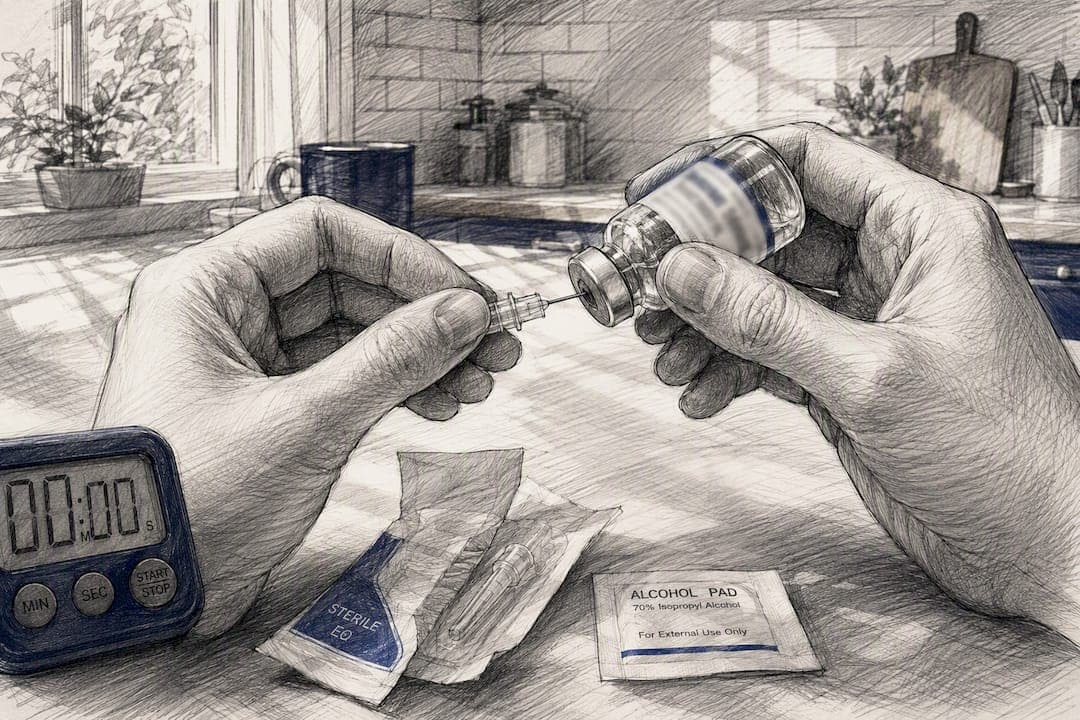
Picking the right combination isn’t guesswork if you work through it in order.
- Confirm your prescribed dose in units or mL, and confirm it’s a U-100 formulation. Every calculation downstream depends on this number being correct and the concentration matching your syringe’s calibration.
- Select the smallest barrel that comfortably holds that dose. A 12 unit dose belongs in a 0.3 mL syringe, not a 1 mL one, because the smaller barrel spreads the scale wider and gives you a more accurate read.
- Default to a short needle, 4 mm to 6 mm, for routine injections. Only consider anything longer, 8 mm up to 12.7 mm, if a clinician has specifically recommended it for your situation.
- Choose gauge based on comfort and solution thickness. Start with 30G as a sensible default. Move to 29G if you’re struggling with a slow draw on a thicker solution, or to 31G if comfort is your top priority and draw speed doesn’t bother you.
- When in doubt, ask. A pharmacist or diabetes educator can confirm whether your specific insulin concentration and prescribed volume match the syringe you’re holding, and that five-minute conversation is worth far more than guessing.
Injection technique, rotation, and disposal that actually matter
Getting the syringe size right solves half the problem. The other half is technique, because even a perfectly matched syringe and needle can deliver an inconsistent dose if the injection itself is done poorly.
- Rotate sites systematically. Abdomen, thighs, and the back of the upper arms all work for subcutaneous injections, but repeatedly hitting the same small patch of skin causes lipohypertrophy, a lumpy tissue buildup that makes absorption unpredictable.
- Pinch a skin fold for shorter needles and inject at the angle your needle length calls for. A 4 mm needle generally goes in straight; some people at the higher end of the 6 mm range are advised to angle slightly, based on their body composition.
- Hold the needle in place for a few seconds after the plunger bottoms out. Pulling out too fast can leave a small amount of insulin sitting in the tissue track instead of under the skin where it belongs.
- Never reuse a needle. Every needle is single-use, both for hygiene and because the tip dulls after one puncture, and CDC injection safety guidance is explicit on this: one needle, one syringe, one time.
- Dispose of used needles in a rigid, puncture-proof sharps container, never loose in household trash.
- Watch for warning signs. Unusual bruising at injection sites, or blood glucose readings that swing unpredictably despite consistent dosing, are worth flagging to your care team rather than dismissing as normal variation.
Pro Tip: Keep an actual rotation map, even a rough sketch on your phone, of where you’ve injected over the past two weeks. Memory alone is unreliable once you’re doing this daily.
Why this guidance holds up
This isn’t guesswork stitched together from forum posts. The needle length and gauge recommendations here trace directly back to Diabetes Canada’s own tools and resources on insulin therapy, and the rationale for shorter needles specifically is backed by clinical research into injection technique, which found that adopting 4 mm to 6 mm needles reduced accidental intramuscular injections and improved how consistently insulin absorbed.
Shorter needles were adopted specifically because intramuscular injection produces unpredictable absorption, and reducing that risk improves day-to-day glucose consistency, not just injection comfort.
Soma Peptide builds its educational content, including its primer on peptide biology and administration basics, around that same clinical foundation rather than around anecdote. A few things worth knowing:
- Recommendations here reflect published Diabetes Canada guidance, not opinion
- Gauge and length trade-offs are drawn from documented clinical and practitioner sources
- Soma Peptide maintains educational resources specifically on injection basics for peptide and insulin users
Matching syringe size to insulin concentration
Barrel size only works correctly when it’s paired with the right insulin concentration, and this is where mismatches cause real dosing errors. A standard U-100 insulin syringe is calibrated on the assumption that 100 units equals 1 mL. That calibration only holds true if the insulin inside the vial or pen is also U-100.
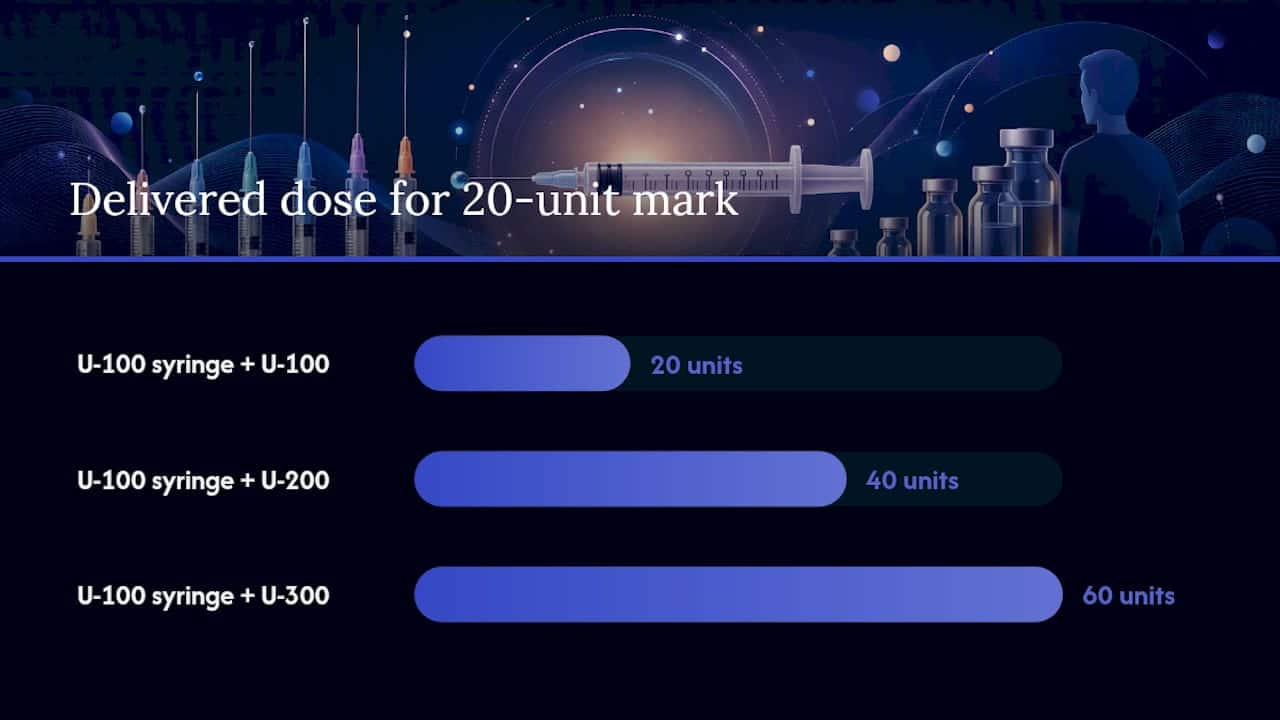
Some insulin comes in higher concentrations, U-200 or U-300, typically for people with higher insulin requirements who would otherwise need to inject larger, less comfortable volumes. Using a standard U-100 syringe with U-300 insulin creates a serious problem: the syringe’s markings would tell you that you’ve drawn, say, 20 units, when you’ve actually drawn three times the insulin content, since the liquid itself is three times as concentrated. This isn’t a minor rounding issue; it’s the kind of error that leads to severe hypoglycemia.
U-200 and U-300 insulins are generally dispensed in pre-filled pens specifically designed to prevent this mismatch, rather than in vials meant for syringe draw. If you’re ever handed a vial and a syringe together, confirm the concentration printed on the vial label matches the calibration printed on the syringe barrel before drawing a single unit. When the concentration or the correct device isn’t obvious, that mismatch is exactly the kind of question a pharmacist should answer before you inject anything.
Unit markings versus concentration: the mistake that causes real harm
The single most dangerous misunderstanding in insulin dosing is treating the unit markings on a syringe as a fixed volume rather than a concentration-dependent measurement. Units and millilitres are not interchangeable outside the context of U-100 insulin specifically.
Twenty units on a U-100 syringe is 0.2 mL, full stop, not 0.5 mL, a mix-up that shows up constantly in casual conversation and even some outdated printed materials. The unit marking only means what it says when the insulin concentration matches the syringe’s calibration. Change the concentration, and the same unit marking on the same physical syringe represents a completely different real-world dose.
This is precisely why U-200 and U-300 insulins are handled differently by design, usually through dedicated pens rather than syringes drawn from a vial, so the person injecting never has to do concentration math under pressure. If you ever find yourself needing to calculate a dose manually because a standard syringe and a non-standard concentration have somehow ended up on the same counter, stop and confirm with a pharmacist or your prescriber rather than estimating. The visual clarity that makes a smaller barrel so useful for precision only protects you when the concentration assumption underneath it is correct.
Choosing the right approach to insulin syringe sizes
The evidence here supports a simple hierarchy: get the concentration right first, then the barrel size, then the needle. Most of the anxiety people feel around syringe sizing has nothing to do with gauge or length. It’s the concentration mismatch risk that actually causes harm, and conventional advice spends far too little time on it compared to how much airtime it gives needle comfort.
Comfort still matters, and it’s not trivial to someone injecting daily. But the conventional framing, treating gauge choice as the main decision point, undersells the two things that actually drive safety: confirming U-100 compatibility, and matching barrel size to dose for accurate measurement. A 31G needle feels nicer going in. It does nothing to protect you from a concentration error.
If there’s one thing worth prioritizing above everything else in this guide, it’s this: read the concentration on your insulin vial or pen every single time, not just the first time. Habits form fast, and habits are exactly what let a concentration mismatch slip through unnoticed.
— Soma Peptide
Where Soma Peptide fits into your injection routine
Soma Peptide supplies research-grade peptides alongside the practical ancillaries that go with them, including bacteriostatic water, syringes, and alcohol pads sized to match the same accuracy principles covered in this guide. If you’re already comfortable choosing the right barrel and gauge for insulin, that same logic applies directly to peptide dosing, where microdose accuracy matters just as much and where a properly sized syringe makes the difference between a clean, comfortable injection and a frustrating one.
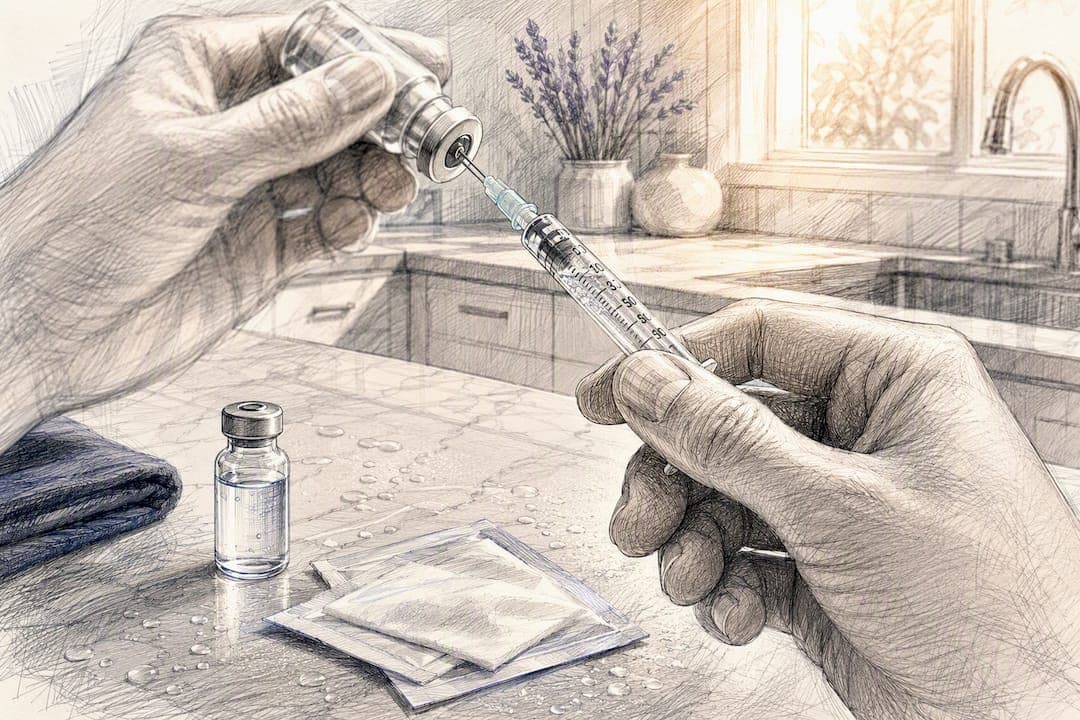
For readers exploring peptide protocols for muscle growth or fat loss, the same 0.3 mL to 0.5 mL barrel range covered above tends to be the right starting point, since most peptide doses fall well under 50 units in volume equivalent. Soma Peptide’s formulations are documented at over 99% purity, giving you one less variable to worry about once your syringe size and injection technique are already dialled in. Browse the current peptide catalogue and reconstitution supplies to put this guide into practice on your next order.
Sources
- The injection technique factor — Diabetes journals
- Best gauge needle for peptide injections — PeptidePick
FAQ
What are the three sizes of insulin syringes?
The three standard sizes are 0.3 mL (holds up to 30 units), 0.5 mL (up to 50 units), and 1 mL (up to 100 units), all calibrated for U-100 insulin.
Is 20 units the same as 0.5 mL?
No. On a U-100 syringe, 20 units equals 0.2 mL, since 100 units equals 1 mL and each unit equals 0.01 mL; 0.5 mL would actually be 50 units.
Which is smaller, a 31G or 32G needle?
Gauge numbers work backwards: higher gauge means a thinner needle. For insulin syringes, the common range is 29G to 31G, with 31G being the finest standard option.
What needle lengths come with insulin syringes?
Common lengths run from 4 mm up to 12.7 mm, but Diabetes Canada guidance points to 4 mm to 6 mm as appropriate for most adults doing subcutaneous injections, with longer needles reserved for specific clinical situations.
What gauge needle works best for peptide injections?
Most peptide injections use the same 29G to 31G range as insulin, with 30G serving as a practical default and 29G helping when a thicker solution draws slowly, according to PeptidePick’s gauge comparison.