



Intramuscular injections deliver medication faster and tolerate larger volumes; subcutaneous injections release medication more slowly and steadily, and they’re easier to self-administer. That’s the core trade-off behind subcutaneous vs intramuscular delivery, and it’s the reason your prescriber picks one route over the other for a given hormone or peptide.
There’s an important wrinkle for hormone therapy specifically: some studies on testosterone dosed subcutaneously versus intramuscularly found comparable overall drug exposure, with subcutaneous injections often better tolerated. Route choice isn’t only about pharmacology. It’s also about needle size, injection frequency, and how much discomfort you’re willing to live with long term.
A few things worth knowing before you go further:
- Needle length and injection angle differ substantially between the two routes, and using the wrong one risks depositing medication in the wrong tissue layer.
- Absorption speed depends on blood supply. Muscle absorbs faster; fat tissue absorbs slower and more evenly.
- Technique details (pinch vs. flat skin, rotation, aftercare) matter more for long-term outcomes than most people assume. Both get covered below, along with what the actual trial evidence says about switching routes safely.
Key Takeaways
Intramuscular injections absorb faster and handle larger volumes, while subcutaneous injections absorb more slowly and steadily, and pilot data shows the two routes can deliver comparable testosterone exposure with better tolerability for subcutaneous dosing.
| Point | Details |
|---|---|
| Needle specs differ sharply | Intramuscular needles run 25 to 38 millimetres; subcutaneous needles run 4 to 8 millimetres, matched to tissue depth. |
| Volume limits diverge | Subcutaneous sites hold about 1 millilitre comfortably; intramuscular sites can take up to roughly 3 millilitres. |
| Testosterone exposure can match | Pilot studies found comparable overall drug exposure between subcutaneous and intramuscular testosterone in some preparations. |
| Technique prevents errors | Pinch skin for subcutaneous, keep it flat for intramuscular, and skip aspiration for both in most cases. |
| Rotation prevents lipohypertrophy | Rotating subcutaneous injection sites is the most reliable way to avoid lumps and thickened tissue. |
Table of Contents
- Subcutaneous vs intramuscular injection sites and specs
- What clinical evidence says about SubQ vs IM for hormones
- How do you correctly perform each injection type?
- What are the risks and complications of each route?
- Choosing the right route for testosterone, GLP‑1s, and peptides
- Where Soma Peptide fits into administration decisions
- Why the route debate misses the real point
- Sources
- FAQ
Subcutaneous vs intramuscular injection sites and specs
The practical differences between these two routes come down to three things: how deep the needle goes, how much fluid the tissue can hold, and how fast that tissue absorbs the drug. Get any one of those wrong and you’re either wasting medication or risking a painful, poorly absorbed dose.
Needle length and gauge
Intramuscular injections typically use needles in the 25 to 38 millimetre range, long enough to punch through skin and subcutaneous fat and land in muscle tissue. Subcutaneous injections use much shorter needles, usually 4 to 8 millimetres, designed to stay within the fatty layer just under the skin. Gauge (the needle’s thickness) also shifts: thinner gauges are standard for subcutaneous work since the goal is comfort over speed, while intramuscular injections sometimes use a slightly thicker gauge to push more viscous formulations through muscle tissue efficiently.
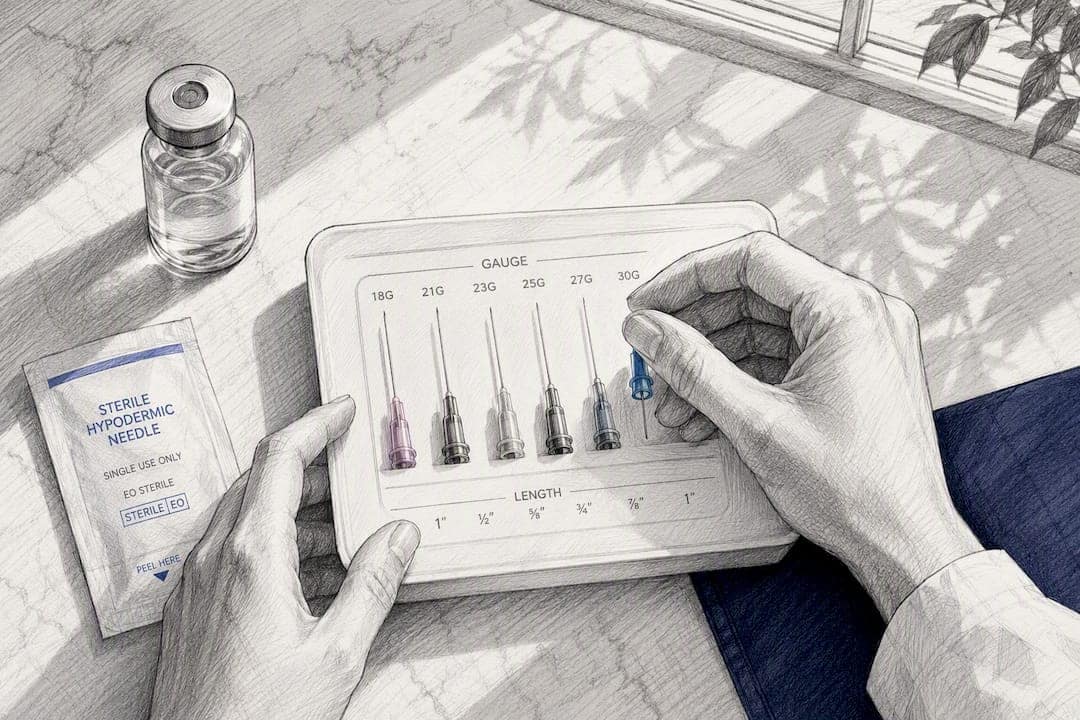
Needle length isn’t a minor detail. A needle that’s too short for an intramuscular injection can leave medication sitting in fat instead of muscle, which changes how fast it’s absorbed and can cause more local irritation. A needle that’s too long for subcutaneous use risks the opposite problem: accidental intramuscular deposition, which throws off the depot effect that makes subcutaneous dosing predictable in the first place.
How much volume each site can handle
Subcutaneous sites are generally comfortable with around 1 millilitre of fluid, sometimes up to 1.5 millilitre depending on the site and formulation. Push past that and you risk swelling, leakage, and pain that has nothing to do with the drug itself. Intramuscular sites, particularly larger muscles like the ventrogluteal or vastus lateralis, can typically accept up to about 3 millilitres in an average adult, sometimes more in a well-developed deltoid or gluteal muscle.
Larger doses that exceed subcutaneous limits usually get split across two sites rather than pushed into one, since overfilling a single subcutaneous pocket is one of the most common causes of post-injection lumps.
Why absorption speed differs
Muscle tissue is dense with blood vessels, so drug injected there reaches systemic circulation quickly. Fat tissue has a comparatively sparse blood supply, which is precisely why subcutaneous injections behave like a slow-release depot rather than a fast bolus. This is the mechanical reason subcutaneous formulations like insulin, many biologics, and a growing list of peptides rely on the fatty layer for sustained release, while vaccines and antibiotics that need rapid systemic action often go intramuscular.
Site choice within each route also matters:
- Intramuscular: ventrogluteal (hip), vastus lateralis (outer thigh), and deltoid (upper arm) are the standard options, chosen based on muscle mass and injection volume.
- Subcutaneous: abdomen (avoiding a two-inch radius around the navel), outer thigh, and the back of the upper arm are the most common sites, largely because they’re easy to reach and pinch.
- Site selection changes absorption slightly. Abdominal subcutaneous injections tend to absorb a little faster than thigh injections, for instance, which matters more for insulin timing than for most hormone therapies.
What clinical evidence says about SubQ vs IM for hormones
The best-documented head-to-head comparison in this space is testosterone. A pilot study and follow-up reviews comparing subcutaneous and intramuscular testosterone found that overall drug exposure, measured as area under the curve, came out comparable between routes for several tested preparations. That’s a meaningful finding: it suggests the fat layer’s slower absorption doesn’t necessarily mean less drug gets into the system over time. It just means it arrives more gradually.
Tolerability is where the two routes tend to diverge more clearly. Multiple sources note that patients switched to subcutaneous testosterone frequently report less injection-site pain and fewer mood swings tied to peak-and-trough hormone spikes, likely because the slower release avoids the sharp concentration spike that intramuscular dosing produces. This doesn’t mean intramuscular testosterone is inferior. It means the two routes produce different exposure curves, and which curve suits a given patient depends on their symptoms, injection frequency, and comfort with self-administration.
Clinicians reviewing subcutaneous testosterone data have described it as “a safe, practical, and reasonable option” for patients who don’t tolerate intramuscular dosing well or who want to self-inject with a smaller, less intimidating needle.
Guideline-level technique guidance backs up a lot of what shapes real-world practice. Nursing and vaccine-administration resources are unambiguous on one point that surprises a lot of self-injectors: aspiration (pulling back on the plunger before injecting) is not required for most subcutaneous or intramuscular injections, including vaccines. Older training once emphasized it as a safety check for accidental intravascular injection, but current guidance found the added pain outweighed the marginal benefit for standard injection sites.
A few evidence gaps are worth naming honestly:
- Regulatory labelling often lags clinical practice. Subcutaneous testosterone remains off-label for some formulations even though pilot data supports its use, which means prescribers are making an evidence-based judgment call rather than following a label instruction.
- Most robust route-comparison trials focus on testosterone and insulin. Data specific to many newer peptides is thinner, so route decisions there lean more heavily on pharmacokinetic reasoning and formulation guidance than on head-to-head trial data.
- Sample sizes in some testosterone route-comparison studies are modest, which is why “comparable exposure” is a fair description but “proven equivalent” would overstate the evidence.
How do you correctly perform each injection type?
Getting technique right is less about following a rulebook and more about understanding why each step exists. Here’s the sequence that actually prevents the two most common mistakes: wrong-tissue deposition and unnecessary bruising.
- Calculate your volume first. Work out the exact dose from your prescription and the concentration on the vial label before you touch a needle. This determines whether the volume even fits comfortably in one subcutaneous site or needs to go intramuscular or split.
- Match the needle to the route. Confirm you’ve got a 4 to 8 millimetre needle for subcutaneous use or a 25 to 38 millimetre needle for intramuscular use, adjusted for body size. A heavier patient may need a longer intramuscular needle to reliably clear the fat layer and reach muscle.
- Prep the site. Clean with an alcohol swab and let it air dry fully. Injecting through wet alcohol stings more and does nothing extra for infection prevention.
- Position the skin correctly. For subcutaneous injections, pinch a fold of skin and insert at a 45 to 90 degree angle depending on needle length and how much fat is available at the site. For intramuscular injections, keep the skin flat (no pinching) and insert at a full 90-degree angle to clear the subcutaneous layer cleanly.
- Inject at a steady pace. No need to aspirate for either route in most cases. Push the plunger at a moderate, even speed rather than rushing it.
- Withdraw and apply light pressure. Don’t rub the site aggressively, especially after subcutaneous injections, since rubbing can disperse the drug faster than intended and irritate the tissue.
- Rotate your sites. Keep a simple rotation pattern (left thigh, right thigh, abdomen quadrants, and so on) and space your subcutaneous sites at least an inch apart between injections.
Rotation deserves its own callout because it’s the single most effective way to prevent lipohypertrophy, the thickened, lumpy tissue that develops from repeatedly injecting the same spot. It’s common in people who’ve been self-injecting insulin or hormones for years and default to whichever site is easiest to reach.
The most frequent mistakes are predictable once you know what to look for: using an intramuscular needle for a subcutaneous injection (risking accidental deep deposition), skipping the pinch on a thin patient (also risking deep deposition), and injecting too fast (which increases bruising and localized soreness regardless of route).
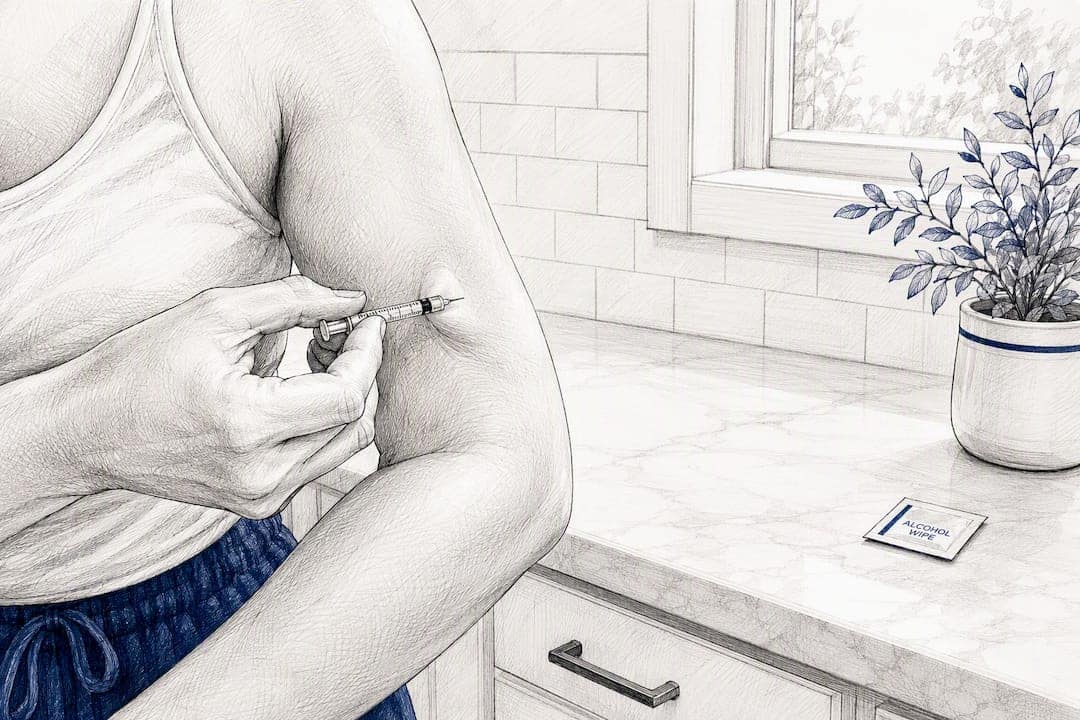
Pro Tip: Keep two needle lengths on hand if your regimen ever calls for both routes. Grabbing a 38 millimetre intramuscular needle out of habit for what should be a subcutaneous dose is one of the most common technique errors self-injectors make, and it’s an easy one to prevent just by labelling your supplies clearly.
For readers managing GLP-1 or peptide injections specifically, practical guidance on subcutaneous self-injection sites covers site rotation patterns tailored to that drug class in more depth.
What are the risks and complications of each route?
Complication profiles diverge in ways that reflect the tissue each route targets. Intramuscular injections go deeper, which means rarer but more serious risks: nerve irritation or, very rarely, vascular injury if the injection lands near a major nerve or blood vessel. That’s part of why ventrogluteal and vastus lateralis sites are preferred over the dorsogluteal site historically used decades ago. Deeper injections also tend to produce more post-injection soreness, especially in smaller or less-developed muscles.
Subcutaneous injections carry a different set of risks, mostly cosmetic and mechanical rather than acute. Lipohypertrophy from repeated same-site injections is the big one, along with localized nodules, bruising from superficial capillary damage, and variable absorption if you inject into scar tissue or an already-lumpy area.
A shortlist worth keeping in mind:
- Infection risk exists for both routes but is preventable with single-use needles, proper alcohol prep, and never reusing a needle even for the same person.
- Watch for redness that spreads, warmth, swelling that worsens after 48 hours, or fever. These are signs of infection, not normal post-injection irritation, and warrant prompt medical attention.
- Persistent nodules or lumps that don’t resolve within a couple of weeks deserve a call to your prescriber, particularly if you suspect the injection landed in the wrong tissue layer.
- Sudden sharp pain, numbness, or tingling radiating down a limb after an intramuscular injection needs urgent evaluation, since it could indicate nerve involvement.
- Routine soreness, mild bruising, and small firm spots that fade within days are normal and don’t require anything beyond basic aftercare.
If you’re ever unsure whether a dose landed correctly, the safer move is a quick call to your prescriber rather than guessing. Route errors are rarely dangerous in isolation, but repeated wrong-tissue injections compound absorption problems over time.
Choosing the right route for testosterone, GLP‑1s, and peptides
Route selection isn’t a fixed rule; it’s a negotiation between the drug’s formulation and the patient’s body and preferences. A handful of factors do most of the deciding.
Formulation matters first. Oil-based esterified testosterone is viscous and traditionally given intramuscularly because thick oil moves more easily through a slightly larger-gauge needle into a well-vascularized muscle. Aqueous (water-based) formulations, including many peptides and insulin-class drugs, flow easily through the fine needles used for subcutaneous injection, which is part of why that route dominates for semaglutide and other GLP-1 therapies.
Patient factors carry real weight too. Someone with very low body fat may find subcutaneous injections harder to pinch correctly, raising the risk of accidental intramuscular deposition. Someone anxious about longer needles often does better on a subcutaneous protocol purely from an adherence standpoint, since a person who dreads their injection is more likely to skip doses. Injection frequency matters as well: subcutaneous hormone protocols are sometimes dosed more often, in smaller amounts, precisely because the depot effect smooths out the peaks and troughs that come with less frequent intramuscular dosing.
Monitoring after a route switch isn’t optional. Prescribers typically track hormone levels and symptom changes over roughly two dosing cycles when moving a patient from intramuscular to subcutaneous testosterone, confirming that trough levels and how the patient feels stay consistent before calling the switch permanent. That’s a deliberate, evidence-based process, not a one-time decision made at a single appointment.
Some concrete examples of how this plays out:
- Testosterone: Traditionally intramuscular, though subcutaneous dosing is increasingly used for patients seeking steadier levels and less injection-site discomfort.
- HCG: Almost always subcutaneous given its aqueous formulation and the small volumes typically required.
- Insulin-class and GLP-1 medications: Subcutaneous by design, formulated specifically for that depot-style absorption profile.
- Growth hormone and related peptides: Subcutaneous is standard, chosen for ease of daily self-administration and compatibility with smaller, more frequent dosing schedules.
- Shorter-acting recovery and repair peptides: Typically subcutaneous, with dosing intervals often tied to the peptide’s half-life rather than to muscle absorption speed.
Where Soma Peptide fits into administration decisions
Getting the route right only matters if what’s going into the syringe is actually what the label says. If a peptide is contaminated or under-concentrated, no amount of correct technique fixes the outcome.
Soma Peptide’s catalogue covers the practical side of subcutaneous administration too, not just the peptides themselves:
- Bacteriostatic water for accurate reconstitution at the concentration your protocol calls for.
- Fine-gauge syringes sized appropriately for subcutaneous self-injection.
- Alcohol prep pads for site cleaning before every injection.
Concentration and reconstitution volume both affect which syringe size and needle length actually make sense for your dose, so it’s worth checking the specific product page for a given peptide before assuming a standard subcutaneous protocol applies. Details on reconstitution ratios and recommended syringe pairings are listed alongside each peptide for muscle growth and related product categories.
None of this replaces a conversation with your prescriber. Route changes, especially for hormone therapy, are a clinical decision that benefits from monitoring, not a switch to make unilaterally based on convenience alone. If you’re weighing options for a specific protocol, Soma Peptide’s product catalogue is a reasonable starting point for comparing formulations before that conversation.
Why the route debate misses the real point
Most discussions of subcutaneous vs intramuscular treat it like a permanent, binary choice, when the actual evidence points somewhere more useful: route is a variable you can adjust, and adjusting it thoughtfully can solve real tolerability problems without sacrificing effectiveness.
The conventional advice, stick with whatever route your protocol started on, undersells how much patient comfort and adherence matter over months and years of self-injection. A person who dreads their weekly shot skips doses more often than one who’s found a comfortable, less painful routine. That’s not a minor quality-of-life detail. It’s a compliance factor that affects whether treatment actually works long term.
What we’d prioritize first: get the technique fundamentals right (needle length, angle, rotation) before assuming a route switch is necessary. Most complications trace back to technique errors, not route selection itself. Once technique is solid, a conversation about route with your prescriber becomes a genuinely useful next step, not a last resort.
This article is general information, not a substitute for advice from a qualified doctor. Consult a qualified healthcare professional about your own circumstances before acting on anything here.
Sources
For readers who want to go deeper into the clinical evidence and technique guidance behind this comparison:
- Testosterone therapy with subcutaneous injections: a safe, practical, and reasonable option
- Intramuscular and subcutaneous routes — NCBI Bookshelf (clinical skills chapter)
- You Call the Shots — Subcutaneous (SUBCUT) injection (CDC)
- Subcutaneous injection — ScienceDirect topic overview
FAQ
Which is better, intramuscular or subcutaneous?
Neither route is universally better. Intramuscular injections suit drugs needing fast absorption and larger volumes, while subcutaneous injections suit slow-release formulations and easier self-administration, with the right choice depending on the specific drug and patient.
What happens if you inject a subcutaneous medication into muscle by mistake?
The drug absorbs faster than intended, which can shift the peak concentration higher and earlier than the formulation was designed for, sometimes increasing side effects tied to that spike.
What happens if an intramuscular injection is given subcutaneously instead?
The medication may absorb more slowly and less predictably than intended, and viscous formulations like oil-based testosterone can also cause more local irritation or lump formation in the fatty layer.
What are the disadvantages of subcutaneous injections?
The main drawbacks are a lower volume limit per site (around 1 millilitre), slower onset for drugs that need rapid effect, and a higher risk of lipohypertrophy if injection sites aren’t rotated regularly.