


The most commonly reported ipamorelin side effects are injection-site pain or redness, nausea, vomiting, headache, and increased appetite. The bigger issue: the strongest human safety data come from a short, inpatient IV trial, not from months of at-home subcutaneous use, so long-term outpatient safety isn’t established. If you’re considering it, arrange baseline glucose testing and stay in contact with a clinician who can watch for shifts in blood sugar.
TL;DR:
- Long-term outpatient safety data for ipamorelin is lacking, with most current evidence based on short, controlled inpatient trials involving surgical patients.
- The most common side effects include injection-site pain, nausea, and increased appetite, with minor short-term cardiovascular responses like flushing and tachycardia.
- There is a small but consistent signal for elevated blood glucose levels, especially in post-surgical trials, raising concerns for those with insulin resistance or diabetes.
- Product sourcing quality significantly impacts safety, as impurities and contamination are common risks with unverified suppliers.
- Those with diabetes, active cancer, pregnancy, or cardiac issues should avoid ipamorelin or seek medical guidance before use.
Table of Contents
- How ipamorelin works and why that predicts its side effects
- What do trials and reports actually record?
- What are the serious, longer-term risks?
- What does the clinical trial evidence actually show?
- Why sourcing matters as much as the peptide itself
- Who should avoid ipamorelin, and what should you monitor?
- How do you manage side effects and know when to seek urgent care?
- How does ipamorelin compare to other growth hormone secretagogues?
- Do drugs or health conditions interact with ipamorelin?
- How common are allergic reactions, and how are they managed?
- Does ipamorelin affect mood, cognition, or mental clarity?
- What do real-world users report outside of clinical trials?
- Does ipamorelin change blood pressure or heart rate?
- Publisher perspective: the evidence gap and how to reduce avoidable risk
- Where to review purity and testing information
- Sources
- FAQ
How ipamorelin works and why that predicts its side effects
Ipamorelin is a growth-hormone secretagogue, a peptide that binds the ghrelin receptor and pushes the pituitary gland to release stored growth hormone in pulses. It’s classified as investigational, meaning no drug regulator has approved it for human use, and any application outside a clinical trial sits outside that oversight.
What sets ipamorelin apart from older growth-hormone releasing peptides (GHRPs) like GHRP-6 is selectivity. Older compounds tend to spike cortisol and prolactin alongside growth hormone, which drives some of their harsher side effects. Ipamorelin appears to trigger growth hormone release with much less of that cortisol/prolactin spillover, at least in the short controlled settings where it’s been studied. That selectivity is a genuine pharmacological advantage, but it’s not the same as proof of long-term safety.
The timing matters too. Growth hormone release after a dose peaks quickly and clears within hours, which explains why most reported reactions cluster in a tight window after injection rather than building gradually:
- Acute vasomotor effects (flushing, lightheadedness) tend to appear within the first hour.
- Gastrointestinal symptoms often follow the same short window as the hormone pulse.
- Injection-site reactions are local and immediate, tied to the mechanics of the injection itself rather than the hormone’s systemic action.
Anyone comparing protocols across peptides, including stacked approaches with CJC-1295, should keep this pulse-and-clear pattern in mind. It’s the same mechanism that explains the acute symptoms researchers recorded in the one large controlled trial available.
What do trials and reports actually record?
Frequency matters more than a bare list of possible reactions, and here the picture is more specific than most articles let on. The events below are ranked from most to least commonly reported, with a note on which data source backs each one.
- Injection-site reactions. Local pain, redness, and mild swelling at the injection site are the most frequently reported reactions across both trial data and informal user reports. These are mechanical, tied to needle trauma and the subcutaneous depot itself, not a systemic drug effect.
- Nausea and vomiting. In the Phase II postoperative trial by Beck et al., a substantial proportion of ipamorelin patients reported nausea and vomiting, compared with a placebo arm that also saw meaningful gastrointestinal complaints given the surgical context.
- Abdominal distension. Recorded in a notable share of ipamorelin patients in that same trial, though it’s difficult to separate this from the effects of recent abdominal surgery in that specific patient population.
- Headache. Reported anecdotally and in class-level reviews of growth-hormone secretagogues as one of the more common systemic complaints, typically mild and self-limited.
- Increased appetite. A predictable consequence of growth-hormone axis stimulation, and one many users report within days of starting a protocol.
- Transient tachycardia and flushing. Short-lived increases in heart rate and skin flushing shortly after dosing, consistent with acute vasomotor response.
- Lightheadedness. Reported at lower frequency, often overlapping with the flushing response.
- Hyperglycemia shift. The trial recorded a higher rate of patients shifting to high blood glucose readings at discharge, a higher rate of patients shifting to high blood glucose readings at discharge in the ipamorelin arm compared to placebo, a signal worth taking seriously even in a short exposure window.
That last point deserves a flag: everything above except the trial-specific figures comes from class-level extrapolation or informal reporting, not from controlled ipamorelin data. The Beck et al. trial is the only large, controlled human dataset publicly available, and it studied hospitalized post-surgical patients receiving intravenous doses for up to seven days, not healthy adults self-injecting subcutaneously over weeks or months. That gap matters, and it comes up again in the section on clinical evidence below.
Notably, the overall rate of any treatment-emergent adverse event was actually lower in the ipamorelin arm (87.5%) than in placebo (94.8%), which tells you something important: many of the symptoms attributed to the peptide in that trial may have been driven by the surgery itself, not the drug.
What are the serious, longer-term risks?
The theoretical risks around ipamorelin cluster in two areas: metabolic effects and tissue growth. Neither is confirmed as a proven long-term harm in humans, but both have a plausible enough mechanism to justify caution.
The glucose signal is real, even if small. The same postoperative trial that showed a 14.3% rate of high blood glucose at discharge in the ipamorelin arm (versus 8.6% on placebo) is one of the few controlled human datasets available. It’s a short-exposure finding in a surgical population, not a long-term outpatient study, but it lines up with what’s known about growth-hormone secretagogues as a drug class: they can reduce insulin sensitivity and raise fasting glucose.
The mechanism behind that glucose shift is straightforward. Growth hormone naturally opposes insulin’s effect on glucose uptake, so any compound that reliably raises growth hormone pulses can nudge fasting glucose upward, particularly in people who already have some degree of insulin resistance. This is a known, mechanistically sound concern, not speculation.
The second theoretical risk involves IGF-1, the downstream hormone that growth hormone stimulates the liver to produce. IGF-1 has mitogenic properties, meaning it can promote cell growth and division. That’s exactly why it’s useful for recovery and tissue repair, and exactly why sustained elevation raises a fair question about whether it could support unwanted cell growth over years of exposure. No public human studies have examined ipamorelin’s carcinogenicity, and that gap remains unaddressed in the current literature. Fluid retention and joint or carpal-tunnel-type symptoms round out the class-level concerns worth watching for, particularly with prolonged use.
What does the clinical trial evidence actually show?
The Beck et al. Phase II trial is worth understanding in detail, because it’s cited constantly and frequently misrepresented. Here’s what it actually tested and what it can and can’t tell you:
- Design: Intravenous ipamorelin dosed intravenously in a controlled inpatient setting, in hospitalized patients recovering from abdominal surgery, for a treatment duration limited to several days in a hospital setting.
- Population: Post-surgical inpatients being monitored for return of bowel function, not healthy adults seeking performance or anti-aging benefits.
- Route: IV administration under medical supervision, distinct from the subcutaneous self-injection most outpatient users practise.
- Key findings: Any treatment-emergent adverse event occurred in 87.5% of the ipamorelin group versus 94.8% on placebo; nausea and vomiting were the most frequent complaints; a modest hyperglycemia signal appeared at discharge.
- Size: With roughly a moderate number of participants, the trial has enough power to detect common side effects but not enough to rule out rare or serious events that might occur in 1 in 500 or 1 in 1,000 users.
Interpreting that trial for someone injecting ipamorelin at home over months is a stretch. The population, route, dose duration, and monitoring intensity are all different from real-world outpatient use, and the trial’s own authors weren’t studying long-term safety at all. Reviews of the broader literature note that outpatient, subcutaneous, long-duration human safety data are effectively absent for this compound. That absence is the single biggest caveat anyone researching ipamorelin should carry into every other section of this guide.
Why sourcing matters as much as the peptide itself
A meaningful share of the harm attributed to peptides like ipamorelin has nothing to do with the molecule’s pharmacology. It comes from what’s actually in the vial. Gray-market suppliers with no third-party testing frequently sell products with impurities, degraded peptide chains, bacterial contamination, or aggregated protein that the body reacts to as if it were a foreign invader. Severe injection-site reactions, unexpected fevers, and prolonged swelling are often signs of a contaminated product, not a reaction to ipamorelin itself.
Evaluating a supplier before you buy is one of the most controllable variables in this entire equation. Look for a current certificate of analysis (COA) from an independent lab, lot-specific testing rather than a single generic COA reused across batches, and clear documentation of purity percentage.
Pro Tip: Ask any supplier for the specific lot number’s COA before you order, not a generic PDF from their website. If they can’t produce lot-specific testing, that’s your answer.
Who should avoid ipamorelin, and what should you monitor?
Certain groups carry higher risk profiles and should treat ipamorelin as off the table without direct medical supervision:
- People with diabetes or prediabetes, given the documented hyperglycemia signal in trial data.
- Anyone with active cancer or a recent cancer history, due to the theoretical IGF-1/mitogenic pathway concern.
- Pregnant or breastfeeding individuals, since no safety data exist for these populations.
- People with severe or unstable cardiac disease, given the acute heart-rate and vasomotor effects reported after dosing.
Before starting, ask a clinician about baseline fasting glucose or HbA1c, a baseline IGF-1 level for comparison, and an electrolyte panel if you have any history of potassium imbalance. An ECG is reasonable if you have existing cardiac risk factors. Recheck glucose and IGF-1 periodically, monthly is a reasonable starting cadence, and treat any new chest pain, severe headache, vision changes, or signs of an allergic reaction as reasons to stop and seek care immediately.
How do you manage side effects and know when to seek urgent care?
Mild injection-site redness or soreness usually responds to a cold compress and rotating injection sites. Transient nausea or flushing after a dose typically resolves within an hour without intervention.
Stop the peptide and seek urgent medical attention for: swelling of the face or throat, difficulty breathing, hives spreading beyond the injection site, fever suggesting infection, symptoms of high blood sugar (excessive thirst, frequent urination, confusion), or new chest pain or irregular heartbeat. Keep the product’s lot number and packaging on hand. If you experience a serious reaction, report it to your clinician and consider notifying the supplier so they can investigate that batch.
How does ipamorelin compare to other growth hormone secretagogues?
Ipamorelin’s main advantage over older ghrelin-receptor agonists like GHRP-6 and GHRP-2 is a cleaner side-effect profile on cortisol and prolactin. Users and clinicians researching those older compounds report more noticeable appetite spikes (GHRP-6 in particular is known for intense hunger) and more cortisol-driven water retention.
Compared to MK-677 (ibutamoren), an oral growth-hormone secretagogue with a much longer half-life, ipamorelin’s effects are shorter-acting and arguably easier to titrate, but MK-677’s longer track record of use has generated more reports of persistent fluid retention and elevated fasting glucose over extended periods. Ipamorelin is frequently stacked with GHRH analogs like CJC-1295 precisely because the combination targets both the GHRH and ghrelin receptor pathways, which changes the side-effect calculus: you’re now managing two compounds’ worth of injection-site and glucose risk rather than one.
None of these secretagogues, including ipamorelin, has the volume of long-term controlled human safety data that approved growth-hormone therapies carry. The comparative advantage of ipamorelin is a narrower acute side-effect footprint, not a proven long-term safety edge.
Do drugs or health conditions interact with ipamorelin?
No formal drug-interaction studies exist for ipamorelin, which is itself a caution rather than a clean bill of health. The theoretical interaction risk clusters around anything that affects blood glucose or insulin sensitivity. Corticosteroids, which independently raise blood sugar, could compound ipamorelin’s own glucose effects. Insulin or oral diabetes medications may need dose adjustments if ipamorelin is layered on top, since the peptide’s effect on insulin sensitivity works against those medications’ purpose.
Anyone on anticoagulant therapy should discuss injection-site bruising risk with a clinician, since subcutaneous injections in general carry a higher bleeding risk on blood thinners. People taking other hormone therapies, testosterone replacement being a common example, should flag that combination to a clinician too, since stacking hormone-active compounds compounds the monitoring burden rather than simply adding side effects in parallel.
Contraindications follow logically from the risk groups already discussed: active cancer, uncontrolled diabetes, pregnancy, and unstable cardiac disease. Because ipamorelin remains investigational with no approved drug label, there’s no official prescribing information listing interactions, which means the burden falls on you and your clinician to reason through each addition to your regimen individually rather than relying on a package insert.
How common are allergic reactions, and how are they managed?
True allergic reactions to ipamorelin appear to be uncommon based on available trial and reporting data, though local hypersensitivity at the injection site (redness, itching, mild hives confined to that area) is reported more often than systemic allergic responses. Peptide products in general carry some immunogenicity risk, meaning the immune system can occasionally recognize the peptide or an impurity within it as foreign and mount a response.
Regulatory safety reviews specifically flag aggregation and peptide impurities as factors that raise immunogenic potential, which loops back to the sourcing issue: a poorly manufactured product is more likely to trigger a reaction that looks allergic but is really a response to contamination.
Managing a suspected allergic reaction starts with recognizing the pattern. Localized itching and mild redness confined to the injection site can often be watched conservatively, with an antihistamine if needed and a switch to a new injection site. Hives spreading beyond the injection site, facial or throat swelling, or any difficulty breathing are signs of a systemic reaction that requires stopping the peptide immediately and seeking emergency care. Anyone with a history of significant allergic reactions to other peptide therapies should mention that history before starting ipamorelin, since cross-reactivity between structurally similar peptides is a reasonable concern even without direct evidence for this specific pairing.
Does ipamorelin affect mood, cognition, or mental clarity?
Reported psychological effects are sparse and mostly anecdotal rather than trial-documented. Some users describe improved sleep quality, which makes physiological sense since growth-hormone pulses naturally rise during deep sleep, and better sleep frequently correlates with subjective improvements in mood and daytime focus.
On the other side, a smaller number of anecdotal reports describe irritability or mild anxiety, particularly in the hours following a dose, which may tie back to the same acute vasomotor response (flushing, transient tachycardia) that produces physical lightheadedness. No controlled trial data specifically track cognitive performance or mood scales for ipamorelin, so any claims of a nootropic-like benefit or, conversely, a mood-related risk should be treated as unverified rather than established.
Because ipamorelin doesn’t cross into the same receptor systems that classic mood-regulating medications target, a direct pharmacological mechanism for significant mood disruption isn’t obvious. That absence of a clear mechanism is reassuring, but it isn’t the same as proof of neutrality, particularly for cognitive effects over months of exposure.
What do real-world users report outside of clinical trials?
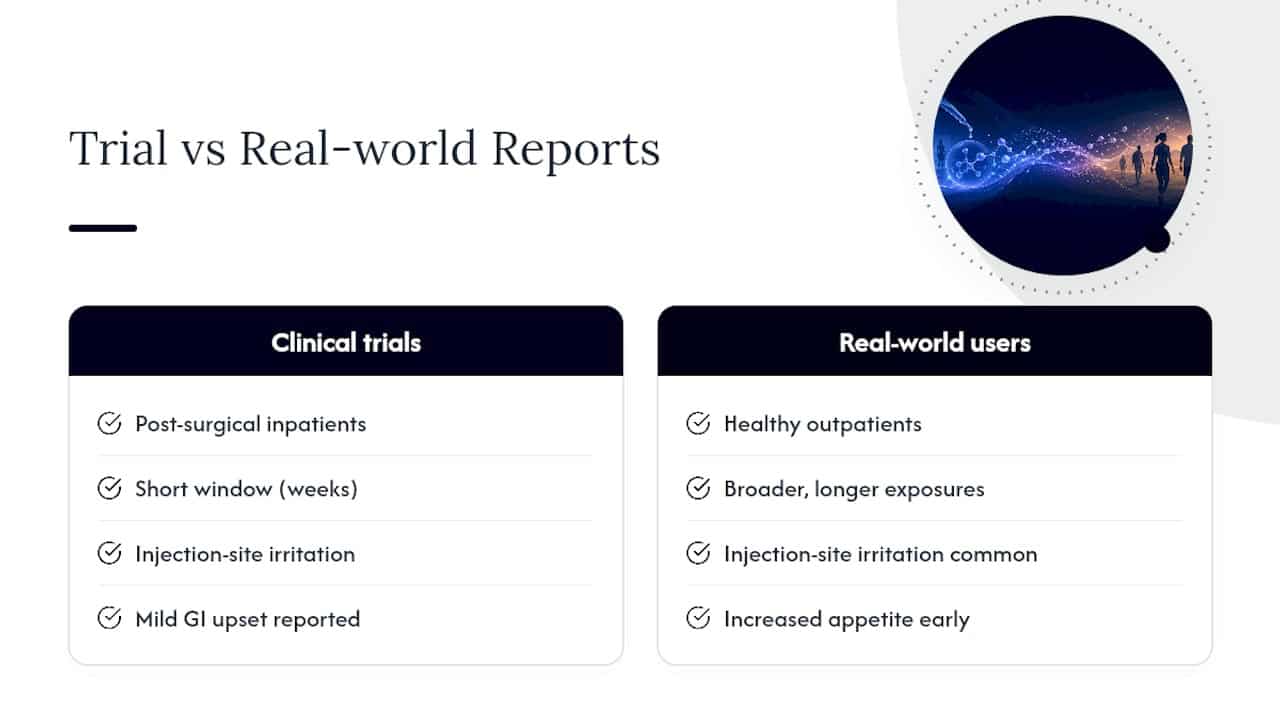
Informal reports from long-term peptide users converge on a few consistent themes that track closely with the trial data, plus a few that trial data doesn’t capture at all. Injection-site irritation and mild gastrointestinal upset, especially early in a protocol, come up most often, echoing the Beck et al. findings. Increased appetite is nearly universal among users, often described as one of the first noticeable effects within the first week.
Sleep improvements are frequently mentioned, more so than in any controlled dataset, likely because the trial population (post-surgical inpatients) wasn’t positioned to report subjective sleep quality in the same way healthy outpatient users do. Water retention and mild joint stiffness show up in longer-term user reports, particularly after several weeks of continuous dosing, aligning with the class-level fluid retention and musculoskeletal concerns noted in secretagogue reviews.
The gap between trial data and real-world reports is instructive rather than contradictory: trials capture a narrow window in a specific population, while user reports capture a broader range of exposures and durations that no controlled study has yet examined. Neither source alone gives a complete picture, and treating anecdotal reports as equivalent to trial evidence, or dismissing them entirely, both miss the point. They’re complementary, and the pattern that emerges when you look at both together is one of generally mild, manageable side effects clustered around the injection site, digestion, and appetite, with fluid retention and glucose shifts as the more serious concerns to track over time.
Does ipamorelin change blood pressure or heart rate?
The clearest cardiovascular signal from trial data is transient tachycardia and flushing shortly after dosing, consistent with an acute vasomotor response rather than a sustained change in cardiovascular function. These effects tend to resolve within an hour and don’t appear to represent a lasting shift in resting heart rate or blood pressure based on available data.
Longer-term cardiovascular effects are far less clear. Growth-hormone axis stimulation can, in theory, contribute to fluid retention, which in turn can modestly raise blood pressure in people who are already borderline hypertensive. This is the same fluid-retention mechanism noted in class-level reviews of growth-hormone secretagogues, and it’s a reasonable basis for monitoring blood pressure periodically rather than assuming ipamorelin is cardio vascularly inert over months of use.
No controlled trial has specifically tracked resting blood pressure or heart rate over an extended outpatient course of ipamorelin, so anyone with pre-existing hypertension, arrhythmia, or other cardiac risk factors should treat this as an open question rather than a settled one. An ECG and periodic blood pressure checks are a sensible precaution for that group, consistent with the monitoring guidance already outlined for higher-risk users.
Publisher perspective: the evidence gap and how to reduce avoidable risk
The honest position is that ipamorelin’s short-term side-effect profile is well enough documented to plan around, but its long-term outpatient safety simply isn’t proven either way. What is controllable is product quality. Purity standards and lot-level testing address the risks you can actually eliminate before they interfere with ongoing clinical care.
— Soma Peptide
Where to review purity and testing information
If sourcing risk is the variable you can actually control, start by reviewing how a peptide is tested before it reaches you. Soma Peptide’s muscle-focused peptide lineup documents formulation purity above 99%, the kind of lot-level transparency that separates a legitimate supplier from a gray-market one selling unverified vials. For readers comparing broader product categories and protocol options, the bodybuilding-focused peptide guide breaks down formulations and testing standards across the catalogue.
Neither page, nor anything in this guide, replaces a conversation with a clinician about whether ipamorelin fits your specific health history. Before you order or dose anything, talk to a doctor who can order baseline labs and watch your glucose and IGF-1 over time. If you’ve done that and you’re ready to compare sourcing options, reviewing a supplier’s purity documentation is the next concrete step.
This article is general information, not a substitute for advice from a qualified doctor. Consult a qualified healthcare professional about your own circumstances before acting on anything here.
Sources
- PubMed: CJC-1295 / ipamorelin trial (Beck et al., Phase II postoperative ileus)
- PMC article summarising GH secretagogue class effects
- Cancer
- NCBI/PMC regulatory and safety discussion
FAQ
What are the dangers of ipamorelin?
The clearest documented dangers are gastrointestinal symptoms (nausea and vomiting), injection-site reactions, and a measurable shift toward high blood glucose shown in the Beck et al. trial. Longer-term risks around IGF-1 and tissue growth remain theoretical and unstudied in humans.
What does ipamorelin do to your body?
Ipamorelin binds the ghrelin receptor to trigger pulsatile growth-hormone release from the pituitary gland, which in turn raises IGF-1 and can produce increased appetite, fluid retention, and short-term glucose changes.
Is ipamorelin a safe peptide?
Short-term controlled data suggest a milder acute side-effect profile than older growth-hormone releasing peptides, but no long-term outpatient safety studies exist, so “safe” can’t be stated without that caveat. Product quality from an unregulated supplier is often a bigger real-world risk than the peptide’s own pharmacology.
Does ipamorelin mess with testosterone?
Ipamorelin doesn’t act directly on the pathways that regulate testosterone production, and no trial data show a direct testosterone effect. Any indirect hormonal shift would more plausibly run through growth hormone and IGF-1 changes rather than a direct testicular or pituitary gonadal effect.