



PT-141 (bremelanotide) typically starts working within 45 to 90 minutes of a subcutaneous injection, with peak effect a few hours after injection. The primary window of noticeable sexual desire and arousal usually lasts several hours, and some people report residual sensitivity lasting up to a day. One hard limit governs all of it: the label allows only one dose per day.
TL;DR:
- The effects of PT-141 start slowly, with physical signs appearing between 30 and 60 minutes and desire peaking around 2 to 4 hours.
- The primary subjective response lasts about four to eight hours, with some residual sensitivity up to 24 hours, especially after initial doses.
- The drug’s plasma half-life is roughly 2.7 hours, but receptor signaling continues longer, explaining effects beyond plasma clearance.
- The approved dose is 1.75 mg injected at least 45 minutes before activity, with a maximum of one dose per day to avoid receptor desensitization.
- Longer intervals between doses (minimum 3 to 4 days) are advisable to prevent tolerance and maintain effectiveness.
Table of Contents
- PT-141 duration of action: the full onset to taper timeline
- Half-life, Tmax and clearance: the PK numbers that explain duration
- Label dosing and safety rules you must know
- How long common side effects last and how to manage them
- How to plan a dose: practical timing anchors and a pre-dose checklist
- Spacing doses, tolerance risk and when to stop or change strategy
- Who should avoid PT-141 and what monitoring to do
- Soma Peptide’s guidance on product quality, reconstitution and administration
- Clinician-minded perspective: realistic expectations and how to talk with your prescriber
- Where to find high-purity peptides and ancillaries at Soma Peptide
- Sources
- FAQ
PT-141 duration of action: the full onset to taper timeline
The clock on PT-141 duration starts the moment the needle comes out, but it doesn’t start fast. Bremelanotide must move from the injection site into circulation, cross into the central nervous system, and activate melanocortin receptors in the hypothalamus before you feel anything resembling desire. That’s a different job than a drug that acts locally or peripherally, and it explains why PT-141 effects duration feels more like a slow tide than a light switch.
Subcutaneous injection is the approved route, and most users report the earliest physical signs (flushing, a warm feeling across the face and chest) somewhere between 30 and 60 minutes post-injection. The subjective sense of desire tends to lag slightly behind, often becoming noticeable in the 45 to 90 minute range and building toward a peak around hour 2 to hour 4.
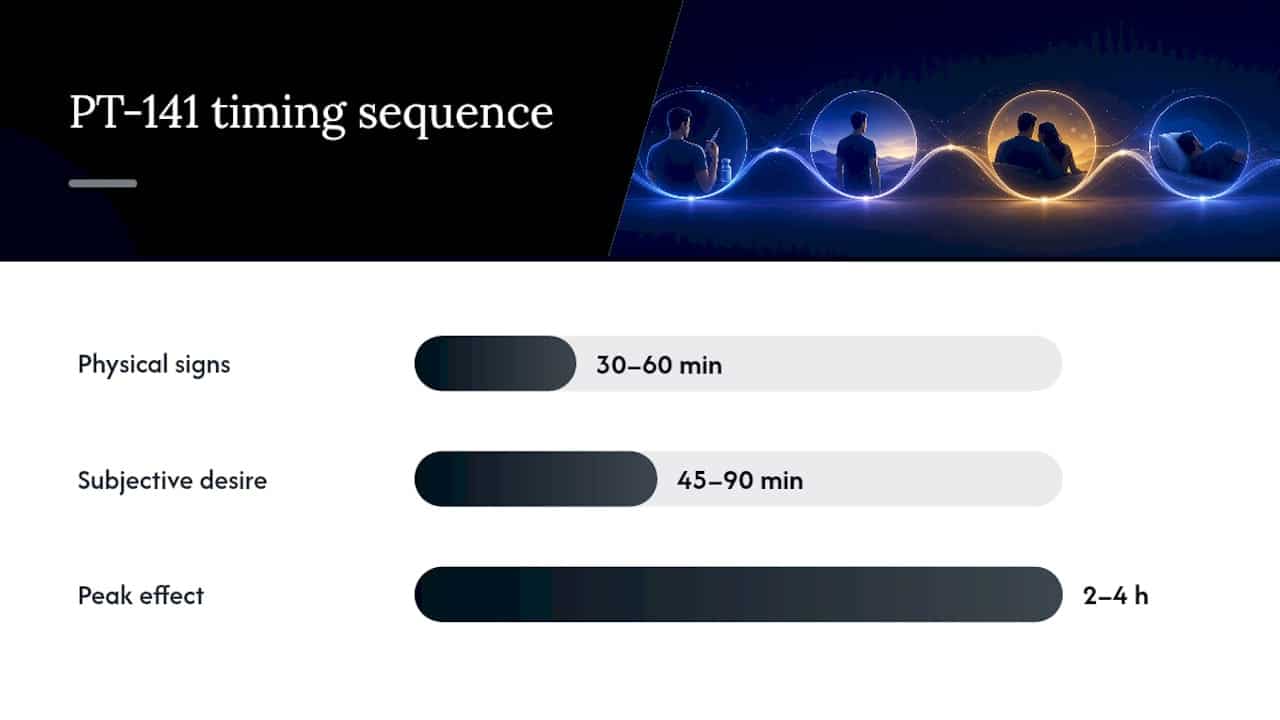
That lag matters clinically. Plasma concentration peaks fast, but the feeling doesn’t peak with it. Melanocortin receptor activation triggers downstream signalling in hypothalamic circuits that continues working after the drug itself has started clearing from the bloodstream, so subjective arousal outlasts the plasma curve by a wide margin.
From there, the primary effect window typically runs 4 to 8 hours, according to clinical and pharmacokinetic reviews on onset and duration. Some users, especially on a first dose or at the full 1.75 mg amount, report a lower-grade residual effect (heightened sensitivity, mild background arousal) for up to 24 hours after that.
A few real-world timing patterns show how this plays out:
- Evening planning: inject in the early evening for an effect window that spans dinner through the night, rather than dosing right before bed.
- Short-notice situations: the 45 to 90 minute onset means PT-141 is not a same-hour option, unlike some other approaches to sexual response.
- Variable partner timing: because peak effect and taper are gradual rather than sharp, a wider window of opportunity exists compared to fast-acting oral options.
- First-time dosing: expect a longer tail of residual effects than subsequent doses, since baseline receptor sensitivity and individual metabolism are still unknown quantities.
Individual variability here is real. Body composition, injection technique, and even stress levels on the day can shift onset by 15 to 30 minutes in either direction. That’s why label guidance builds in a conservative buffer rather than a razor-thin timing window.
Half-life, Tmax and clearance: the PK numbers that explain duration
The number that actually explains PT-141 duration of action is the terminal half-life: approximately 2.7 hours after subcutaneous injection, with peak plasma concentration (Tmax) reached around 60 to 90 minutes, according to integrated clinical evidence on bremelanotide.
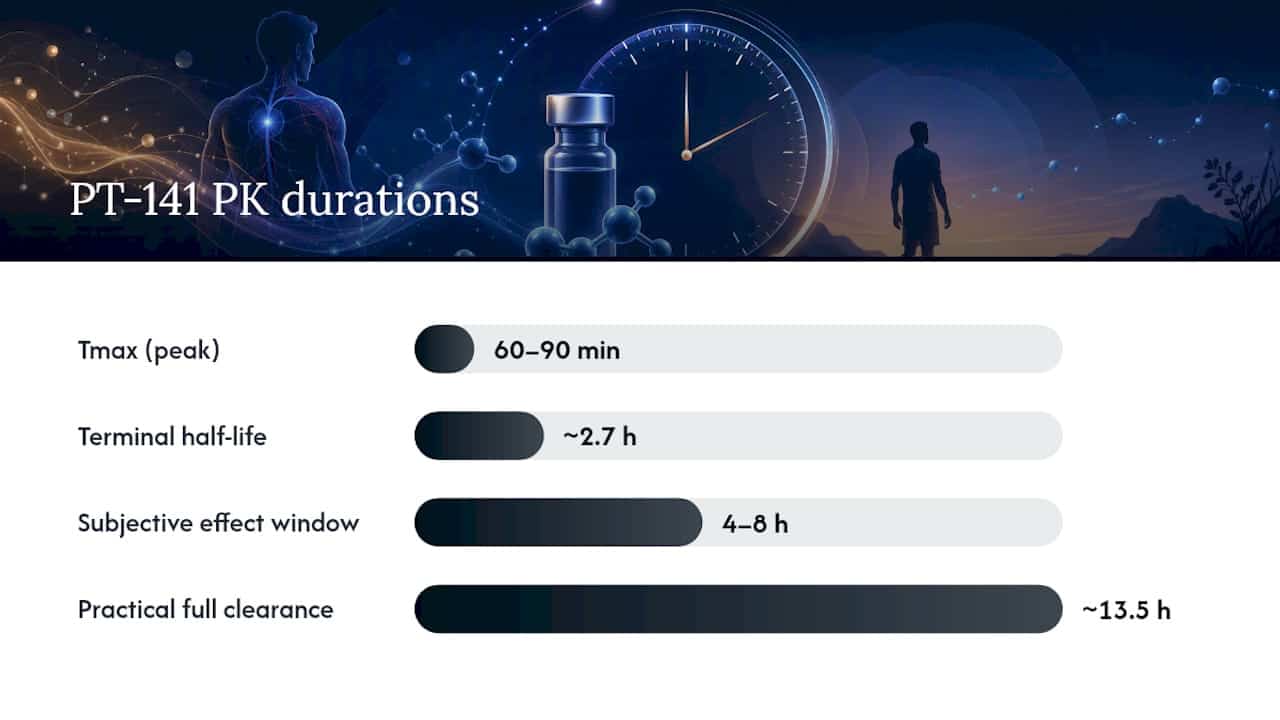
Half-life math gives you the clearance timeline. Five half-lives is the standard benchmark for near-complete elimination from plasma, which puts full clearance at roughly 13.5 hours after a single dose, a figure confirmed in pharmacokinetic guides tracking bremelanotide’s elimination curve. That’s the pharmacological basis for the label’s once-per-24-hour cap: by the time a second dose would be permitted, the first is essentially gone from the bloodstream.
Here’s where it gets counterintuitive. If plasma bremelanotide is nearly cleared by hour 13.5, why do people report effects lasting 8 hours and residual sensitivity up to 24? The answer is PK/PD dissociation, a gap between how fast a drug leaves the blood and how long its downstream effects persist. Melanocortin receptor activation sets off a signalling cascade in the hypothalamus that keeps running well after the triggering molecule has been metabolized. Plasma half-life measures the drug. It doesn’t measure the biology the drug switched on.
| PK parameter | Approximate value | What it explains |
|---|---|---|
| Tmax (time to peak plasma concentration) | 60–90 minutes | Why physical signs like flushing show up before hour 2 |
| Terminal half-life | ~2.7 hours | The rate at which the drug leaves circulation |
| Practical full clearance (5 half-lives) | ~13.5 hours | Why the label allows only one dose per 24 hours |
| Primary subjective effect window | 4–8 hours | The gap between plasma clearance and felt duration (PK/PD dissociation) |
Dose and individual biology both shift these numbers slightly. Higher doses generally extend the tail of the effect curve, and factors like injection site, subcutaneous fat thickness, and metabolic rate all influence how quickly the drug is absorbed in the first place. None of that changes the underlying PK/PD gap, though. It just moves the timeline by a fraction of an hour in either direction.
Label dosing and safety rules you must know
The FDA-approved prescribing information for Vyleesi (bremelanotide) sets out a specific, narrow regimen, and it’s worth knowing exactly what it says before assuming any dose or timing is safe by default.
The core rules, straight from DailyMed’s Vyleesi prescribing information:
- Dose and route: the labeled dose delivered by subcutaneous autoinjector, typically in the abdomen or thigh.
- Timing: inject at least 45 minutes before anticipated sexual activity, as recommended by the label.
- Frequency cap: a maximum of one dose per day.
- Monthly guidance: the label notes limits on cumulative monthly use, reflecting clinical trial data on efficacy and safety.
- Approved population: premenopausal women with hypoactive sexual desire disorder (HSDD), based on the RECONNECT phase 3 programme.
That last point deserves attention because so much of the discussion around PT-141 usage guidelines happens outside its approved indication. The RECONNECT trials enrolled premenopausal women with HSDD and measured desire-related endpoints against placebo, which is the population the dosing and safety profile was actually built around. Off-label use in other populations, including men seeking libido or erectile support, happens in practice, but it happens without the same clinical trial safety net, and dosing decisions in that context should go through a clinician who understands the cardiovascular and blood-pressure considerations involved.
The 45-minute minimum isn’t a rounded-up marketing number. It reflects the onset data covered earlier: the drug needs time to reach the CNS and trigger receptor activation before any physical effect is a reasonable expectation. Injecting closer to activity than that just wastes the dose against a body that hasn’t caught up yet.
How long common side effects last and how to manage them
Side effect timing generally mirrors the drug’s own action curve, and knowing what’s normal versus what needs medical attention makes a real difference in how confidently someone can use PT-141.
Nausea is the most frequently reported adverse effect in clinical trials, and Mayo Clinic’s summary of bremelanotide’s side effect profile notes it affects roughly 40% of users at the approved dose. It tends to appear within the first hour or two post-injection, often coinciding with the rising plasma curve, and usually resolves within a few hours without intervention. Prophylactic antiemetics are sometimes used by clinicians managing repeat dosing, though they’re not part of the standard label regimen and should be a discussion with a prescriber rather than a self-directed workaround.
Flushing and a warm, sometimes reddish sensation across the face, neck, and chest are common and tend to track closely with the onset window, typically resolving within 3 to 4 hours as plasma levels decline.
Transient blood pressure elevation is the one that demands the most caution. It typically peaks a few hours after dosing and returns to baseline as the drug clears, but the magnitude of the rise is exactly why cardiac and hypertensive patients need a different risk conversation than a generally healthy user.
Other reported effects and their rough timelines:
- Injection-site reactions (redness, mild swelling): usually resolve within a day.
- Headache: often overlaps with the primary effect window and fades as the drug clears.
- Skin hyperpigmentation (less common, tied to melanocortin receptor activity elsewhere in the body): can take weeks to fade if it occurs, unlike the acute effects above.
Pro Tip: Track your first dose on a day with zero obligations for the following 24 hours. It’s the easiest way to learn your personal side-effect timeline before you ever need to plan around it.
How to plan a dose: practical timing anchors and a pre-dose checklist
Treat PT-141 as something you schedule, not something you reach for in the moment. That single mental shift solves most of the timing frustration people run into.
The conservative, evidence-aligned anchor is to inject 60 to 90 minutes before anticipated activity. This builds in a buffer beyond the label’s 45 minute minimum and accounts for individual variability in absorption. Experienced users who have already mapped their personal onset curve across a few doses sometimes shift closer to the 45 to 60 minute range, but that’s a refinement earned through repeated use, not a starting point.
A simple approach for a first dose or a new routine:
- Pick a low-pressure window. Choose an evening with no hard deadline afterward, since onset and peak effect are gradual rather than instant.
- Prepare supplies in advance. Have the autoinjector, alcohol swab, and a clean injection site ready before the clock starts, so nothing delays the actual dosing time.
- Inject 60 to 90 minutes ahead. Set a mental or literal timer rather than guessing.
- Note food, stress, and sleep that day. All three influence absorption speed and can shift your personal onset window by 15 to 30 minutes.
- Monitor and log the response. Write down when flushing started, when desire became noticeable, and when it faded. That log becomes your personal PT-141 peak effectiveness map for future doses.
Injection technique matters more than most people expect. A rushed, shallow injection into scar tissue or a poorly rotated site can slow absorption and blur the timing you’re trying to nail down.
Spacing doses, tolerance risk and when to stop or change strategy
The label sets a hard ceiling of one dose per 24 hours, but the practical spacing question that actually matters for long-term use is how many days apart doses should sit to avoid diminishing returns.
Many clinicians advise spacing doses at least 3 to 4 days apart rather than using PT-141 back to back on consecutive available days, even though the label technically permits daily dosing. The rationale is receptor desensitization: melanocortin receptors, like many G-protein coupled receptors, can down-regulate their sensitivity with frequent, repeated activation. Use it too often and the same 1.75 mg dose that worked reliably at first starts producing a weaker response, which pushes some users toward dose escalation that isn’t part of the approved regimen and carries its own side-effect tradeoffs.
Signs worth paying attention to:
- A noticeably shorter or weaker effect window compared to your first few doses.
- Needing to dose more frequently to get the same subjective result.
- Side effects intensifying rather than fading as tolerance to the desired effect builds.
If any of that shows up, the right move is a pause, not a bigger dose. Stepping back for a couple of weeks, reassessing with a clinician, and returning to a wider spacing interval is the standard way to reset receptor sensitivity rather than chasing the same effect with escalating amounts.
Who should avoid PT-141 and what monitoring to do
Bremelanotide carries clear exclusions that anyone considering it needs to take seriously before the first dose, not after.
- Uncontrolled hypertension or cardiovascular disease: the label lists these as contraindications, tied directly to the transient blood pressure elevation the drug causes in nearly everyone who uses it.
- Baseline blood pressure check: getting a reading before the first dose gives you and your clinician an actual comparison point if anything feels off afterward.
- First-dose observation: using the first dose in a setting where you can monitor how you respond, rather than immediately before an important commitment, is the safer approach.
- Emergency signs: severe headache, chest pain, or a blood pressure spike that doesn’t settle within a few hours warrants immediate medical attention, not a wait-and-see approach.
- Medication and substance review: discuss any blood pressure medications, other libido-related compounds, or recreational substance use with a clinician before combining anything with bremelanotide.
Soma Peptide’s guidance on product quality, reconstitution and administration
Everything in this article assumes the dose you’re injecting is actually 1.75 mg of bremelanotide and nothing else. That assumption only holds if the product itself is reliable, and purity is where a lot of the “my timing was off” reports actually originate.
A batch with unpredictable actual concentration makes every timing anchor in this article a guess rather than a plan.
Administration technique also drives a meaningful share of onset variability. Consistent injection site rotation, proper reconstitution technique, and correct subcutaneous depth all reduce the odds of a slow or uneven absorption curve. For a deeper look at half-life concepts applied to another common peptide, Soma Peptide’s guide on BPC-157 half-life walks through the same clearance math from a different angle, and the PT-141 side effects resource covers dose-related tolerability in more depth than fits here.
Clinician-minded perspective: realistic expectations and how to talk with your prescriber
The biggest misconception about PT-141 duration is treating it like a fast-acting pill. It isn’t. It’s an event-planning drug, built around a 45 to 90 minute lead time and a multi-hour window, not a same-hour fix.
Most clinicians start at the standard 1.75 mg dose and hold there for several cycles before considering any change, since escalating too fast obscures whether the timing or the dose was ever the actual issue. Anyone with hypertension, cardiac history, or unclear blood pressure control should get screened before a first dose, not after a concerning reaction.
— Soma Peptide
Where to find high-purity peptides and ancillaries at Soma Peptide
Getting the timing right starts with knowing exactly what’s in the vial.
Beyond the peptide itself, Soma Peptide also carries the ancillaries that affect how cleanly a dose gets administered, including bacteriostatic water for reconstitution and sterile syringes for consistent, accurate injection. Sloppy reconstitution is one of the more overlooked reasons two doses from the “same” product can feel different.
Browse the current catalogue and lab documentation at Soma Peptide before your next order, and talk to your clinician about your cardiovascular history and current medications before starting or adjusting any dose.
This article is general information, not a substitute for advice from a qualified doctor. Consult a qualified healthcare professional about your own circumstances before acting on anything here.
Sources
- Diamond LE et al., studies on bremelanotide; integrated clinical evidence (PMC5384512)
- DailyMed: VYLEESI prescribing information
- Mayo Clinic: Bremelanotide (subcutaneous route) — side effects & dosage
- PT-141 (Bremelanotide) Half-Life: ~2.7 Hours | PK Guide (HalfLife Labs)
FAQ
Can I take PT-141 two days in a row?
The label technically permits one dose every 24 hours, but many clinicians recommend spacing doses at least 3 to 4 days apart to avoid receptor desensitization and a weakening response over time.
Is PT-141 better than Viagra?
They work through different mechanisms entirely: PT-141 acts on melanocortin receptors in the brain to affect desire, while Viagra works peripherally on blood flow, so “better” depends on whether the underlying issue is desire-related or vascular, a distinction worth discussing with a clinician rather than assuming.
Can you microdose PT-141?
Doses below the labelled 1.75 mg are used by some people seeking fewer side effects, but there’s no clinical trial data behind a specific lower dose, so any adjustment outside the approved regimen should happen under medical supervision.
How long does flushing from PT-141 last?
Flushing typically starts within an hour of injection and resolves within 3 to 4 hours as plasma levels decline, tracking closely with the drug’s overall onset and peak window.