


The CJC-1295 and ipamorelin stack reliably raises growth hormone and IGF-1, and that shift shows up on bloodwork before it shows up in the mirror. Most people notice better sleep and faster recovery within one to two weeks. Visible body-composition changes typically take several weeks or longer, and they lean heavily on training and diet. Lab monitoring of IGF-1, ideally under medical supervision, is the only way to confirm that the stack is actually doing something.
TL;DR:
- Bloodwork showing IGF-1 levels peak between six to eleven days after dosing, with a sustained effect lasting up to two weeks for CJC-1295 with DAC.
- Early improvements in sleep, dreams, and reduced joint stiffness typically occur within the first two weeks, but visible body changes require consistent training and diet over several weeks.
- Modest fat loss and muscle fullness may emerge from six weeks onward, but significant physique changes are usually the result of combined effort, not peptides alone.
- Protocols vary significantly based on whether CJC-1295 with DAC or without DAC is used, with the former requiring less frequent injections due to longer half-life.
- Verifying efficacy relies on objective blood tests for IGF-1 and consistent tracking of strength, photos, and measurements over months, not relying solely on subjective feelings.
Table of Contents
- What does the CJC-1295 ipamorelin timeline actually look like?
- Why does GH and IGF-1 rise while physique evidence stays thin?
- What are typical CJC-1295 dosing patterns and protocol timing?
- What side effects and monitoring should you expect?
- How can you tell if the peptides are actually working?
- What happens to results after you stop the peptides?
- Soma Peptide’s evidence and resources for verifying your results
- The gap between the hype and the bloodwork
- How to get started with a supervised protocol
- Sources
- FAQ
What does the CJC-1295 ipamorelin timeline actually look like?
Most of what circulates online about cjc 1295 ipamorelin results comes from forum posts and Instagram transformation photos, not controlled research. That does not mean the pattern is fake. It means the sequence is fairly consistent across reported experiences, even if the size of the effect varies a lot from person to person. Clinic blogs and community write-ups converge on a similar order of events: sleep first, recovery second, composition last, a pattern echoed in week-by-week reporting from practitioner sources.
Here is the realistic breakdown, stage by stage.
1. Weeks 1 to 2: sleep and early recovery signals
This is where almost everyone who sticks with the protocol reports something happening. Deeper sleep, more vivid dreams, and waking up less groggy are the three most common early notes. Some people also describe a subtle drop in joint stiffness after training.
None of this is measurable on a bathroom scale or a tape measure. It is subjective, self-reported, and easy to talk yourself into feeling. That is worth sitting with before you get excited: expectation bias is real, and two weeks into any new protocol, plenty of people report improvement regardless of what is actually happening biologically. What is unlikely in this window is any visible change in muscle fullness, waistline, or strength numbers. If someone claims dramatic fat loss or visible muscle gain by day 10, be skeptical.
2. Weeks 3 to 4: energy stabilizes, soreness drops
By the third week, the initial adjustment period (some people report mild water retention or a “puffy” feeling in week one) tends to settle. Energy during training sessions becomes more consistent, and post-workout soreness often fades faster than it used to.
This is also when small strength or pump improvements start showing up, but only for people who are training with any consistency. The peptide stack is not doing this alone. Growth hormone and IGF-1 support recovery capacity, which lets you train harder and more often, and that training is what eventually drives visible change. Skip the gym for four weeks and you will not see this phase, no matter how well the injections are timed.
3. Weeks 6 to 12: the composition window opens, slowly
This is the stretch where people start posting cjc ipamorelin before and after comparisons, and it is also where the most exaggeration creeps in. Modest fat loss and improved muscle fullness are realistic outcomes here, particularly around the midsection and in muscle definition under the skin. Skin quality (a slight improvement in texture or firmness) gets mentioned often enough in community reports to be worth noting, though it is not something you can put a number on.
The honest caveat: “modest” is the operative word. This is not a body transformation drug. It is a recovery and hormone-support tool that, paired with a genuine training and nutrition plan, can nudge composition in the right direction over a few months. People who see bigger changes in this window are almost always the same people who tightened their diet and increased training volume at the same time they started the peptides.
4. Months 3 to 6 and beyond: gradual, and easy to overstate
Longer-term users describe continued, incremental improvements in body composition, but the curve flattens. The dramatic “after” photos that circulate on forums after four or five months are almost always the outliers people chose to post, not the median experience. Selection bias runs deep in this community: nobody posts the unremarkable outcome.
How to separate signal from story
A few practical checks help cut through the noise:
- Track strength numbers on your main lifts, not just how you feel in the gym.
- Use the same lighting, pose, and time of day for progress photos, every single time.
- If you have access to a DEXA scan, use it, but treat any single scan cautiously. Hydration status and even the time since your last meal can shift body-fat percentage readings by a percentage point or two.
- Waist and hip tape measurements are useful trend data over months, not a week-to-week scoreboard.
- Log training volume and sleep hours alongside your peptide log so you can tell what is actually driving change.
For a broader look at how these effects are documented and where expectations tend to run ahead of evidence, Soma Peptide’s overview of CJC-1295 results walks through what a realistic outcome curve looks like.
Why does GH and IGF-1 rise while physique evidence stays thin?
CJC-1295 and ipamorelin work on the same hormonal pathway from two different angles. CJC-1295 is a growth-hormone-releasing hormone (GHRH) analogue. It tells the pituitary gland to release growth hormone and, in its DAC form, does this on a sustained basis because it binds to albumin in the blood and stays active far longer than a typical peptide. Ipamorelin is a different class entirely: a selective growth-hormone secretagogue that triggers a GH pulse through the ghrelin receptor pathway, and it does this with minimal impact on cortisol or prolactin, according to the National Cancer Institute’s drug dictionary. That selectivity is a big part of why ipamorelin is preferred over older GH secretagogues, which tended to spike appetite and cortisol along with growth hormone.
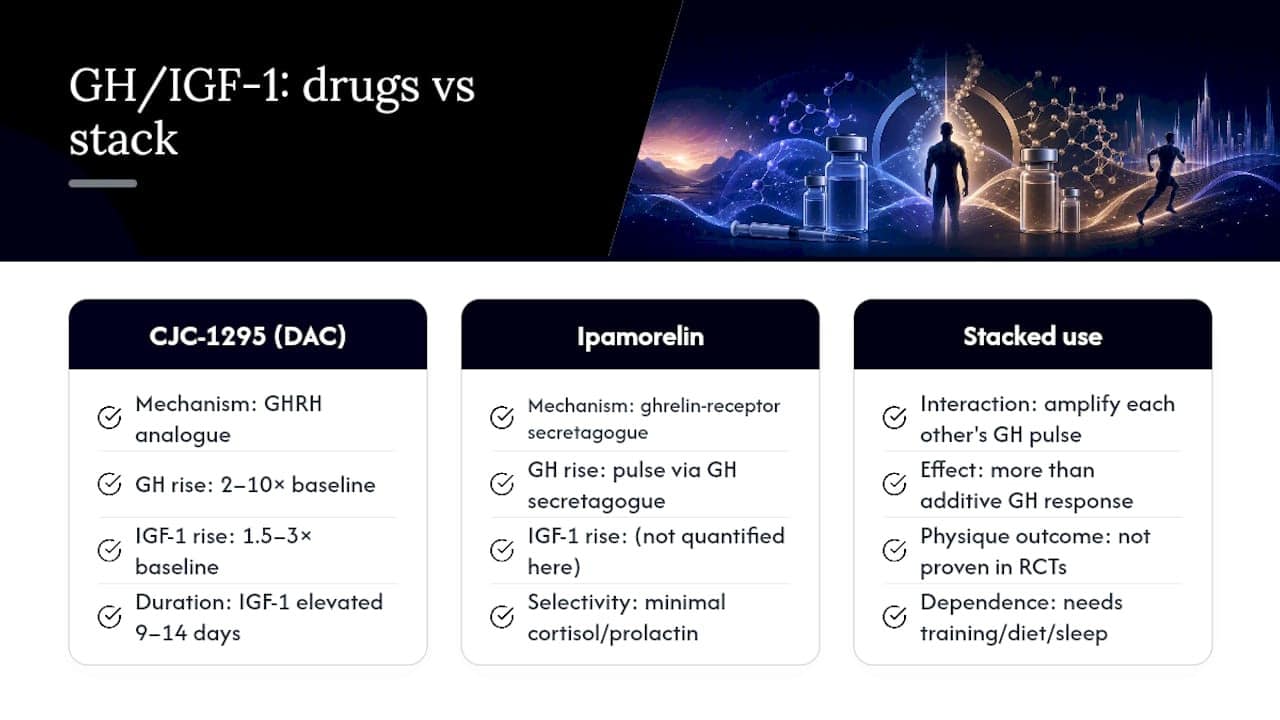
Stacked together, the two peptides amplify each other’s GH pulse rather than simply adding two small effects.
The clinical data on this mechanism is more solid than most of what circulates about dosing. A randomized, double-blind trial published in the Journal of Clinical Endocrinology and Metabolism gave healthy adults single doses of CJC-1295 (DAC) and tracked the hormonal response. GH rose two to ten times baseline for roughly six days, and IGF-1 rose 1.5 to 3 times baseline and stayed elevated for 9 to 11 days, with mean elevation lasting up to 14 days after a single injection. The compound’s half-life measured between 5.8 and 8.1 days, according to the pharmacokinetic data from Teichman et al.. That is an unusually long window for a peptide, supporting why DAC-based protocols are typically run on a weekly schedule rather than daily.
The biomarker response to CJC-1295 is genuinely well-documented in controlled research. What is not documented, at least not in large controlled trials on healthy adults, is how much of that hormonal shift translates into measurable muscle growth or fat loss on its own. Reviews of GH-axis secretagogues consistently flag this gap between reliable biomarker movement and demonstrated physique outcomes.
That distinction between what a blood test shows and what a mirror shows is not a technicality. GH and IGF-1 elevation is real, reproducible, and specific to this drug class. But translating that hormonal signal into visible muscle or fat-loss outcomes depends on variables the injections cannot control: training stimulus, caloric intake, protein timing, sleep quality, and age. Reviews of the broader GH secretagogue literature note there is no large randomized controlled trial isolating CJC-1295 plus ipamorelin’s physique effects independent of diet and resistance training in healthy adults. Anyone promising a specific number, like “5 pounds of muscle in six weeks,” is quoting anecdote dressed up as certainty.
What are typical CJC-1295 dosing patterns and protocol timing?
The single biggest variable that changes what kind of results (and what kind of timeline) you should expect is which version of CJC-1295 you’re using. This is where a lot of confusion in online CJC 1295 experiences comes from, because people compare notes without realizing they were running completely different compounds.
DAC vs. no-DAC: why the half-life gap matters
CJC-1295 with DAC (Drug Affinity Complex) binds to albumin in the bloodstream, giving it a multi-day half-life. A once or twice-weekly injection schedule is common with DAC because the compound remains active for several days after administration.
CJC-1295 without DAC, often labelled Mod GRF 1-29, is a completely different animal pharmacokinetically. That means it needs to be dosed multiple times per day, typically timed around sleep and training, to produce a similar cumulative GH-pulsing effect. A guide to CJC-1295 without DAC covers why frequent dosing is non-negotiable with this variant.
The table below lays out how the two variants are commonly discussed in clinic and community protocols. These are not official medical dosing standards. They reflect patterns reported across clinics and online peptide communities, and they should be treated as a starting reference point for a conversation with a licensed provider, not a prescription.
Timing rationale: why fasted and pre-bed dosing show up so often
Two timing habits come up repeatedly in clinic protocols and practitioner guidance, and both have a straightforward physiological reason behind them.
- Injecting in a fasted state, or at least two hours after a meal, avoids the insulin spike that follows eating, since elevated insulin can blunt the GH pulse the peptides are trying to trigger.
- Pre-bed dosing lines up with the body’s natural nighttime GH release, which is already the largest pulse of the day, so the peptide’s effect stacks on top of a window that is already primed for it.
None of these timing conventions come from a large randomized trial testing injection timing against outcomes. They are extrapolated from what is known about insulin’s effect on GH release and from patterns clinics have observed over years of use. That is a meaningfully different evidence tier than the pharmacokinetic data on CJC-1295 itself, and it is another reason working with a licensed provider who can adjust protocol based on your bloodwork matters more than following a forum-sourced schedule to the letter. Anyone researching CJC-1295 dosage should treat community numbers as a reference point, not gospel.
What side effects and monitoring should you expect?
The side-effect profile for this stack is generally mild relative to many hormonal interventions, but “mild” does not mean “ignore it.” Watch for these more commonly reported CJC-1295 side effects and ipamorelin effects:
- Water retention, especially in the first one to two weeks, often described as facial puffiness or slightly swollen hands.
- Mild flushing or warmth in the face shortly after injection.
- Injection-site redness or a small welt that resolves within a day.
- Changes in glucose regulation, since growth hormone counteracts insulin’s effect to some degree, which matters most for anyone already managing blood sugar.
- Rare but reported headaches or mild dizziness in the hours following a dose.
Statistic in focus: IGF-1 levels can stay measurably elevated for up to 14 days after a single dose of CJC-1295 (DAC), based on controlled pharmacokinetic data. That window is exactly why testing too early, or too late, gives a misleading picture of whether your dosing schedule is actually working.
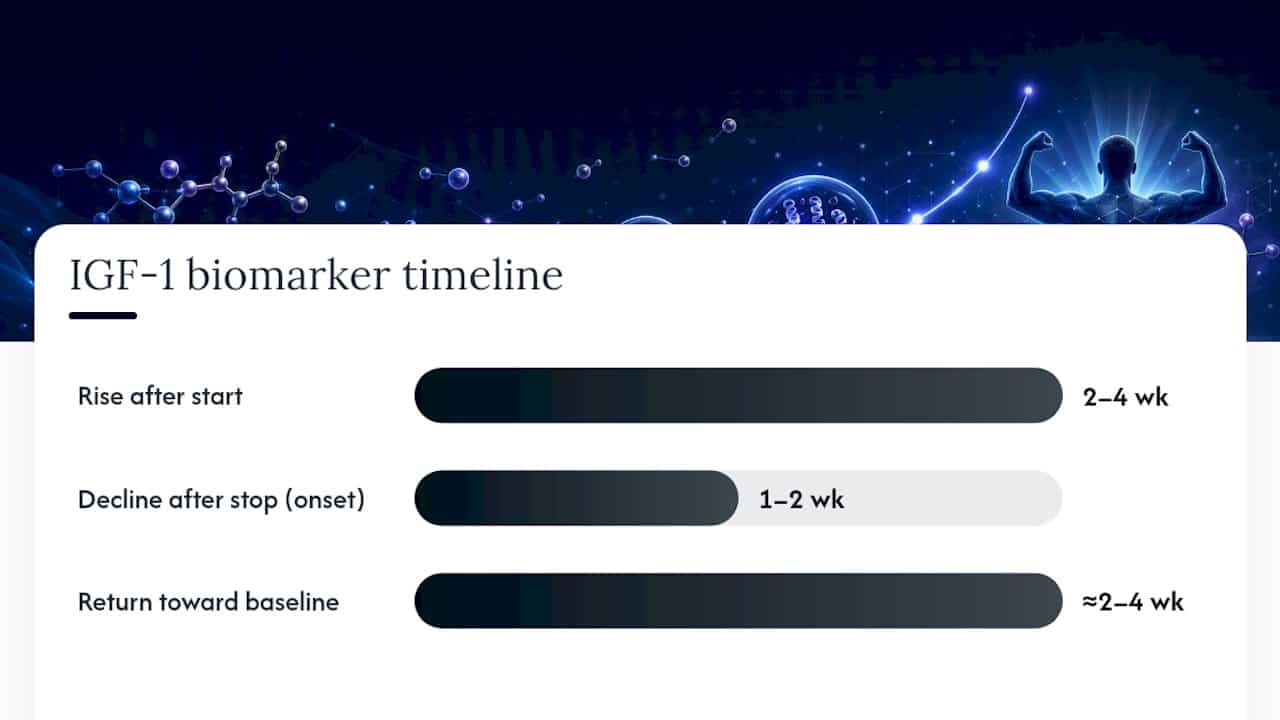
Baseline testing matters more than most first-time users realize. Get an IGF-1 test before you start, then retest at roughly two to four weeks in to confirm your body is responding the way the pharmacokinetic data suggests it should. Clinical guidance on endocrine therapy monitoring consistently points to IGF-1 as the objective marker for confirming GH-axis stimulation, precisely because subjective feelings of “it’s working” are unreliable on their own.
A few groups need to be more cautious than the general population, and this is not a place to guess. Anyone with uncontrolled diabetes, a history of hormone-sensitive cancers, or active cancer risk factors should discuss GH-axis stimulation with a physician before starting, since elevated GH and IGF-1 signalling touches cell growth pathways that matter in those conditions. Off-label peptide use of this kind lacks standardized clinical dosing protocols, and clinic-based evidence reviews routinely stress medical supervision for exactly this reason. If you’re weighing this stack for weight management specifically, A page on CJC-1295 for weight loss covers the clinical data on that particular use case in more depth.
How can you tell if the peptides are actually working?
The honest answer is that feeling different and measuring different are two separate questions, and you need both to know what is really happening.
Set up a simple tracking cadence before you start, not after you’re three weeks in and wondering. Get baseline bloodwork, including IGF-1, before your first dose. Retest IGF-1 at roughly two to four weeks; that window lines up with the pharmacokinetic pattern where a clear biochemical response should already be visible if the protocol is doing its job. Push composition tracking, photos, tape measurements, or a DEXA scan if you have access, out to the six to twelve week mark, since that is the earliest realistic window for visible change.
A few notes on the objective measures themselves:
- Strength progression logs on your main lifts are one of the most reliable, cheapest tracking tools you have. If your working weights are climbing steadily, recovery capacity is improving, whatever the cause.
- DEXA scans are the gold standard for body composition, but a single scan proves nothing. Hydration, recent meals, and even the scan’s own margin of error can shift readings. Use it for trend data across two or three scans spaced months apart, not a single snapshot.
- Tape measurements and photos need identical conditions every time: same time of day, same lighting, same pose, same state of hydration.
Pro Tip: Take your peptide dose in a fasted state, at least two hours removed from your last meal, especially if you’re dosing before bed. Insulin release after eating can blunt the GH pulse the peptides are meant to trigger, so a well-timed dose on an empty stomach gets more out of the same vial.
What happens to results after you stop the peptides?
IGF-1 does not stay elevated forever once you stop dosing. Based on CJC-1295’s pharmacokinetic profile, expect levels to begin declining within roughly one to two weeks of your last dose and to return toward baseline within a similar window to how long they took to rise.
Subjective benefits, sleep quality and recovery speed, tend to fade faster than any composition changes you’ve built up. That is an important distinction: the hormone spike is temporary, but a few pounds of muscle gained through eight weeks of better-recovered training sessions will not disappear the day you stop injecting.
Practical steps for coming off the protocol:
- Retest IGF-1 around three to four weeks after your last dose to confirm levels have normalized, particularly if you plan to cycle back on later.
- Expect sleep quality and recovery speed to drift back toward your pre-protocol baseline within the same few weeks.
- Whatever training and diet habits you built during the protocol are what determine whether composition gains stick around. The peptides do not lock anything in permanently.
Soma Peptide’s evidence and resources for verifying your results
Soma Peptide’s peptides are manufactured to documented purity levels above 99%, verified through third-party testing, which matters directly here: a contaminated or underdosed peptide will not produce the GH and IGF-1 response the research above describes, no matter how carefully you time your injections. If your bloodwork isn’t moving the way the pharmacokinetic data suggests it should, purity and dosing accuracy are two of the first things worth ruling out.
A few resources worth working through if you’re trying to interpret your own IGF-1 numbers or timeline against what’s typical:
- A breakdown of CJC-1295 benefits separates documented biomarker research from anecdotal physique claims.
- An ipamorelin bodybuilding guide covers how training and nutrition interact with the peptide’s recovery effects.
- A CJC-1295 results page walks through realistic expectation-setting for new users.
None of this replaces a conversation with a licensed medical provider. Soma Peptide presents its products as one supported option within a category that still requires informed, supervised use, and every recommendation in this article assumes you’re running bloodwork and working with a provider who can interpret it.
The gap between the hype and the bloodwork
Most of the disappointment people report with this stack comes from timeline mismatch, not a failed protocol. They expected a six-week body transformation and got a six-week improvement in sleep and recovery instead, then assumed nothing was happening. The biomarker data says otherwise; it just doesn’t photograph well.
Before-and-after content on forums and social media is a selection-biased sample. Nobody posts the unremarkable outcome, and dramatic photos tend to come from people who also overhauled their training and diet at the same time, then credited the peptides for the whole result. That doesn’t make the stack fake. It makes the hype around it disconnected from what controlled pharmacokinetic data actually supports.
The people who get the most consistent, verifiable results are the ones running lab work alongside the protocol, not the ones chasing someone else’s transformation photo. Measure what you can measure. Let the rest happen on its own timeline.
— Soma Peptide
How to get started with a supervised protocol
If you’re weighing whether this stack fits your goals, the practical next step is straightforward: get your baseline bloodwork done first, verify the certificate of analysis on whatever peptide you’re considering, and work with a licensed provider who can adjust your protocol based on your actual IGF-1 response rather than a generic forum schedule. Soma Peptide’s peptides for muscle category page documents purity testing above 99% for its GH-axis compounds, which addresses one of the most common causes of a “why isn’t this working” experience: an underdosed or contaminated product that never produces the biomarker response the research describes.
Recovery quality often depends on more than the peptide protocol itself. If sleep is part of what you’re tracking, pairing your regimen with an evidence-based sleep-support routine can help you separate a genuine peptide-driven improvement from a placebo effect.
Beyond muscle-focused compounds, Soma Peptide’s best peptides for muscle growth guide breaks down how this stack compares to other GH-axis and recovery-focused options, in case a different protocol fits your goals better. Whatever you choose, start with labs, not guesswork about how you feel in week one.
This article is general information, not a substitute for advice from a qualified doctor. Consult a qualified healthcare professional about your own circumstances before acting on anything here.
Sources
- PubMed — Teichman et al., J Clin Endocrinol Metab (CJC‑1295 pharmacokinetics/pharmacodynamics)
- National Cancer Institute drug dictionary — ipamorelin
- NCBI PMC — review articles on GH secretagogues and translational evidence
- NCBI Bookshelf — endocrine therapy monitoring
FAQ
How long does it take for CJC-1295 and ipamorelin to work?
Subjective effects like sleep quality and recovery speed often show up within one to two weeks. Measurable IGF-1 changes are confirmable by bloodwork within two to four weeks, and visible body-composition changes typically take six weeks or longer.
How do I know if CJC-1295 and ipamorelin are working?
The only objective confirmation is bloodwork: a follow-up IGF-1 test at two to four weeks should show elevation compared to baseline if the protocol is working as expected. Subjective signs like better sleep and less soreness are a reasonable early signal but not proof on their own.
Does CJC-1295 and ipamorelin make you stronger?
Indirectly, yes, though not through a direct strength-building mechanism. Better recovery and sleep let you train harder and more consistently, and that increased training capacity is what drives strength gains over weeks and months.
How long will 5 mg of CJC-1295 with ipamorelin last?
That depends entirely on dosing frequency and the CJC-1295 variant used, since DAC and non-DAC forms have vastly different half-lives; a single DAC dose can influence IGF-1 for up to 14 days, while non-DAC clears within minutes and needs redosing multiple times daily. Total supply duration is a math problem based on your specific protocol, not a fixed number, so calculate it against your provider’s prescribed schedule.