


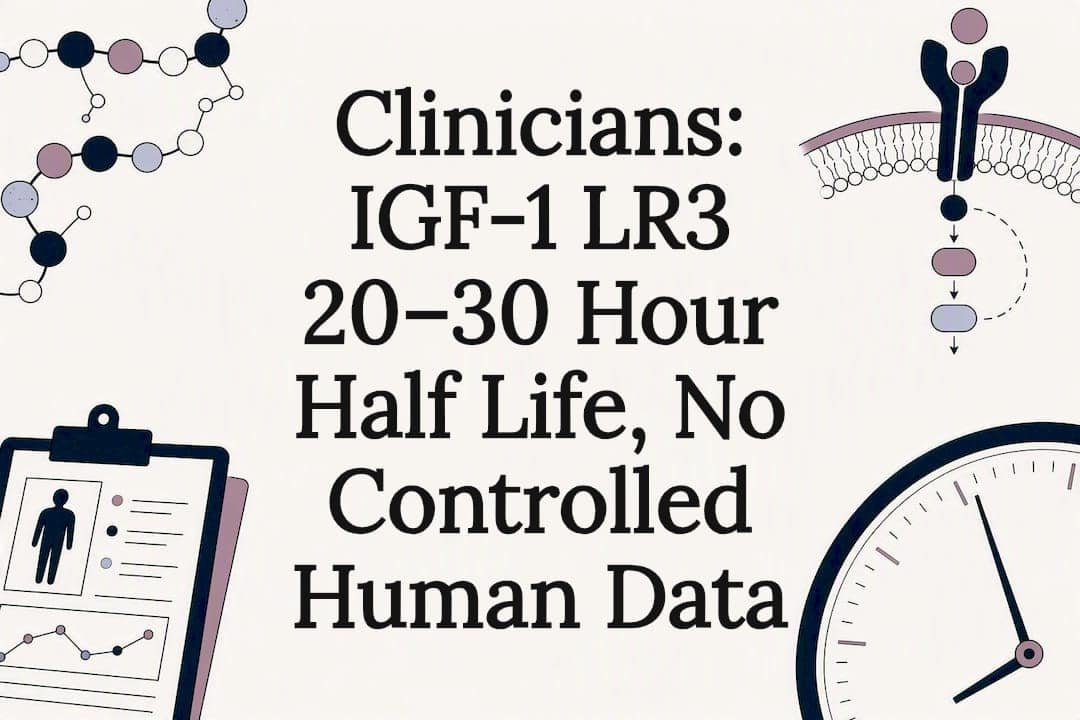
IGF-1 LR3 has strong preclinical support for building muscle and improving nutrient partitioning, but no controlled human trials confirm those benefits or its safety. Animal research shows real anabolic activity and real risk. Until that gap closes, treat every claimed benefit as mechanistically plausible, not proven, and the safety concerns, hypoglycaemia especially, as immediate rather than theoretical. The sections below cover what it is, how it’s dosed, and where the real dangers lie.
TL;DR:
- Animal studies show IGF-1 LR3 can promote muscle growth and regeneration, but no controlled human trials confirm these effects or safely establish dosing protocols.
- Its long half-life and insulin-like activity significantly increase the risk of hypoglycemia and potential organ growth, especially with prolonged or unsupervised use.
- Dosing typically involves subcutaneous injections for four to six weeks, with careful blood glucose monitoring and meal timing to mitigate hypoglycemia risks.
- The primary safety concern is that sustained IGF-1 signaling may raise cancer risk and cause tissue abnormalities, yet human safety data remains absent.
- Purity improvements do not equate to safety guarantees, making medical supervision essential before considering IGF-1 LR3 use outside research settings.
Table of Contents
- What is IGF-1 LR3 and how does it work in the body?
- What are the claimed benefits of IGF-1 LR3?
- Where does the evidence for IGF-1 LR3 actually come from?
- How is IGF-1 LR3 typically dosed and administered?
- What are the real risks and who should avoid IGF-1 LR3?
- What does Soma Peptide document about IGF-1 LR3?
- Is IGF-1 LR3 worth the risk right now?
- Where to go if you’re researching peptides for muscle growth
- Sources
- FAQ
What is IGF-1 LR3 and how does it work in the body?
IGF-1 LR3 is a synthetic 83 amino acid analog of insulin-like growth factor 1, built by substituting an arginine at position 3 and adding a 13 amino acid extension to the N-terminus. That modification isn’t cosmetic. It sharply reduces the molecule’s binding to IGF-binding proteins, the carrier proteins that normally mop up native IGF-1 within minutes. The result is a half-life of roughly 20 to 30 hours, compared to minutes for unmodified IGF-1.
That extended window is the entire point of the LR3 modification, and also its central liability. Once in circulation, IGF-1 LR3 binds the IGF-1 receptor (IGF-1R), a tyrosine kinase receptor found on muscle, liver, kidney, and most other tissue types in the body. Receptor binding triggers two separate signalling cascades. The PI3K/Akt pathway drives protein synthesis through mTOR, which is the anabolic engine behind muscle growth. The MAPK/ERK pathway drives cell proliferation, meaning it tells cells to divide.
IGF-1R also shares meaningful structural overlap with the insulin receptor, so IGF-1 LR3 produces insulin-like effects on blood glucose even though it isn’t insulin. This is why the same mechanism that makes LR3 anabolically interesting also makes it capable of causing dangerous blood sugar drops and, over sustained exposure, unwanted tissue growth outside skeletal muscle. Pro Tip: If you’re trying to understand LR3 in one sentence: it’s a longer-acting key that opens the same lock as IGF-1, and that lock opens doors you don’t necessarily want opened.
What are the claimed benefits of IGF-1 LR3?
The benefits attributed to IGF-1 LR3 all trace back to that IGF-1R signalling cascade, just expressed in different tissues. Here’s what’s actually being claimed, and the mechanism behind each one:
- Muscle hypertrophy and possible hyperplasia — PI3K/Akt/mTOR activation increases protein synthesis in existing muscle fibres. Some research also points to satellite cell activation, the process by which muscle stem cells fuse into existing fibres or form new ones, which would technically be hyperplasia rather than simple growth.
- Faster recovery from training — IGF-1 signalling supports collagen synthesis and soft-tissue repair, theoretically shortening the window between hard sessions.
- Improved nutrient partitioning and fat loss — the insulin-like activity pushes glucose and amino acids toward muscle tissue rather than fat storage, which is the rationale behind body composition claims.
- Skin and aesthetic effects — collagen synthesis pathways overlap with skin repair mechanisms, which is where anti-aging claims originate.
A comprehensive review of IGF-1 in skeletal muscle therapeutics confirms the muscle-mass and regenerative effects are real and repeatable in animal models. That’s a meaningfully different claim than confirming them in humans at the doses and cycle lengths reported in community use.
The gap between plausible and proven matters here. Muscle growth in a mouse study with controlled dosing and full necropsy data doesn’t automatically transfer to a person self-administering a research peptide based on forum consensus. Recovery and skin claims are the weakest of the bunch. They’re logically consistent with what IGF-1 signalling does to collagen, but they rest almost entirely on user-reported outcomes rather than any dedicated experimental data on LR3 itself. If you’re weighing IGF-1 LR3 benefits against a realistic timeline, the honest answer is that hypertrophy signals in animal models show up over weeks, while human anecdotal reports describing visible change often run four to eight weeks, a timeline nobody has validated in a controlled trial.
Where does the evidence for IGF-1 LR3 actually come from?
The evidence base for IGF-1 LR3 splits cleanly into two categories, and conflating them is the most common mistake in how this compound gets discussed online.
The first category is genuine, peer-reviewed data on native IGF-1 and its close relatives. The review cited above lays out solid animal evidence: IGF-1 administration increases muscle mass and regenerative capacity across multiple rodent models, with a detailed table of clinical attempts at translating that into human therapies. That same review flags dose-dependent organ growth and carcinogenic risk as recurring concerns once you move from animal dosing to anything resembling sustained human exposure.
The second category is regulatory and clinical precedent from mecasermin, sold as Increlex, a recombinant human IGF-1 approved for severe primary IGF-1 deficiency in children. Mecasermin’s own prescribing information carries a boxed hypoglycaemia warning and requires patients to eat at the time of injection. This is the closest thing to human clinical trial data on IGF-1 signalling that exists, and it comes from a molecule that isn’t LR3 and isn’t dosed the way LR3 is used in community settings.
What’s missing is the obvious part: there are no controlled human clinical trials establishing IGF-1 LR3’s safety or efficacy for muscle growth, fat loss, or anti-aging in healthy adults. Reviews addressing IGF binding proteins and clinical implications confirm that most human risk inference for elevated IGF-1 signalling comes from epidemiological data linking higher endogenous IGF-1 levels to increased cancer risk, not from trials of the LR3 analog itself. Every performance claim you’ll read about IGF-1 LR3 results is extrapolated from a different molecule, a different dosing context, or an animal model. That doesn’t mean the biology is wrong. It means nobody has quantified the actual long-term safety profile in humans, including cancer risk, at community-reported doses.
How is IGF-1 LR3 typically dosed and administered?
Reported use of IGF-1 LR3 follows fairly consistent patterns across community and research-facing resources, though none of this constitutes medical guidance and all of it carries the same evidence limitations described above.
- Route: subcutaneous injection is the standard route reported, either localised near a target muscle group or delivered systemically depending on the intended effect.
- Cycle length: a commonly reported pattern is four to six weeks on, followed by four to six weeks off, with the rationale being that continuous IGF-1R stimulation drives receptor desensitisation, reducing the anabolic response over time.
- Timing around meals: because of the long half-life, carbohydrate intake near injection times is widely recommended to blunt the hypoglycaemic effect.
- Blood glucose monitoring: checking glucose levels for several hours post-injection is a practical step for anyone using LR3, given how prolonged its glucose-lowering window is compared to native IGF-1.
- Stacking cautions: combining LR3 with insulin, growth hormone, or any glucose-lowering medication compounds the hypoglycaemia risk substantially, since each of these lowers blood sugar through an overlapping mechanism.
Pro Tip: If you’re already tracking baseline labs and following up with a clinician before starting anything in this category, you’re ahead of most community use, which frequently skips both steps entirely.
Practitioners who work with IGF therapies clinically treat mandatory feeding around dosing as non-negotiable precisely because LR3’s extended half-life creates a prolonged hypoglycaemia window that a single meal doesn’t necessarily cover.
What are the real risks and who should avoid IGF-1 LR3?
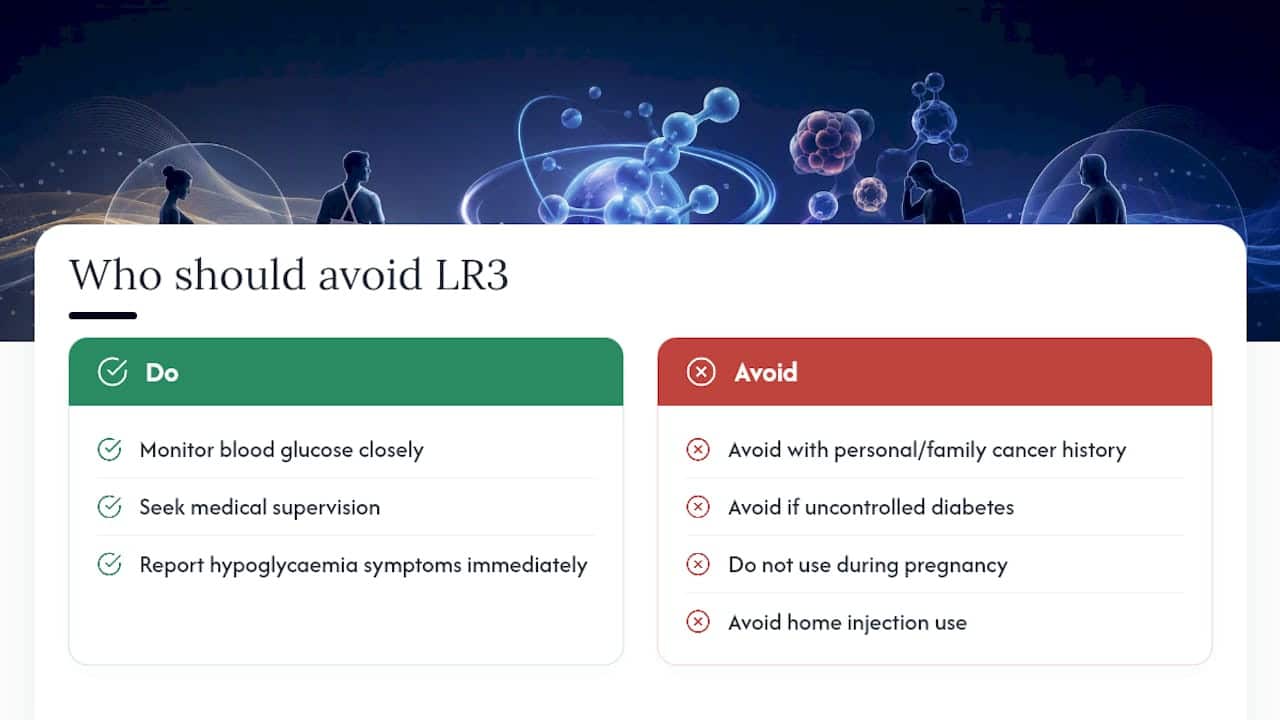
Hypoglycaemia is the acute risk that matters most, and it’s mechanistic, not incidental. IGF-1 LR3 activates the insulin receptor alongside IGF-1R, so it lowers blood glucose the same way insulin does. Symptoms to watch for include shakiness, sweating, confusion, and in severe cases, loss of consciousness. Because LR3’s half-life stretches to 20 to 30 hours, that glucose-lowering effect doesn’t resolve after one meal. It persists across the day, which is why single-dose carbohydrate loading isn’t a complete solution.
The chronic risks are less immediate but arguably more serious for long-term users. Sustained IGF-1R activation can lead to receptor downregulation and worsening insulin resistance over time. Animal studies on chronic LR3 infusion show disproportionate growth in visceral organs including the spleen, liver, gut, and kidney, not just muscle. That’s the mechanistic basis for concerns about acromegaly-like changes, thickened features, organ enlargement, joint issues, in humans exposed to elevated IGF-1 signalling for extended periods.
The cancer question deserves a straight answer rather than a hedge. Epidemiological research links higher circulating endogenous IGF-1 to increased risk for prostate, colorectal, and breast cancers. No study has quantified that risk specifically for IGF-1 LR3 at self-administered doses, because no such study exists. But the biological plausibility is there: MAPK/ERK signalling drives cell proliferation, and artificially sustaining that signal for weeks at a time is not something the epidemiological data can currently rule out as risky.
Certain people should not be experimenting with this compound under any circumstance: anyone with a personal or family history of cancer, anyone with uncontrolled diabetes or unstable blood glucose, and anyone who is pregnant. The laboratory community’s own use of LR3 as a cell culture growth supplement is itself a signal worth noting. It’s potent enough to reliably stimulate cell growth in a petri dish, which is exactly why it belongs in a supervised research setting rather than a home injection routine.
What does Soma Peptide document about IGF-1 LR3?
Soma Peptide’s IGF-1 LR3 formulations are manufactured to exceed 99% purity using advanced purification methods, and the company’s IGF-1 LR3 overview walks through dosing conventions and typical reported results alongside a dedicated side effects and safety page.
None of that substitutes for the human clinical trial data this compound lacks. Purity addresses contamination risk. It doesn’t address the biology of an under-tested molecule. Anyone considering IGF-1 LR3 should treat purity as a baseline expectation, not a safety guarantee, and involve a physician before combining it with any other compound.
Is IGF-1 LR3 worth the risk right now?
The biology here is genuinely compelling. IGF-1R signalling through PI3K/Akt is one of the most well-mapped anabolic pathways in muscle physiology, and the animal data on IGF-1 backs that up consistently. Our position at Soma Peptide is that promising mechanism and proven human outcome are two different things, and IGF-1 LR3 currently sits on the wrong side of that line for anyone outside a supervised research or clinical setting.
Supervised clinical use makes sense for genuine muscle-wasting conditions where physicians can monitor glucose and organ function directly. For everyone else, regulated, evidence-based options remain the more defensible starting point.
— Soma Peptide
Where to go if you’re researching peptides for muscle growth
If you’re evaluating peptide options with a clearer evidence base or a more established regulatory history, Soma Peptide’s peptides for muscle category page breaks down the compounds we carry, each manufactured to the same purity standard described above. We also supply the reconstitution supplies, bacteriostatic water, syringes, and alcohol pads, needed to prepare any peptide correctly once you’ve discussed a protocol with a healthcare provider.
Nothing here replaces medical supervision. If you’re set on researching IGF-1 LR3 specifically, read our IGF LR3 research overview first, then talk to a physician before you order anything. If muscle growth is the goal and you want a broader comparison of what’s available, our peptides for muscle growth guide is the better starting point, and you can browse the full catalogue at Soma Peptide once you know what you’re looking for.
This article is general information, not a substitute for advice from a qualified doctor. Consult a qualified healthcare professional about your own circumstances before acting on anything here.
Sources
- Optimizing IGF‑I for skeletal muscle therapeutics (PMC4665094)
- IGF‑1 LR3: how it works, mechanism & evidence (Peptides Institute)
- IGF‑1 LR3: dosing, safety & regulatory status (The Peptide Toolkit)
FAQ
What does IGF-1 LR3 do to the body?
It binds the IGF-1 receptor and activates PI3K/Akt/mTOR signalling for muscle protein synthesis, while also producing insulin-like effects that lower blood glucose, the mechanism behind both its claimed muscle benefits and its hypoglycaemia risk.
Does IGF-1 LR3 increase testosterone?
No. IGF-1 LR3 works through the IGF-1 receptor pathway, not the hypothalamic-pituitary-gonadal axis, so it has no direct mechanism for raising testosterone.
Is IGF-1 LR3 worth it?
The preclinical case for muscle growth is genuinely strong, but with no controlled human trials confirming safety or efficacy and real hypoglycaemia risk, it’s a decision to make only with medical supervision, not on community anecdotes alone.
Which is better, HGH or IGF-1 LR3?
They work through different pathways, growth hormone stimulates the liver to produce IGF-1 over time, while IGF-1 LR3 acts directly and immediately on the IGF-1 receptor, so “better” depends on the desired onset speed and risk tolerance rather than one being universally superior.
Are there any approved human uses related to IGF-1 LR3?
IGF-1 LR3 itself is not FDA-approved for human use and is sold as a research reagent; the closest regulatory precedent is mecasermin (Increlex), an approved recombinant IGF-1 therapy for severe IGF-1 deficiency, which is a different molecule entirely.