


GHRH binds pituitary GHRH receptors and drives the pulsatile pattern of growth hormone release your body already runs on. GHRPs, ghrelin mimetics like GHRP-6 and ipamorelin, work through an entirely different receptor (GHS-R1a) and amplify that same pulse while quieting the somatostatin brake. Stack them together and challenge studies consistently show a bigger GH peak than either agent produces alone, though the long-term safety picture is still thin and dosing errors blunt the effect. That’s the whole GHRP vs GHRH story in one breath. Everything below explains why it works that way.
TL;DR:
- Combining GHRH analogues with GHRPs produces a larger and more sustained growth hormone pulse than using either alone, but requires precise dosing to avoid blunting effects.
- GHRH operates via the GHRH receptor to produce pulsatile GH release aligned with natural physiology, while GHRPs trigger GH exocytosis through a different receptor system involving calcium influx.
- GHRPs often have stronger appetite stimulation and off-target hormonal effects like cortisol and prolactin increases, especially with non-selective types like hexarelin and GHRP-2.
- Short-acting GHRH analogues like sermorelin mimic natural GH release closely, whereas longer-acting options like CJC-1295 with DAC produce continuous GH elevation, impacting dosing strategies.
- Strict monitoring of blood glucose, IGF-1, cortisol, and prolactin is essential due to potential side effects, with high purity peptides being crucial for predictable results.
Table of Contents
- GHRP vs GHRH: the core mechanistic split
- How does GHRH work?
- How does GHRP work?
- GHRP vs GHRH: side-by-side comparison
- Why GHRH and GHRP are often combined
- Common GHRH and GHRP peptides you’ll encounter
- What does the clinical evidence actually support?
- Safety, side effects, and what to monitor
- Why peptide purity matters for these results
- How to read this evidence in practice
- Where to find research-grade GHRH and GHRP peptides
- Sources
- FAQ
GHRP vs GHRH: the core mechanistic split
The fastest way to understand GHRP vs GHRH is to stop thinking of them as competitors and start thinking of them as two separate ignition switches for the same engine. GHRH is the body’s native signal. GHRPs borrow a completely different receptor system, one originally discovered through ghrelin, the “hunger hormone,” to trigger a similar outcome through a side door.
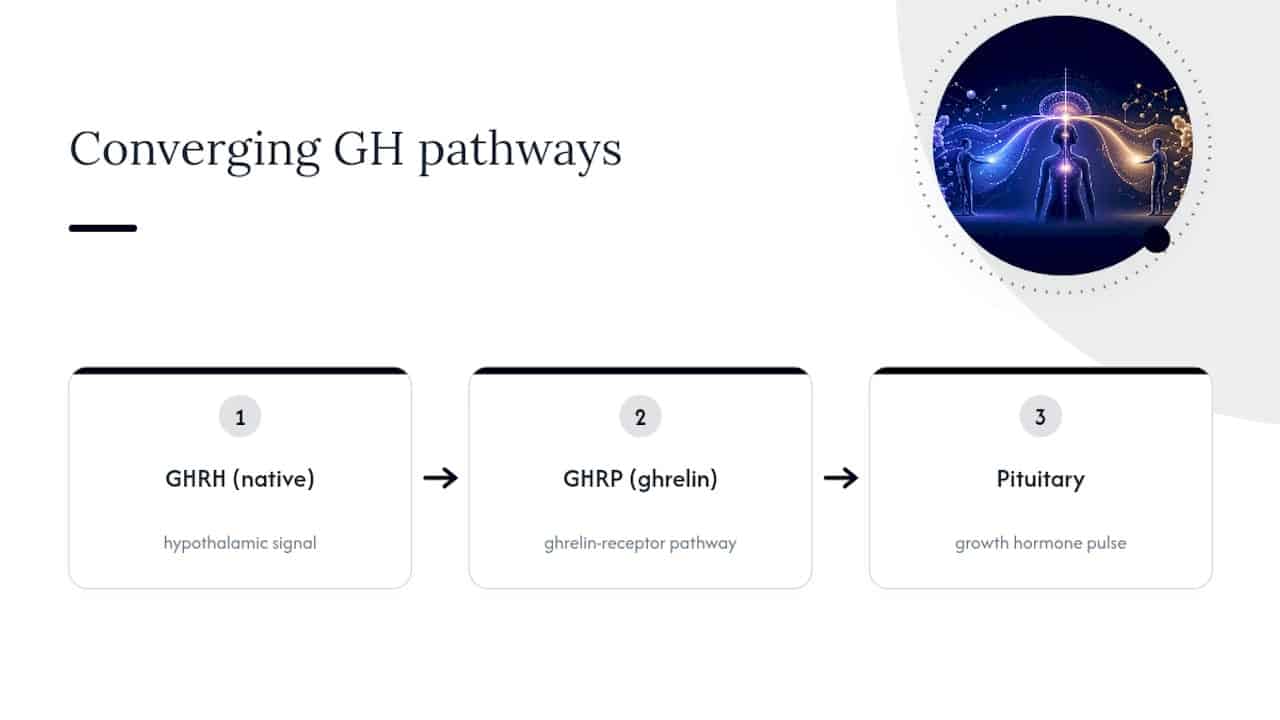
That distinction is not academic. It explains why combining them produces effects neither one gets close to alone, and why the two families carry different side effect profiles despite both ending in the same place: a growth hormone pulse from the pituitary.
How does GHRH work?
GHRH is a 44-amino-acid peptide released from the hypothalamus that binds GHRH-R, a class B G protein-coupled receptor sitting on pituitary somatotroph cells. That binding activates the cAMP/PKA signalling cascade, which switches on GH gene transcription and triggers the pulsatile release pattern that defines normal GH physiology, according to endocrine physiology reviews. GHRH doesn’t act alone. Somatostatin and IGF-1 both apply negative feedback, restraining the somatotroph so GH release stays pulsatile rather than continuous. This feedback loop is exactly why exogenous GHRH analogues tend to preserve a more physiological rhythm compared to injecting GH directly.
Several GHRH analogues have made it into clinical and research use, each with a different half-life and purpose:
- Sermorelin (GRF 1-29) carries a short half-life of a few minutes, closely mimicking the body’s native pulsatile signal.
- Mod GRF / CJC-1295 without DAC extends that action modestly, giving a longer signalling window without the sustained exposure of DAC-conjugated versions.
- CJC-1295 with DAC binds serum albumin, extending its half-life to days rather than minutes, which produces sustained rather than pulsatile GH elevation.
- Tesamorelin is the one GHRH analogue with a defined clinical indication, used specifically for HIV-associated lipodystrophy.
The GHRH page on Soma Peptide breaks down these differences further if you’re comparing formulations for a specific research application.
How does GHRP work?
GHRPs, along with ghrelin mimetics like MK-677, activate GHS-R1a, a receptor coupled to Gq/Gi proteins rather than the cAMP pathway GHRH uses. That triggers phospholipase C activation and a calcium influx into somatotroph cells, which drives GH vesicle exocytosis through an entirely separate mechanical route than GHRH’s transcription-focused approach. GHRPs don’t just act at the pituitary. They also modulate the hypothalamus directly, and part of their potency comes from suppressing somatostatin tone, the same brake that normally limits GHRH’s effect. Recent endocrine reviews describe ghrelin’s interaction with GHRH neurons directly, showing GHS-R1a expression on the very neurons that produce GHRH, which is part of the mechanistic explanation for why the two families synergize rather than simply add together.
GHRPs also do things GHRH does not:
- Most stimulate appetite, an orexigenic effect tied to their shared ancestry with ghrelin.
- Several, including hexarelin and GHRP-2, can raise cortisol and prolactin as an off-target consequence of receptor activation elsewhere.
- Preclinical and small human studies report GH-independent cardioprotective effects for hexarelin specifically, including improved left ventricular function in ischemia models, an effect that occurs independent of GH output entirely.
Pro Tip: If cortisol and prolactin shifts concern you more than raw GH output, that’s a reason to look at receptor selectivity across the GHRP family rather than assuming all ghrelin mimetics behave the same way.
GHRP vs GHRH: side-by-side comparison
The practical differences between these two families come down to where they act, how the GH pulse looks on paper, and what else moves alongside it.
| Factor | GHRH analogues | GHRP family |
|---|---|---|
| Primary receptor / pathway | GHRH-R, cAMP/PKA | GHS-R1a, Gq/PLC, calcium influx |
| GH release pattern | Pulsatile, closer to physiological rhythm (sustained with DAC forms) | Sharper, often larger peak amplitude |
| Appetite effect | Minimal | Often orexigenic (strongest with GHRP-6) |
| Cortisol / prolactin effect | Minimal | Varies: ipamorelin low, hexarelin and GHRP-2 higher |
| Half-life / dosing frequency | Minutes (sermorelin) to days (CJC-1295 with DAC) | Minutes to hours; MK-677 lasts up to daily dosing orally |
| Notable non-GH effects | None well established | Cytoprotective/cardioprotective signals (hexarelin) |
| Monitoring focus | IGF-1, glucose | IGF-1, glucose, cortisol, prolactin |
Obesity and elevated somatostatin tone blunt both pathways, but they hit GHRH harder since GHRH’s effect depends more heavily on a permissive feedback environment. GHRPs tend to punch through that suppression more reliably, one reason they’re often the partner peptide of choice in combination protocols.
Why GHRH and GHRP are often combined
Pairing GHRH with a GHRP isn’t a marketing gimmick, it’s a documented pharmacological effect. A controlled bolus study measuring GH responses to GHRH and GHRP-2 given separately and together found that combined administration produced a significantly larger GH area-under-curve and a higher peak GH than either peptide alone in healthy adult volunteers.
The mechanism behind that synergy makes sense once you see the two pathways side by side:
- GHRH drives transcription and release through cAMP; GHRP drives calcium-triggered exocytosis and suppresses somatostatin at the same time, removing the brake GHRH normally has to work against.
- Because the two peptides hit different receptors, single-axis desensitization is less of a problem than repeatedly hammering one receptor type alone.
- Ghrelin’s action directly on GHRH-producing neurons appears to reinforce this loop at a level above the pituitary, not just within it.
Challenge studies typically measure GH peak and GH AUC in the 30 to 90 minutes following bolus administration to quantify how strong that synergy actually is. That combined bolus study remains one of the clearest human data points showing GHRP and GHRH aren’t redundant, they’re additive through separate mechanisms.
Synergy isn’t guaranteed, though. Dose imbalance is the most common failure point: overshoot one peptide’s molar dose and it can mask the other’s contribution entirely. Obesity and prior suppression of the GH axis (from long-term exogenous GH use, for instance) also flatten the combined response compared to a treatment-naive baseline.
Common GHRH and GHRP peptides you’ll encounter
Anyone reading peptide literature or product pages will run into the same handful of names repeatedly. Here’s what separates them functionally.
GHRH analogues:
- Sermorelin has the shortest half-life of the group and most closely mirrors natural GHRH signalling.
- Mod GRF / CJC-1295 without DAC offers a middle ground: longer action than sermorelin, without the multi-day exposure of the DAC version.
- Tesamorelin stands apart with an actual approved indication for lipodystrophy, backed by more rigorous trial data than most other secretagogues on this list.
GHRPs:
- GHRP-6 is the most orexigenic of the group and shows preclinical cytoprotective signals worth watching in cardiac research.
- GHRP-2 produces a strong GH pulse but carries more cortisol and prolactin movement than the more selective options.
- Ipamorelin is generally favoured when minimizing off-target hormonal shifts matters, since it triggers minimal cortisol and prolactin change relative to hexarelin or GHRP-2.
- Hexarelin produces some of the largest GH peaks in the family alongside the cardiotropic signals mentioned above.
- MK-677 (ibutamoren), an oral ghrelin mimetic, stands out for a half-life long enough to support once-daily dosing rather than injections.
Readers comparing hexarelin specifically against the rest of the field can find more detail on the hexarelin peptide page, and GHRP-6’s dual appetite and cytoprotective profile is covered on the GHRP-6 peptide page.
What does the clinical evidence actually support?
The strongest evidence sits behind a narrow set of indications. Tesamorelin has trial data specific to HIV-associated lipodystrophy. Sermorelin and other GHRH analogues have decades of use in evaluating adult GH deficiency through GH challenge testing. Beyond those defined cases, most of what’s published falls into a narrower evidence tier.
- GH challenge studies (like the combined GHRH/GHRP-2 bolus trial cited above) establish acute mechanism and receptor interaction, not long-term outcomes.
- Small randomized trials exist for several secretagogues, but sample sizes are modest and follow-up periods are short.
- Cardioprotective signals for hexarelin remain preclinical or based on small human cohorts, promising but far from settled.
- Endpoints that matter most in practice, sustained lean mass gains, fat mass reduction, functional strength or mobility outcomes, remain under studied across the secretagogue class as a whole.
That gap between acute GH response and durable health outcomes is the single biggest thing to keep in mind before assuming a bigger GH peak translates into a bigger real-world result.
Safety, side effects, and what to monitor
Growth hormone secretagogues shift more than GH. Expect some combination of appetite increase, mild fluid retention, and transient changes in blood glucose, plus cortisol or prolactin elevation with the less selective GHRPs like hexarelin and GHRP-2. Reviews of secretagogue use flag hyperglycaemia as a recurring risk worth tracking closely, particularly in anyone with existing insulin resistance.
A sensible monitoring routine looks like this:
- Baseline labs before starting: fasting glucose, HbA1c, and IGF-1 at minimum.
- Follow-up testing at 4 to 12 weeks: repeat the same panel to catch drift early rather than after months of unmonitored use.
- Add cortisol and prolactin checks if using a non-selective GHRP such as GHRP-2 or hexarelin.
- Stop and seek specialist review if you see clustering symptoms, significant hormone abnormalities, or if you’re pregnant or have an active cancer diagnosis, both firm contraindications regardless of which peptide family is involved.
Pro Tip: Don’t wait for symptoms to order labs. IGF-1 and glucose shifts often show up on paper well before you’d notice anything subjectively.
None of this replaces a conversation with a physician familiar with your bloodwork and history.
Why peptide purity matters for these results
Every mechanism described above assumes you’re working with what the label says you’re working with. Impurities in a poorly manufactured peptide can trigger reactions that have nothing to do with GHRH-R or GHS-R1a biology, and they make it impossible to know if a disappointing (or alarming) result reflects the peptide or the contaminant riding along with it.
A few things that follow from that standard:
- Reliable purity means the GH AUC and peak responses described in challenge studies are more likely to reflect what you’re actually administering.
- Reduced impurity load lowers the odds of off-target reactions unrelated to the intended receptor pathway.
- Every batch should come with documentation you can actually check rather than take on faith.
Readers wanting the fuller catalogue of GH-targeting compounds can browse Soma Peptide’s growth hormone peptide guide for formulation-level detail.
How to read this evidence in practice
The honest read on GHRP vs GHRH is that the mechanism is well established, the combined-dose synergy is real and measurable, and the long-term outcome data still lags behind the acute physiology. That gap should shape how anyone approaches this, not by avoiding the peptides, but by treating them as measured interventions rather than casual additions to a routine.
Get baseline labs before starting. Track IGF-1 and glucose rather than relying on how you feel, since subjective impressions arrive well after the numbers move. And treat combination protocols as something to run under specialist oversight, not as a stack you assemble because a forum thread said it works. The physiology supports real effects here. It also supports being careful about which effects you’re actually chasing.
— Soma Peptide
Where to find research-grade GHRH and GHRP peptides
If you’re weighing sermorelin against CJC-1295, or comparing ipamorelin’s selectivity against a stronger GHRP, the peptides for muscle category page breaks down formulation options tied to growth hormone and recovery goals in more depth than any single comparison table can. Talk to a physician before starting any secretagogue protocol, particularly if you’re combining a GHRH analogue with a GHRP, since that combination calls for the closest lab monitoring of any approach discussed here. When you’re ready to compare specific products and certificates of analysis, the full peptide catalogue at Soma Peptide is the place to start.
This article is general information, not a substitute for advice from a qualified doctor. Consult a qualified healthcare professional about your own circumstances before acting on anything here.
Sources
- GH responses to intravenous bolus infusions of GH releasing hormone and GH releasing peptide 2 separately and in combination in adult volunteers
- Synthetic growth hormone‑releasing peptides: a historical appraisal of the evidences supporting their cytoprotective effects
- Normal physiology of growth hormone in normal adults – Endotext
FAQ
Which peptides are classified as GHRH?
Sermorelin (GRF 1-29), mod GRF/CJC-1295 without DAC, CJC-1295 with DAC, and tesamorelin are all GHRH analogues, meaning they bind GHRH-R and work through the cAMP/PKA pathway.
What is the difference between GHRP-2 and HGH?
GHRP-2 stimulates your own pituitary to release growth hormone through GHS-R1a, while HGH (somatropin) is the growth hormone itself, given directly and bypassing the pituitary and its natural pulsatile pattern entirely.
What is the best GHRH peptide?
There’s no single “best” option since it depends on the goal: sermorelin offers the shortest, most physiological pulse, while tesamorelin has the most substantial clinical trial data behind it for a specific indication.
What is GHRP peptide good for?
GHRPs are used to stimulate growth hormone release through the ghrelin receptor pathway, and several, particularly hexarelin, also show preclinical cardioprotective and cytoprotective effects that appear independent of GH output.