
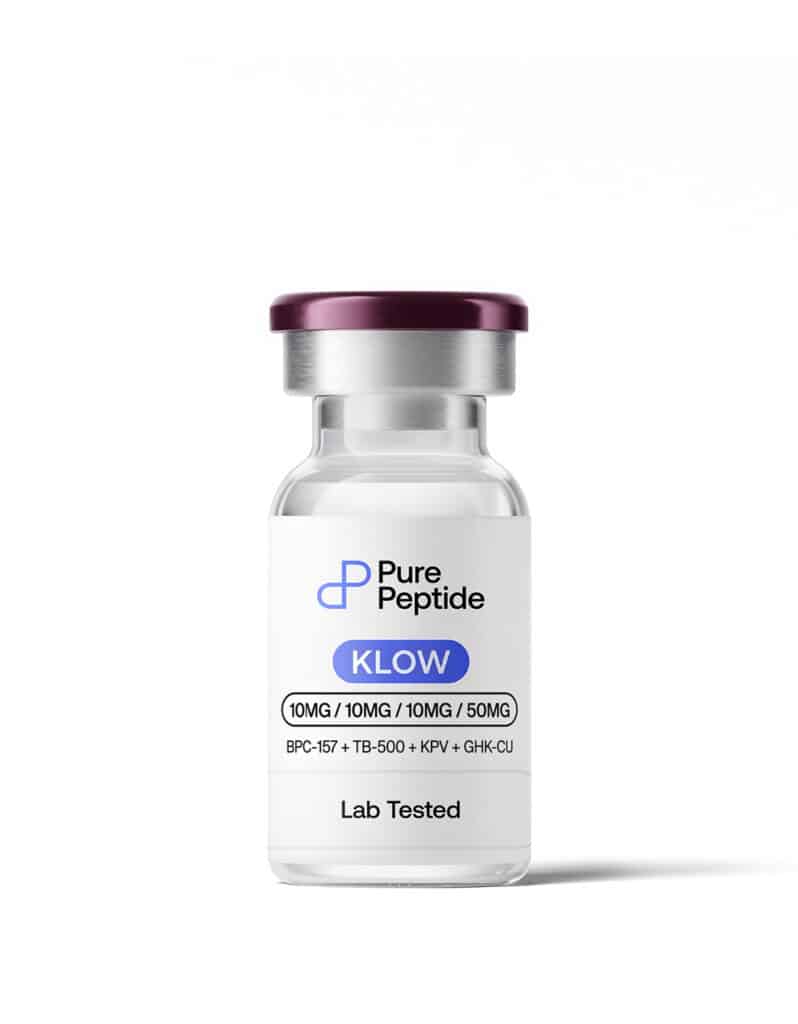
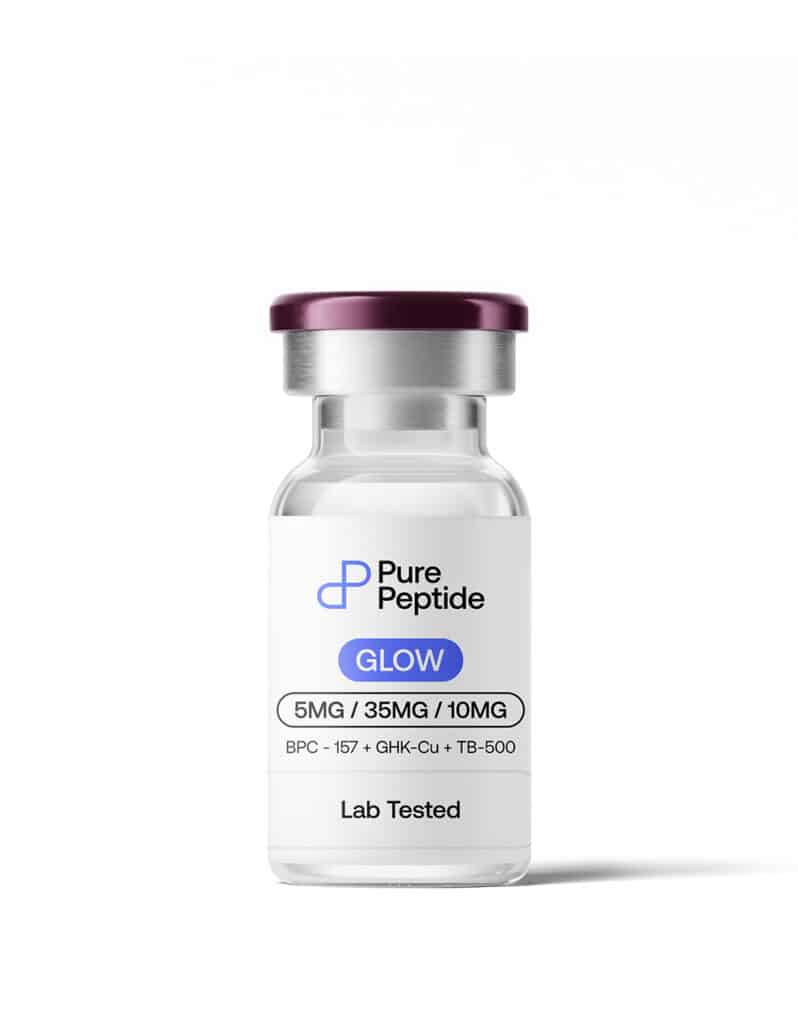
Lyophilized peptide vials stored cold and dark generally hold their potency for months to years; once reconstituted, expect weeks, not months. Plan on roughly 28 days when bacteriostatic water is your diluent. That window has less to do with the peptide falling apart chemically overnight and everything to do with preservative and sterility limits on the water itself.
TL;DR:
- Lyophilized peptides stored at −20°C or colder can remain stable for three to five years, but reconstituted solutions are only viable for about 28 days with preservatives.
- The 28-day reconstitution window is based on preservative efficacy, not chemical stability, so peptides may last longer if stored properly and used promptly.
- Residual moisture, vial seal integrity, and formulation excipients can significantly influence the short-term stability of lyophilized peptides.
- Repeated freeze-thaw cycles and delayed aliquoting of reconstituted solutions accelerate potency loss and contamination risks.
- Proper shipping, handling, and visual inspection are essential to maintaining peptide potency, especially during transit and upon arrival.
Table of Contents
- What makes peptide shelf life so different for powder versus solution?
- How long do peptides last at different storage temperatures?
- Why does everyone say reconstituted peptides only last 28 days?
- Which parts of a peptide sequence break down first?
- What’s the best way to store and handle peptides day to day?
- How should peptides be shipped and inspected on arrival?
- How can you tell if a peptide has gone bad?
- How Soma Peptide’s quality practices support these storage guidelines
- A short routine we follow for every shipment
- Where to find research-grade peptides and the ancillaries to store them properly
- Sources
- FAQ
What makes peptide shelf life so different for powder versus solution?
Water is the enemy of a peptide bond, and lyophilization exists specifically to remove it. Freeze-drying pulls free water out of the formulation, which slows the three reactions that quietly wreck peptides over time: hydrolysis, oxidation, and aggregation. Without water acting as a reaction medium, molecular motion drops and degradation nearly stalls, especially when the vial is also kept cold and shielded from light.
Reconstitution reverses all of that. The moment you add water, you reintroduce a reaction medium and dissolved oxygen, and every degradation pathway that was dormant in the powder starts running again, just at a slower pace than at room temperature.
A few variables you rarely see discussed decide how well a given lyophilized peptide survives storage:
- Residual moisture left over from an imperfect freeze-drying cycle accelerates hydrolysis even in powder form.
- Vial seal integrity matters more than most researchers assume. A compromised stopper lets in ambient humidity over months.
- Excipients like mannitol or trehalose used as bulking agents can stabilize or destabilize a given sequence depending on formulation.
How long do peptides last at different storage temperatures?
Published stability work gives researchers real numbers to plan around instead of guessing. Peer-reviewed peptide stability data shows lyophilized peptides holding chemical stability for three to five years at −20°C, with −80°C extending that further in several published studies.
Typical shelf-life ranges by condition: lyophilized peptides can remain viable for years at ultra-low temperatures, while a reconstituted vial measures its useful life in weeks, not months, once the diluent is added.
| Form | Storage condition | Typical stability range |
|---|---|---|
| Lyophilized (powder) | −80°C | Multiple years |
| Lyophilized (powder) | −20°C | 3–5 years |
| Lyophilized (powder) | 2–8°C (fridge) | Several months to about a year |
| Lyophilized (powder) | Room temperature | Days to a few weeks, sequence-dependent |
| Reconstituted, bacteriostatic water | 2–8°C | Up to ≈28 days |
| Reconstituted, sterile water (no preservative) | 2–8°C | Days; use promptly, ideally same-day to a few days |
| Reconstituted (either diluent) | Room temperature | Hours to a few days at most |
These are conservative defaults, not universal law. Manufacturer handling guidance from GenScript recommends −20°C for dry storage and 2–8°C for reconstituted solutions across most standard research peptides, but exceptions exist. Copper-binding peptides such as GHK-Cu are notably incompatible with benzyl alcohol preservative, which can chelate the metal ion and inactivate the compound. Large or structurally complex proteins also tend to behave less predictably than short synthetic peptides, so product-specific data should always override a generic table when it’s available.
Why does everyone say reconstituted peptides only last 28 days?
The 28 to 30 day rule that circulates through peptide forums and lab protocols alike didn’t come from a chemistry paper. It came from a drug label. Dailymed’s product information for Hospira bacteriostatic water specifies a 28-day discard window after first puncture for its 0.9% benzyl alcohol formulation. That’s a sterility and preservative-efficacy limit, not a chemical decay curve for the peptide dissolved in it.
Benzyl alcohol works as a bacteriostatic agent by disrupting microbial cell membranes, and its antimicrobial activity is only validated for that 28-day span once the seal is broken, as explained in detail in PEMF Therapy Side Effects: What You Need to Know. Beyond that point, the manufacturer makes no claim the solution stays sterile, regardless of how the peptide itself is holding up chemically.
Practical controls that keep you inside safe limits:
- Write the puncture date on the vial the moment you reconstitute, not from memory later.
- Never refreeze an already-reconstituted vial that was mixed with bacteriostatic water; the freeze-thaw cycle stresses the peptide and doesn’t reset the sterility clock.
- If you’re using sterile water without a preservative, treat the vial as single-use or plan to use it within days, since there’s no antimicrobial protection at all.
Pro Tip: If your protocol calls for peptide use spread across several weeks, reconstitute smaller volumes more frequently rather than mixing one large vial and stretching it past the 28-day mark on the assumption the peptide is “probably fine.”
Which parts of a peptide sequence break down first?
Not all peptides age at the same rate, and the reason comes down to which amino acids sit in the sequence. A 2023 Pharmaceutics review on degradation mechanisms maps out the major pathways researchers need to watch:
- Hydrolysis cleaves the peptide backbone in the presence of water, especially at Asp-Pro motifs, which are notoriously acid-labile.
- Deamidation converts asparagine and glutamine residues into aspartate or glutamate, altering charge and sometimes bioactivity.
- Oxidation targets methionine, cysteine, and tryptophan, whose side chains react readily with dissolved oxygen.
- Aggregation clusters peptide chains together, often triggered by hydrophobic stretches or disulfide mismatching in cysteine-containing sequences.
- Diketopiperazine (DKP) formation and pyroglutamate cyclization affect peptides with proline or glutamine near the N-terminus, sometimes within hours in solution.
- Racemization flips a residue’s stereochemistry, most commonly at aspartate, quietly changing how a receptor recognizes the molecule.
Sequence-aware handling gives labs the best return on effort: knowing in advance which residues are oxidation- or deamidation-prone lets you choose pH, buffer, and excipients that materially extend in-solution life for critical samples, rather than applying a blanket storage rule to every peptide in the freezer.
Mitigation isn’t limited to temperature. Buffer selection and pH control slow hydrolysis and deamidation, certain excipients scavenge reactive oxygen species, and design-level choices like PEGylation or hydrocarbon stapling can extend proteolytic stability, though they change the molecule’s pharmacology enough to require separate validation before use.
What’s the best way to store and handle peptides day to day?
A short standard operating procedure prevents most of the potency loss researchers see in practice:
- Store lyophilized stock at −20°C or colder, in the original vial, away from light exposure.
- Use amber or foil-wrapped containers if the original packaging isn’t opaque.
- Minimize headspace in reconstituted vials; excess air accelerates oxidation of sensitive residues.
- Keep a small silica desiccant packet in the storage box for powder kept above −20°C.
- Label every vial with compound name, reconstitution date, and diluent used.
- Aliquot reconstituted peptide into single-use cryovials immediately rather than drawing repeatedly from one working vial.
- Schedule dosing to consume an aliquoted batch within the 28-day preservative window.
Freeze-thaw cycling deserves its own line of caution. Guidance on freeze-thaw damage indicates a single freeze-thaw cycle is usually tolerated without major loss, but repeated cycles produce measurable, cumulative potency decline. Aliquoting solves this problem at the source: instead of freezing and thawing one master vial ten times over a month, you freeze ten small aliquots once and thaw each only when needed.
Pro Tip: Batch your aliquoting the same day you reconstitute. Waiting even a day to split a vial into single-use portions defeats the purpose, since the solution has already begun degrading before you’ve protected any of it.
How should peptides be shipped and inspected on arrival?
Cold-chain integrity during transit matters as much as storage once the vial reaches your bench. Reputable shipping uses insulated packaging with gel packs sized for the expected transit window, generally one to three days for most domestic routes; dry ice is sometimes used for longer or international shipments but introduces its own handling risks around sublimation and pressure buildup in sealed containers.
On arrival, check for:
- An intact cold pack or gel pack that still shows partial freeze, not a fully liquefied one.
- Any temperature-logging indicator included in the shipment, if your supplier provides one.
- Vial integrity: cracked seals or leakage indicate a compromised shipment.
Lyophilized peptides tolerate brief warm excursions far better than reconstituted ones. A few hours above refrigeration temperature during transit rarely damages dry powder, but the same exposure applied to an already-reconstituted solution accelerates degradation meaningfully. If a reconstituted sample arrives warm, treat its shelf-life clock as compressed rather than assuming it’s unaffected.
How can you tell if a peptide has gone bad?
Visual and physical inspection catches most problems before they become a research liability. Watch for:
- Cloudiness or turbidity in a solution that was clear at reconstitution.
- Colour shift in either the powder or the reconstituted liquid.
- Visible particulates or flocculation, which usually signal aggregation.
- Lyophilisate that has collapsed, shrunk, or taken on a wet, glassy appearance instead of its original cake structure.
- Any off odour, which can indicate microbial contamination rather than simple chemical decay.
An estimated meaningful share of apparent peptide “failures” reported anecdotally in research settings trace back to storage or handling errors rather than manufacturing defects, underscoring why SOP discipline matters as much as sourcing quality.
When a sample is critical to a study’s reproducibility, don’t guess. Send it for HPLC or mass spectrometry re-analysis rather than assuming visual normalcy equals full potency. If a vial shows any contamination sign, discard it according to your lab’s biohazard or chemical waste protocol rather than attempting to salvage it.
How Soma Peptide’s quality practices support these storage guidelines
Every recommendation above assumes you’re starting with a peptide that was pure and stable at the moment of manufacture, and that’s where sourcing quality becomes inseparable from shelf-life planning. Soma Peptide formulates to a documented purity standard above 99%, verified through analytical testing and certificate of analysis practices that give researchers a known baseline rather than a guess.
Access to a batch-specific COA matters more than it sounds. It tells you the starting purity, so any degradation you observe later is measured against a real number, not an assumption. Soma Peptide’s testing methodology and quality standards are documented for exactly this reason. [Proprietary stability data specific to Soma Peptide formulations would be inserted here as it becomes available.]
A short routine we follow for every shipment
Soma Peptide ships cold, dates every vial at packaging, and includes COA documentation with every order so researchers aren’t guessing about starting purity. We recommend aliquoting immediately on reconstitution, not after a few uses. Questions about handling a specific compound or requesting COA detail? Our support team is there for exactly that.
— Soma Peptide
Where to find research-grade peptides and the ancillaries to store them properly
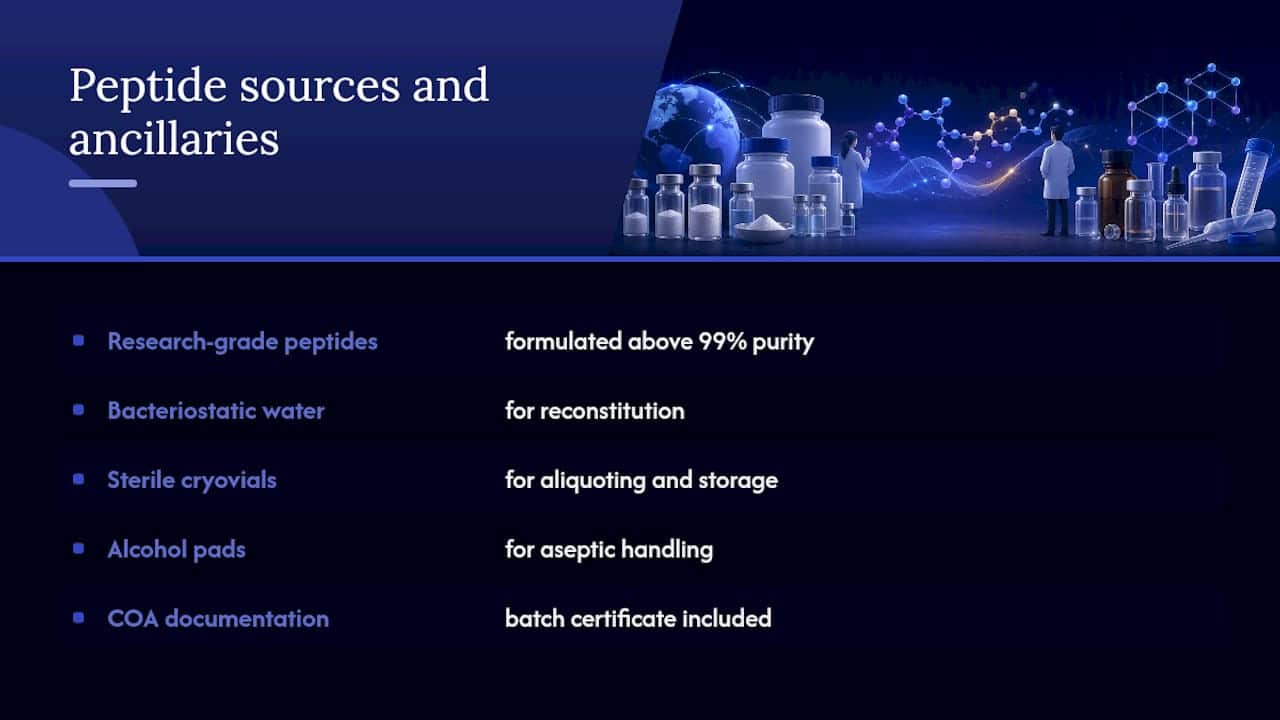
Getting the storage math right starts with getting the starting material right. Soma Peptide supplies research-grade peptides formulated above 99% purity, along with the bacteriostatic water, sterile cryovials, and alcohol pads you need to reconstitute and aliquot correctly from day one. Every batch ships with COA documentation, so you’re not guessing at your starting point when you plan a 28-day working window or troubleshoot an unexpected result. For researchers building out a fat-loss, recovery, or performance protocol, the bodybuilding-focused peptide range covers the compounds most commonly paired with the storage practices outlined above. Browse the current catalogue and order the peptides and ancillaries you need for your next reconstitution cycle.
This article is general information, not a substitute for advice from a qualified doctor. Consult a qualified healthcare professional about your own circumstances before acting on anything here.
Sources
- Pharmaceutics 2023 review on peptide stability
- Dailymed product labelling (Hospira) for bacteriostatic water
- Pharmaceutics review (MDPI) — peptide degradation mechanisms and stabilisation strategies
- GenScript peptide storage and handling guidance
FAQ
How long do peptides last on the shelf?
Lyophilized peptides stored at −20°C typically remain chemically stable for three to five years, with −80°C extending that further; once reconstituted, plan for weeks rather than years.
Do peptides really go bad after 30 days?
Not necessarily from chemical breakdown alone. The 28 to 30 day figure comes from bacteriostatic water’s labelled sterility window after puncture, not from the peptide instantly losing potency at that exact point.
What happens if I use expired peptides?
Using peptides past their reconstituted window risks both reduced potency from ongoing degradation and contamination risk once the preservative’s antimicrobial guarantee expires; discard and re-test rather than assume safety.
How fragile are reconstituted peptides?
More fragile than most researchers assume. Dissolved oxygen and water reactivate hydrolysis, oxidation, and deamidation pathways that were essentially paused in the freeze-dried powder, so refrigeration and prompt use matter far more once a vial is reconstituted.
What’s the difference between chemical stability and sterility when planning peptide shelf life?
Chemical stability refers to the peptide’s molecular integrity over time, while sterility refers to whether the solution remains free of microbial growth. A peptide can be chemically intact past 28 days but no longer meet the preservative’s sterility guarantee, which is why both factors need separate tracking.