



Stacking makes sense in one narrow situation: you have a single, clear goal, you already know which peptide alone hits a wall, and you’re adding a second compound with a genuinely different mechanism to break through that specific bottleneck. The clearest case is the classic GH-axis pairing, a GHRH analog with a GHRP, which has more clinical pharmacology behind it than almost any other combination. The rule that governs everything else: introduce one new peptide at a time, start at the low end of the dose range, and track labs before you add anything else.
TL;DR:
- Peptide stacking should target one specific bottleneck with clear clinical or preclinical evidence, avoiding combinations with receptor overlap that risk desensitization.
- Always evaluate if you have a well-defined goal, run the first peptide alone for at least two weeks, and monitor labs before adding another compound.
- Combining a GHRH analog with a GHRP is the most strongly supported peptide stack for GH optimization due to their complementary mechanisms.
- Avoid stacking peptides without understanding the evidence level, especially for recovery and healing, where most supporting data are preclinical or anecdotal.
- Use separate syringes when mixing peptides with different compatibility profiles, and request third-party purity testing to ensure product quality.
Table of Contents
- What is peptide stacking, and how do you judge the evidence behind it?
- When should you actually stack, and when should you skip it?
- What are the best peptide stacks for common goals?
- How do you build a peptide stack safely, step by step?
- What are the timing, dosing, and mixing rules for peptide stacks?
- What are the risks, evidence gaps, and sourcing rules for peptide stacking?
- What sourcing standards should you expect from a peptide supplier?
- Which medications and health conditions rule out peptide stacking?
- How do you taper and cycle a peptide stack correctly?
- Is peptide stacking legal, and does that vary by region?
- What side effects should you expect, and how do you manage them?
- Cautious optimism: why discipline matters more than the stack itself
- Ready to build your stack? Start with the purity that makes attribution possible
- Sources
- FAQ
What is peptide stacking, and how do you judge the evidence behind it?
Peptide stacking means combining two or more peptides, usually to hit one goal: muscle growth, faster tissue repair, fat loss, or skin quality, from more than one biological angle at once. That’s the whole idea in a sentence. The harder part is figuring out which combinations are backed by real data and which are just popular on forums.
Three evidence tiers matter here, and mixing them up is where most people get into trouble.
- Clinical evidence: human trials or long-standing clinical pharmacology, the strongest tier, seen most clearly with GH-axis peptides.
- Preclinical evidence: animal studies or cell-based research showing a plausible mechanism, common for repair peptides like BPC-157, where human trials remain limited.
- Anecdotal evidence: user reports and practitioner experience, useful for hypothesis generation but not proof of anything.
The other concept worth understanding before you combine anything is complementary mechanisms versus redundant receptor overlap. A GHRH analog (like CJC-1295) and a GHRP work through different receptors to produce one amplified GH pulse, that’s complementary. Two GLP-1 agonists, or two compounds hitting the same secretagogue receptor, just compete for the same site and risk faster receptor desensitization instead of added benefit. Community-validated stacking guides consistently flag this overlap as the single most common beginner error.
When should you actually stack, and when should you skip it?
Before you combine anything, run through this checklist. If you can’t check every box honestly, you’re not ready to stack yet.
- You have one clear goal, not a vague wish list like “better everything.” Pick muscle, recovery, fat loss, or skin, not all four.
- You’ve identified the actual bottleneck. If growth hormone release is already adequate but recovery is the limiting factor, adding more GH-axis stimulation won’t fix a tissue-repair problem.
- You’ve run the first peptide alone for at least a few weeks and know how your body responds to it individually.
- You have a monitoring plan, meaning you know which labs to check and you’ll actually check them.
- You understand the evidence tier you’re operating in and you’re comfortable with that level of uncertainty.
A sensible stack looks like CJC-1295 paired with a GHRP once you’ve confirmed single-peptide response and you’re specifically chasing GH-axis output. A poor stack looks like adding three different repair peptides simultaneously because “more coverage” sounds appealing, you’ll have no idea which one is doing anything if something goes wrong or something works.
The single biggest mistake beginners make is treating stacking as an intensity multiplier rather than a mechanism-targeting decision. Most experts recommend a bottleneck approach instead: find the one rate-limiting step for your specific goal, target it with one compound, and only add a second peptide if a different, distinct bottleneck persists after that.
Pro Tip: Keep a simple log, dates, doses, subjective notes, lab results, from day one. When you eventually add a second peptide, that log is the only way to tell which compound is actually responsible for a change you notice three weeks later.
What are the best peptide stacks for common goals?
Different goals call for different combinations, and the evidence quality varies a lot between them. Treating a preclinical pairing with the same confidence as a well-documented clinical one is where a lot of stacking advice goes wrong.
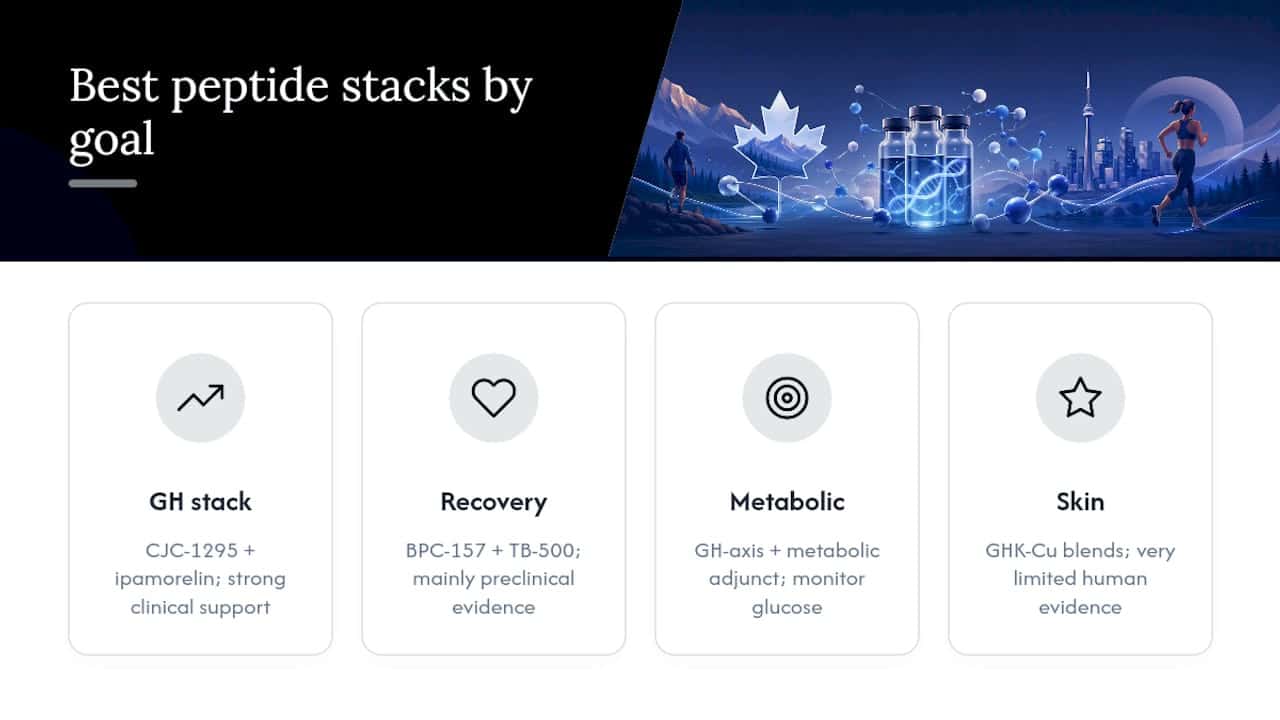
GH optimization. A GHRH analog such as CJC-1295 combined with a GHRP (like ipamorelin) is the combination with the strongest mechanistic and human clinical pharmacology support among common stacks, since the two compounds act on separate receptors to produce a larger, more natural pulsatile GH release than either alone. This is the pairing referenced most often in peer-reviewed pharmacology literature on GH secretagogues. Pure Peptide’s CJC-1295 evidence breakdown covers the dosing range and mechanism in more depth.
Recovery and healing. BPC-157 paired with TB-500 is the community-favourite recovery stack, with a pharmacological rationale built on complementary tissue-repair pathways. The catch: this evidence sits mostly in preclinical and case-report territory. Human randomized trials for BPC-157 specifically remain limited, so treat outcomes as promising rather than proven.
Metabolic and fat loss. Combining a GH-axis peptide with a metabolic adjunct can theoretically address both lean mass preservation and fat oxidation, but this is where monitoring matters most. GH-axis compounds can shift insulin sensitivity, so anyone stacking here needs a clear glucose-monitoring plan, not an afterthought.
Skin and anti-aging. Multi-target blends combining collagen-supportive peptides like GHK-Cu with other growth-factor peptides are the most experimental category on this list. The individual mechanisms are documented, but the combined, layered effect of stacking several at once has the thinnest human evidence of any goal covered here.
How do you build a peptide stack safely, step by step?
This is the sequential-addition protocol that clinical guides and community-run programs converge on almost identically, because it’s the only approach that lets you actually attribute results to a specific compound instead of guessing.
- Pick one goal and name the bottleneck. Write it down. “Improve recovery from training” is too vague; “reduce tendon soreness that’s limiting training frequency” is a bottleneck you can target.
- Run the first peptide alone for an attribution window of two to four weeks. Log doses, timing, and any subjective changes. Pull baseline labs before you start so you have something to compare against.
- Add the second, complementary peptide at a low dose once you have a baseline response. Wait another two to four weeks before judging the combination. Resist the urge to judge too early, most peptide effects build gradually rather than showing up in days.
- Withdraw one peptide at a time if you need to stop, never both simultaneously. Dropping one variable while holding the other steady is the only way to know which compound was driving an effect, good or bad.
- Pause the entire stack if labs move outside expected ranges or side effects appear that don’t resolve with a dose reduction.
For labs, IGF-1 is the standard marker for tracking GH-axis activity, while a basic metabolic panel and fasting glucose cover metabolic stacks. Recheck roughly every four to eight weeks depending on the compound.
Pro Tip: If you’re stacking for recovery, pair your lab schedule with a simple pain or mobility score, one to ten, logged weekly. Numbers on a lab report don’t always match how a joint actually feels, and both data points matter.
What are the timing, dosing, and mixing rules for peptide stacks?
GH-axis peptides work best on an empty stomach, typically right before bed or first thing in the morning, because elevated insulin from a recent meal blunts the natural GH pulse these compounds are designed to trigger. Weekly agents, including metabolic and dual-agonist compounds, run on a completely different cadence: a fixed weekly injection day with gradual dose titration rather than daily timing precision.
Mixing compatibility is where sloppy habits cause real problems.
- Match diluents before combining anything in one syringe, peptides reconstituted with different bacteriostatic water concentrations or pH-sensitive formulations don’t always play well together.
- Watch for visible cloudiness or precipitate after mixing. That’s a discard signal, never inject a solution that looks off.
- When you’re not certain two peptides are chemically compatible, use separate syringes and sequential injections. The extra thirty seconds is a small price for knowing exactly what went in and where.
What are the risks, evidence gaps, and sourcing rules for peptide stacking?
The honest picture, as Henry Ford Health notes, is that peptide stacking rationale rests mostly on preclinical research and practitioner protocols rather than large-scale human trials, and many popular combinations remain unregulated with no long-term safety data.
Real risks worth naming directly: hormonal imbalance from overstimulating the GH axis, hypoglycemia risk when GH-axis or IGF-related compounds are stacked with insulin-sensitizing agents, and infection risk from poor injection technique or contaminated product. None of these are theoretical, they show up in practitioner-reported case notes regularly.
- Request a certificate of analysis and third-party purity testing for every compound before you inject it, not just the ones that seem risky.
- Treat any lab value that moves sharply outside its reference range as a stop signal, not something to push through.
- Persistent injection-site redness, unexplained fatigue, or blood sugar swings warrant a pause and a conversation with a clinician, not a dose adjustment on your own.
- Review peptide safety fundamentals before your first injection, not after your first side effect.
What sourcing standards should you expect from a peptide supplier?
Purity is not a marketing detail, it’s the difference between a predictable response and a guessing game. Pure Peptide formulates its products above 99% purity using advanced purification methods, verified through third-party testing rather than taken on faith.
Beyond the product itself, useful resources for anyone building a stack include:
- Reconstitution guides covering bacteriostatic water ratios and shelf stability after mixing.
- Binding-site and mechanism explainers that clarify why certain pairings are complementary and others overlap.
- Product-specific dosing and evidence pages, such as the CJC-1295 clinical data breakdown, for readers who want the pharmacology behind a specific compound before they buy it.
Which medications and health conditions rule out peptide stacking?
Certain combinations of peptides and existing medications create real risk rather than added benefit, and this is where a lot of self-directed stacking goes wrong. Anyone on insulin or an insulin-sensitizing medication needs to treat GH-axis or IGF-related peptides with real caution, since both classes affect blood glucose, and stacking them without clinician oversight raises hypoglycemia risk meaningfully.
People with active cancer or a history of hormone-sensitive tumours should avoid GH-axis and IGF-related peptides entirely, since these pathways can influence cell growth signalling. Anyone with uncontrolled thyroid disease, pregnant or breastfeeding individuals, and people on immunosuppressive therapy fall into the same “talk to a doctor first” category, not because every peptide is unsafe for them, but because the interaction data simply doesn’t exist to rule out harm.
Existing prescriptions deserve a second look too. GLP-1 or dual-agonist medications prescribed for diabetes or weight management should never be stacked with another peptide acting on the same receptor family, that’s redundant overlap, not synergy, and it raises the risk of excessive appetite suppression or gastrointestinal side effects. Anyone on corticosteroids, anticoagulants, or thyroid medication should flag every peptide addition to their prescribing physician before starting, since peptide-driven hormonal shifts can change how those medications behave.
The pattern across all of these: peptide stacking adds variables to a system that’s often already being managed medically. That’s exactly the scenario where clinical oversight isn’t optional caution, it’s the only way to catch an interaction before it becomes a problem.
How do you taper and cycle a peptide stack correctly?
Cycling exists because continuous exposure to some peptides, particularly GH secretagogues, can blunt receptor sensitivity over time, the same reason athletes cycle certain training stimuli rather than maxing out every session. Common practice involves several weeks on followed by a several-week break, though the right length depends on the specific compounds and your monitoring results, not a fixed calendar rule.
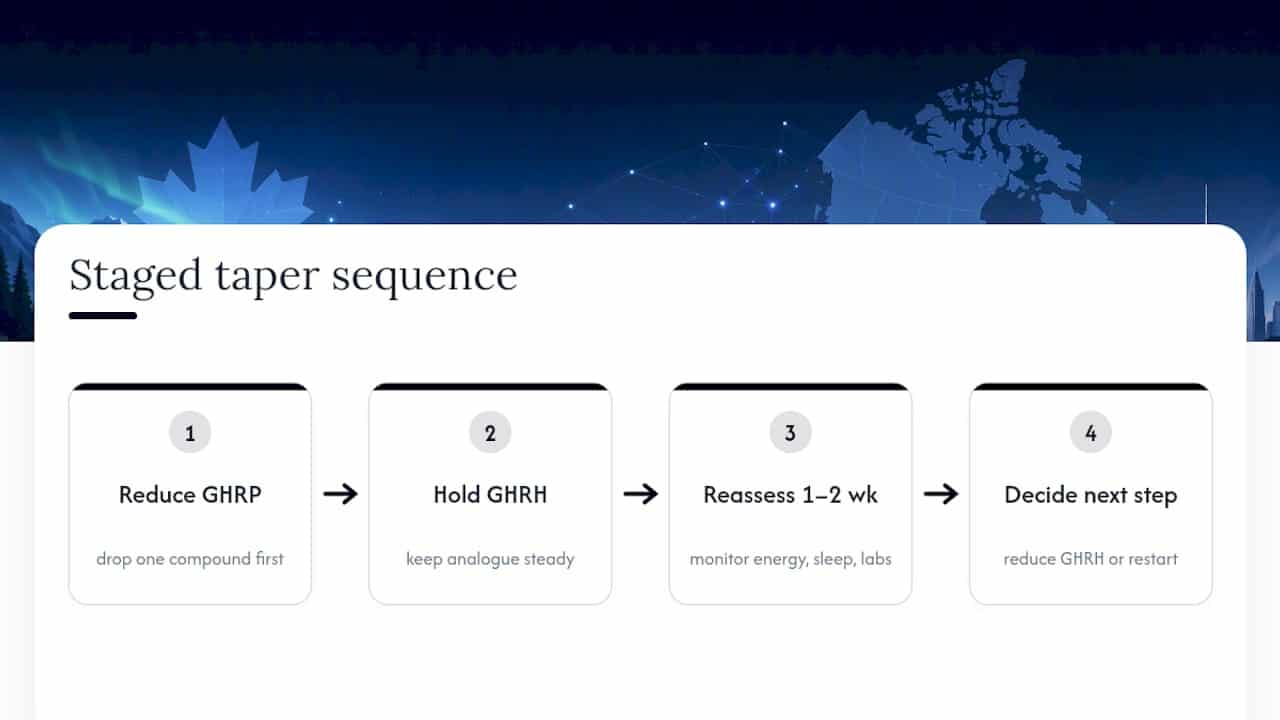
Tapering off a stack should always mean dropping one compound before the other, never stopping both simultaneously. If you’re running a GH-axis pair, taper the GHRP first while holding the GHRH analog steady, then reassess after a week or two before deciding whether to reduce the second compound. This staged approach protects the attribution logic you built during the addition phase, you learn how your body responds to partial withdrawal, not just full stoppage.
Watch for the same subjective and lab markers during a taper that you tracked during the buildup: energy levels, sleep quality, injection-site reactions, and whichever lab value mattered most for that specific stack. A rebound in symptoms during taper often signals the peptide was doing more than you realized, useful information for deciding whether to restart after the break or adjust the protocol. Skipping the taper and stopping cold isn’t dangerous for most peptides in the way abrupt steroid cessation can be, but it does erase the clean data you’d otherwise get from a staged withdrawal.
Is peptide stacking legal, and does that vary by region?
Legal status for peptides varies significantly depending on the specific compound, the country, and whether it’s classified for research use versus approved clinical use. Some peptides used in stacking protocols have full or partial regulatory approval for specific medical indications in certain countries, while others are sold explicitly for research purposes and exist in a legal grey zone for personal use almost everywhere.
In Canada, regulatory status depends on the individual peptide and its intended use, and rules can differ from what applies in the United States, the European Union, or elsewhere. A compound approved for one clinical indication in one country may be entirely unregulated, or explicitly restricted, in another. That inconsistency is exactly why blanket statements like “peptides are legal” or “peptides are banned” are almost always wrong, the honest answer depends on the specific compound and your specific jurisdiction.
The practical implication: verify the status of any specific peptide before ordering it, rather than assuming a stack is fine because one component of it is well-established. Reputable suppliers are transparent about a product’s intended use and purity, but that transparency doesn’t substitute for you understanding your own region’s rules, particularly if you’re combining several compounds with different regulatory histories.
What side effects should you expect, and how do you manage them?
Most peptide stacking side effects fall into a few predictable categories, and knowing what’s manageable versus what’s a stop signal makes a real difference. Injection-site reactions, redness, mild swelling, or itching at the injection point, are the most common complaint and usually resolve within a day or two with proper rotation of injection sites and correct technique.
GH-axis peptides frequently cause water retention, mild joint stiffness, or a tingling sensation in the hands and feet, particularly during the first few weeks. These effects often ease as the body adjusts, but persistent joint pain or swelling that doesn’t improve after two to three weeks warrants a dose reduction or a pause rather than pushing through it. Headaches and mild fatigue show up occasionally with GH-axis compounds too, usually more pronounced right after dosing and fading within a few hours.
Metabolic and dual-agonist peptides carry a different side effect profile, nausea, reduced appetite, and occasional gastrointestinal discomfort, especially during dose titration. Slowing the titration schedule rather than pushing to a target dose on a fixed timeline resolves most of these complaints. Any side effect that includes significant blood sugar swings, unusual mood changes, or symptoms that worsen rather than plateau after the first month should prompt an immediate conversation with a clinician, not a wait-and-see approach.
Cautious optimism: why discipline matters more than the stack itself
The framework in this guide works because it treats stacking as a hypothesis to test, not a shortcut to chase. Most combinations, outside the GH-axis pairing, still rest on preclinical or anecdotal ground, and pretending otherwise does readers a disservice. Start one peptide, monitor labs, get clinical oversight before combining anything with real hormonal reach. None of it replaces sleep, training consistency, or a diet that actually supports recovery, stacking is a refinement on a foundation, never a substitute for one.
— Pure Peptide
Ready to build your stack? Start with the purity that makes attribution possible
Every step in this guide, sequential attribution, mechanism-based pairing, lab monitoring, depends on knowing exactly what’s in your syringe. That’s the one variable a supplier controls and you can’t verify yourself without a certificate of analysis in hand. Pure Peptide formulates every compound above 99% purity with third-party verification, which means when you run a single peptide for your attribution window, any response you see is the compound, not contamination or dosing inconsistency muddying the signal.
If a GH-axis stack fits your goal, the muscle and recovery peptide collection is the practical starting point, paired with the muscle growth guide for dosing context. Anyone leaning toward a metabolic stack should review the weight-loss peptide guide before ordering. Whatever you’re building, loop in a clinician for baseline labs before you start, and use Pure Peptide’s product-specific resources to plan the sequence rather than guessing.
This article is general information, not a substitute for advice from a qualified doctor. Consult a qualified healthcare professional about your own circumstances before acting on anything here.
Sources
- Should you try peptide stacking? | Henry Ford Health
- PMC article (indexed review)
- Stacking peptides, how to combine them without messing up the signal | Pepdex
FAQ
What peptides should not be stacked together?
Avoid combining two compounds that hit the same receptor family, such as two GLP-1 agonists or two GH secretagogues acting through identical pathways, since this causes redundant overlap and faster receptor desensitization rather than added benefit.
What is the most effective peptide stack?
The GHRH analog plus GHRP pairing for GH optimization carries the strongest clinical pharmacology support of any common stack, since the two compounds act on separate receptors to produce a larger natural GH pulse.
How do beginners stack peptides safely?
Run one peptide alone for two to four weeks first, log labs and symptoms, then add a single complementary peptide at a low dose and reassess before considering any further additions.
What can you stack with BPC-157?
TB-500 is the most common pairing with BPC-157 for tissue repair, based on complementary healing pathways, though the supporting evidence for this combination remains largely preclinical rather than backed by large human trials.