


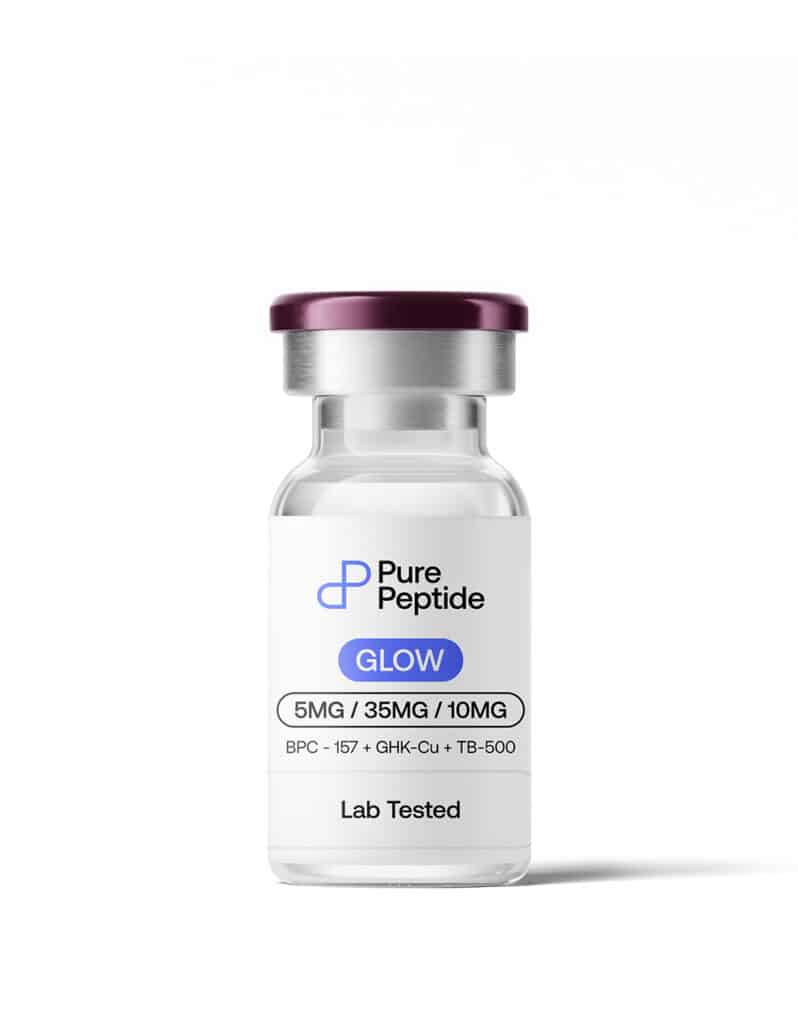
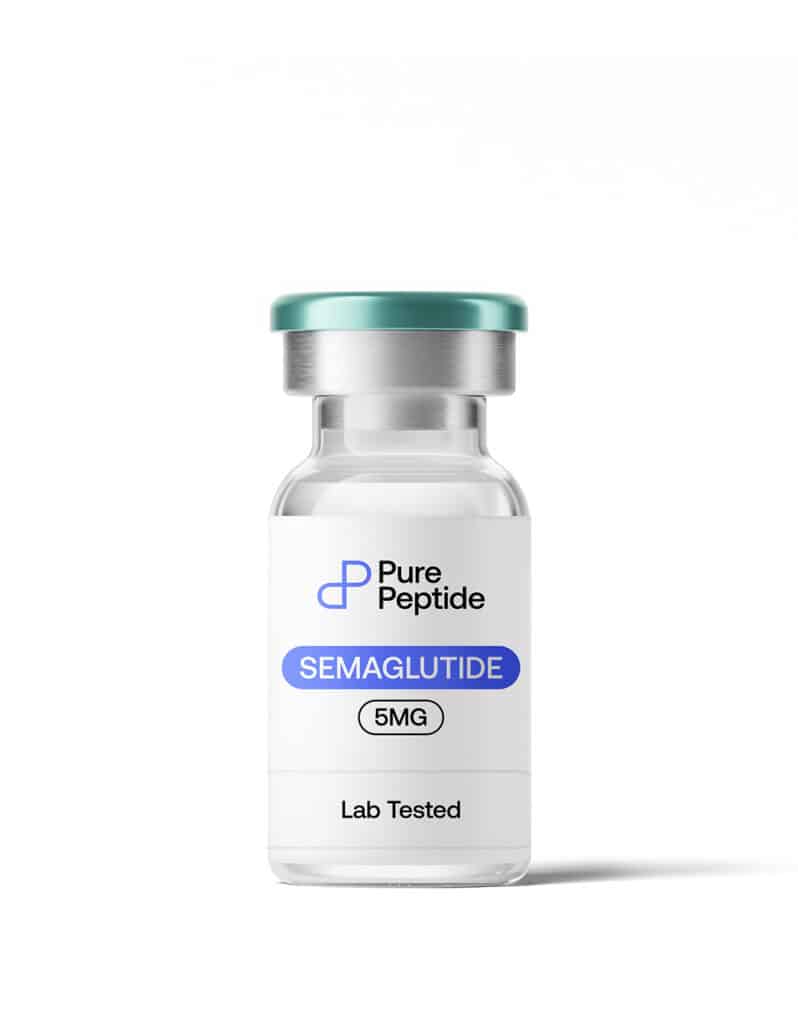

Injectable peptides bought online are not safe as a category, and no amount of marketing language changes that. Health Canada has warned consumers to think twice before injecting peptides purchased outside a pharmacy, Harvard Health Publishing says most of these products lack human trial data, and the American Medical Association points out there’s no agreed-upon safe dosing for many of them. A peptide can be legitimately safe when it’s an approved medication, prescribed by a clinician, and sourced through a regulated pharmacy. The version sold in a plain vial through a website with no prescription requirement is a different product entirely, even if the label lists the same molecule name.
If you’ve already injected something and feel off, here’s what matters right now, not after you’ve finished reading:
- Stop using the product immediately if you notice swelling, hives, shortness of breath, chest tightness, or dizziness. These can signal an allergic reaction or anaphylaxis, and they need emergency care, not a wait-and-see approach.
- Keep the vial, box, and any batch or lot numbers. This is the only way a clinician or regulator can trace what you actually took.
- Call a doctor or go to urgent care for persistent nausea, fever, or injection-site infection that doesn’t settle within a day.
- Report the product to Health Canada’s adverse-event reporting system or your local equivalent. This is how patterns of harm get caught before they spread.
The reasoning behind that opening verdict isn’t guesswork. It’s built on a documented pattern: unregulated peptide vials sold as “research use only” have turned up with wrong concentrations, wrong compounds entirely, or bacterial contamination, according to reporting reviewed by PBS NewsHour. That’s the core problem with peptide safety as a topic: it’s not really about whether peptides as a class of molecule are dangerous. It’s about whether the specific vial in front of you was made, tested, and handled the way a medicine should be.
Key Takeaways
Injectable peptides are only as safe as their regulatory status, manufacturing quality, and clinical evidence, and most wellness peptides sold online fail at least one of those three tests.
| Point | Details |
|---|---|
| Verdict on online injectables | Safe use requires prescription oversight and regulated manufacturing; grey-market vials carry contamination and mislabelling risk. |
| Evidence gap is real | BPC-157, CJC-1295, and GHK-Cu rely mainly on animal and in vitro data, not large human trials. |
| Short-term risks are documented | Injection-site reactions, nausea, headaches, and fatigue appear consistently in user reports and advisories. |
| Verify before you buy | Check Health Canada’s database, search ClinicalTrials.gov, and demand an independent certificate of analysis. |
| Soma Peptide’s approach | Formulates above 99% purity with published testing standards, positioning it as a more verifiable option than anonymous RUO sellers. |
Table of Contents
- What peptides actually are and how people use them
- Which peptides are approved medicines, and which are experimental
- Known short-term side effects, and the long-term risks nobody’s fully mapped
- Why grey market injectable peptides carry extra danger
- How to lower your risk, and when to see a healthcare provider
- What the evidence actually shows, and where it runs out
- Where Soma Peptide stands on all of this
- Where to buy peptides you can actually trust
- Sources
- FAQ
What peptides actually are and how people use them
A peptide is a short chain of amino acids, smaller than a full protein, that typically acts as a signalling molecule in the body. Think of it as a chemical instruction rather than a building block. Some peptides tell cells to release growth hormone, some regulate blood sugar, some influence how tissue repairs itself. That signalling role is exactly why they’ve become popular in both mainstream medicine and the wellness market, and why the safety conversation gets confusing fast: the same word, “peptide,” covers both a decades-old, rigorously tested insulin formulation and a compound someone is mixing in a kitchen after watching a video.
On the approved medicine side, insulin is a peptide hormone, and several GLP-1 receptor agonists used for diabetes and weight management are peptide-based drugs with large clinical trial datasets behind them. These went through years of controlled human studies before reaching a pharmacy shelf.
On the wellness and experimental side, three names show up constantly in online forums and supplier listings: BPC-157, promoted for tissue and gut healing; CJC-1295, marketed as a growth hormone releasing compound; and GHK-Cu, a copper-binding peptide associated with skin and collagen claims. None of these carries the same weight of human clinical evidence as approved peptide drugs, a distinction covered in more detail in the next section.

Route of administration matters as much as the molecule itself. Oral peptides get broken down by digestion before they do much of anything, which is part of why so many wellness peptides are sold as injectables instead. Topical peptides, used in skincare, act locally and carry a much smaller risk profile. Injectable peptides skip the digestive system entirely and enter systemic circulation directly, which is exactly where things get riskier when the product wasn’t manufactured to pharmaceutical standards.
Which peptides are approved medicines, and which are experimental
Regulatory approval isn’t a marketing badge, it’s a specific process. A peptide reaches approved status after controlled human trials assess safety and effectiveness, and after an agency like Health Canada or the FDA reviews that data and authorizes a specific formulation, dose, and use case. Insulin and select GLP-1 medications cleared that bar. That’s why their side effect profiles, interactions, and long-term safety data are relatively well mapped, even though no drug is risk-free.
BPC-157, CJC-1295, and GHK-Cu have not gone through that process for the uses they’re marketed for online. Most of the supporting evidence for these compounds comes from animal studies or lab-based (in vitro) work, not controlled human trials. That doesn’t automatically mean they’re harmful. It means nobody has done the work to confirm they’re safe at scale, in humans, over time, which is a very different statement than “proven safe.”
A quick checklist before trusting any peptide product’s safety claims:
- Check for Health Canada or FDA approval for the specific compound and use. The Health Canada Drug Product Database is the fastest way to confirm this.
- Search Clinicaltrials for registered human trials involving the compound. A listing doesn’t guarantee safety, but the absence of any listing tells you a lot.
- Look for peer-reviewed human studies, not just animal research, when a seller cites “clinical evidence.”
- Ask for a certificate of analysis (COA) from an independent lab confirming purity and identity, not just a document the seller wrote themselves.
Roughly one figure sums up the gap: while approved peptide drugs carry years of registered trial data, many of the compounds discussed in wellness circles show up in PubMed searches mostly as small preclinical studies, with reviewers repeatedly calling for larger, controlled human trials before drawing firm safety conclusions.
Known short-term side effects, and the long-term risks nobody’s fully mapped
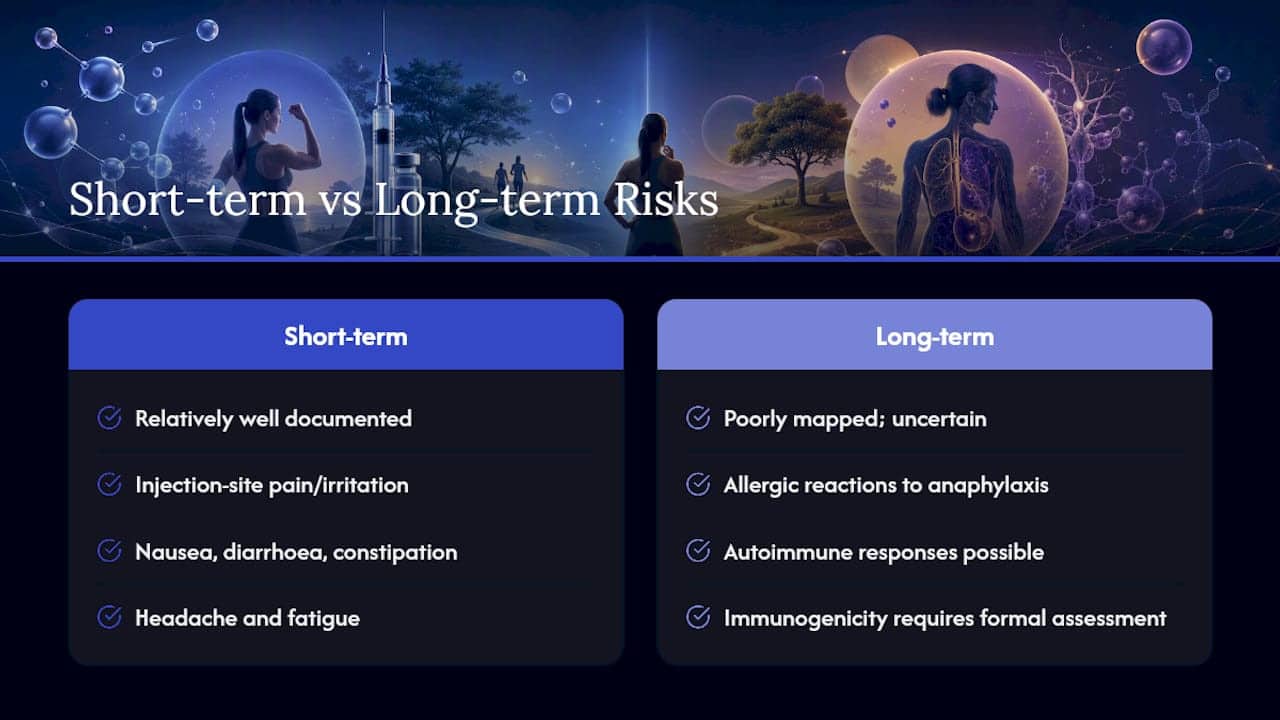
Short-term reactions are the part of peptide safety with the most solid documentation. Health Canada and clinics tracking user reports consistently list injection-site pain or irritation, nausea, diarrhoea, constipation, headaches, and fatigue as common short-term effects of injectable peptides, a pattern also described in Verywell Health’s coverage of peptide injection risks. Most of that reporting comes from user accounts and small case series rather than large controlled trials, so treat the frequency estimates as directional, not precise.
The rarer, more serious end of the spectrum is where the real uncertainty lives. Allergic reactions up to anaphylaxis, autoimmune responses, and pancreatitis in certain peptide classes have all been flagged as possible risks. There’s also a theoretical concern, not a confirmed one, that some growth-signalling peptides could promote abnormal cell growth through angiogenesis, the process of forming new blood vessels. Researchers describing peptide therapeutics stress that this class of risk needs proper long-term study before anyone can rule it in or out.
Immunogenicity, the possibility that the body mounts an adverse immune response against a peptide, is flagged as a central safety concern in peptide drug development, one that must be formally assessed before any peptide can be considered safe for wider use. That single issue explains why a compound that looks harmless in a lab dish can still cause real problems once it’s circulating in a human body, a point made directly in a peer-reviewed review on peptide immunogenicity.
Here’s the pharmacological reason injectables carry more weight than a pill: injection bypasses first-pass metabolism, the liver’s normal filtering process for anything swallowed. Whatever is in that syringe, active ingredient or contaminant, goes straight into systemic circulation. The AMA points to this as one reason injectable peptides deserve more caution than oral supplements: there’s no digestive buffer catching mistakes before they reach your bloodstream.
Put simply, the risk matrix looks like this: short-term effects are reasonably well documented for many peptides, even unapproved ones, because enough people have reported them. Long-term effects are the unknown column across almost every compound except the handful with full regulatory approval and years of trial data behind them.
Why grey market injectable peptides carry extra danger
The “research use only” label is doing a lot of quiet work in this market. Sellers use RUO labelling specifically to sidestep pharmaceutical regulation, and direct sourcing vs resellers: what determines peptide quality explains why products marketed this way frequently skip current Good Manufacturing Practice (cGMP) standards entirely. No cGMP oversight means no guarantee of sterility, no verified concentration, and no required testing for bacterial endotoxins, the toxic byproducts of bacterial contamination that can trigger severe immune reactions.
Testing of grey-market vials has turned up products containing the wrong compound, the wrong concentration, or contamination that shouldn’t be anywhere near a syringe, issues PBS NewsHour has documented in its coverage of the online peptide market. This isn’t a hypothetical risk category. It’s what happens when a supply chain has zero accountability between manufacturer and buyer.
Supply chain and storage failures compound the problem. Many peptides are shipped as a freeze-dried (lyophilized) powder that needs precise reconstitution with bacteriostatic water in exact volumes. Get that wrong, or use the wrong diluent, and dosing becomes unpredictable. Add a broken cold chain during shipping, a package left on a porch in summer heat, and a peptide that was borderline stable to begin with degrades before it’s even opened. Health Canada’s permanent injunction against an illegal peptide seller is a concrete example of the regulatory system stepping in after exactly this kind of unregulated sale.
- RUO labelling avoids pharmaceutical oversight, not just paperwork.
- No cGMP means no guaranteed sterility or accurate concentration.
- Improper reconstitution and cold-chain failures create unpredictable dosing.
- Regulatory enforcement (injunctions, alerts) is already targeting this exact problem in Canada.
Pro Tip: If you already own a peptide vial from an unverified source and you’re unsure about its handling history, don’t use it to “see what happens.” Store it refrigerated, do not reconstitute it, and treat it as unknown until you can get a straight answer on its provenance.
How to lower your risk, and when to see a healthcare provider
If you’re set on exploring peptides for a wellness or therapeutic goal, the safest path runs through a prescriber, not a supplier website. Here’s the practical sequence:
- Start with a conversation, not a purchase. A physician or nurse practitioner can tell you whether a regulated option exists for your goal, and whether peptides make sense given your health history.
- Ask for a certificate of analysis on any product you’re considering, and confirm it comes from an independent lab, not the seller’s in-house paperwork.
- Confirm cGMP manufacturing or licensed compounding oversight before anything reaches your body. A compounding pharmacy operating under proper licence is a different category entirely from an anonymous online storefront.
- Use sterile injection technique every time, including proper reconstitution volumes, clean needles, and correct storage temperature between doses.
- Store and transport the product correctly, keeping cold-chain items refrigerated and checking expiry dates rather than assuming a vial is still good.
Some readers should talk to a clinician before even considering a peptide, not after. That includes anyone with an existing endocrine condition, anyone on medications that could interact with hormone-signalling compounds, anyone pregnant or trying to conceive, and anyone with a personal or family history of hormone-sensitive cancers. Growth-signalling peptides in particular deserve extra caution in that last group, given the unresolved questions around cell growth mentioned earlier.
If you’ve already used an injectable peptide and something feels wrong:
- Save the packaging, vial, and any batch or lot numbers before you throw anything out.
- Seek urgent medical care right away for breathing difficulty, facial or throat swelling, or a rapid drop in blood pressure. These are anaphylaxis symptoms and they’re time-critical.
- Report the incident to Health Canada or your regional adverse-event system, even if symptoms resolved on their own. That reporting is how patterns get identified before more people get hurt.
- Before starting anything new, check Clinicaltrials for registered studies and search PubMed for peer-reviewed human data, not just marketing claims repeating each other across different websites.
What the evidence actually shows, and where it runs out
Evidence strength varies sharply across the peptides that dominate online conversation, and lumping them together does readers a disservice.
| Evidence dimension | BPC-157 | CJC-1295 | GHK-Cu |
|---|---|---|---|
| Regulatory status | Not approved for human use | Not approved for human use | Approved in cosmetic formulations only |
| Level of clinical evidence | Primarily animal and in vitro studies | Primarily animal and in vitro studies | Mostly dermatological and in vitro studies |
| Known short-term side effects | Reported anecdotally: injection-site reactions | Reported anecdotally: headache, flushing | Generally well tolerated topically; injectable use poorly studied |
| Known/unknown long-term safety | Unknown; no long-term human data | Unknown; no long-term human data | Unknown for injectable use; topical use has longer track record |
| Manufacturing provenance | Highly variable across online sellers | Highly variable across online sellers | Variable; cosmetic-grade differs from injectable-grade |
The pattern across all three: preclinical and animal data exist, sometimes promising, but controlled human trials establishing safe dosing and long-term outcomes are largely missing. Reviewers searching PubMed for rigorous human studies on these compounds consistently note the same gap and call for randomized trials before any of them could be considered established medicine.
That gap is the entire reason peptide safety is such a live issue in 2026. It’s not that every wellness peptide is definitely dangerous. It’s that the research infrastructure needed to say “safe” with any confidence, standardized dosing studies, long-term follow-up, registered trials, simply hasn’t been built for most of these compounds yet. If you want to see the difference between “this looks promising in a Petra dish” and “this is proven safe in humans,” reading a few Health Canada advisories against a ClinicalTrials.gov search makes the distance obvious fast.
Where Soma Peptide stands on all of this
We built this company around a simple premise: if you’re going to work with peptides, the product in your hand shouldn’t be the biggest unknown in the equation. That’s why Soma Peptide formulates to purity levels exceeding 99% and treats a certificate of analysis as a baseline requirement, not a marketing extra. Our position isn’t that every wellness peptide is a lost cause. It’s that the compound and the manufacturing behind it have to be verifiable, because that’s the one part of this equation you can actually control as a consumer.
We’re not going to tell you a peptide is a miracle solution, and we’re not going to pretend clinician oversight is optional for anyone with an underlying health condition. What we can promise is transparency about sourcing and testing, and a refusal to hide behind “research use only” labelling as a way of dodging accountability. Our purity and testing standards are published, not proprietary secrets, because informed decisions require actual information, not reassurance.
Editorial independence matters here too. Nothing in this article was softened to sell a product, and nothing in our catalogue changes the fact that regulated, prescription pathways remain the gold standard for anyone with a diagnosed condition. Peptides deserve a level head, not hype in either direction.
Where to buy peptides you can actually trust
If everything above left you thinking “fine, but where do I actually source something reliable,” that’s the gap Soma Peptide exists to close. Unlike anonymous RUO listings with no accountability trail, every Soma Peptide formulation ships with documented purity testing above 99%, and we treat a certificate of analysis as something you’re entitled to see, not something you have to ask twice for.
If your interest is performance and recovery, our peptides for bodybuilding guide breaks down which compounds have the strongest evidence behind them for that specific goal. If you’re weighing options for muscle growth more broadly, the muscle growth peptide guide walks through what the research actually supports versus what’s just forum chatter. And if recovery and tissue repair are your priority, our peptides for healing page lays out the evidence status honestly, gaps included.
The next step is simple: browse the full peptide selection, check the purity documentation for the compound you’re considering, and talk to a healthcare provider before you start if you have any underlying condition. That’s the whole process, no grey-market guesswork required.
Sources
- Think twice before injecting peptides bought online: unauthorized products can seriously harm you — Health Canada
- Peptides: What they are, potential benefits, and safety concerns — Harvard Health Publishing
- Beyond Efficacy: Ensuring Safety in Peptide Therapeutics through Immunogenicity Assessment — PMC
- Clinicaltrials
FAQ
Are peptides safer than steroids?
Peptides and anabolic steroids carry different risk profiles rather than one being uniformly safer. Approved peptide medications with full clinical trial data are well characterized, but unregulated wellness peptides sold online can carry contamination and dosing risks comparable to unregulated steroid sources, since both categories depend entirely on manufacturing quality and oversight.
Can you use peptides safely?
Yes, when the peptide is an approved medication, prescribed by a clinician, and sourced through a regulated pharmacy with verified manufacturing standards. Safety drops sharply once any of those three conditions is missing, particularly with unregulated injectable products bought online.
Who should not take peptides?
Anyone with an existing endocrine condition, a history of hormone-sensitive cancers, or who is pregnant should not use peptides without direct medical supervision, given the unresolved questions around long-term hormonal and cell-growth effects. People currently on medications that could interact with hormone signalling also need a clinician’s input before starting.
Is taking peptides a good idea?
It depends entirely on which peptide, from where, and under whose oversight. An approved peptide medication prescribed for a diagnosed condition is a reasonable, evidence-backed choice, while an unregulated injectable bought online with no certificate of analysis carries risks that Health Canada and Harvard Health have both flagged as serious.
This article provides general information and is not a substitute for professional medical advice. Speak with a qualified healthcare provider before starting any peptide, and confirm current regulatory status through Health Canada or an equivalent authority in your region.