



Oral collagen peptides have the strongest human evidence for joint pain, with multiple randomized trials showing reduced pain and better mobility over 12 to 24 weeks. Injectable peptides like BPC-157, TB-500, and GHK-Cu look promising in lab and animal studies, but robust human trials for joint conditions are largely missing. Talk to a clinician before trying any peptide, and treat product purity as a safety issue, not a marketing detail.
TL;DR:
- Oral collagen peptides have the most robust human evidence, with clinical trials showing pain reduction after 12 to 24 weeks at doses of 3 to 10 grams daily.
- Undenatured type II collagen (UC-II) has a single controlled trial indicating benefits with 40 mg daily over six months, but longer trials are needed.
- Most injectable peptides like BPC-157, TB-500, and GHK-Cu have limited human studies, with animal or lab data not reliably translating to clinical effectiveness for joint pain.
- Safety concerns primarily relate to product quality, sterility, and sourcing, as many peptides are sold unregulated without third-party testing, increasing infection and contamination risks.
- Larger, standardized human trials and transparent quality verification are essential for the future validation of peptide therapies for joint pain.
Table of Contents
- What the research actually shows about peptides for joint pain
- The key peptides people ask about, graded by evidence
- Oral versus injectable: routes, absorption, and realistic timelines
- Safety, product quality, and where the regulatory lines actually sit
- How to decide whether to try peptides for joint pain
- How Soma Peptide approaches sourcing, purity, and the limits of the evidence
- Where the evidence needs to go next
- Where to find quality-tested peptides if you and your clinician decide to move forward
- Sources
- FAQ
What the research actually shows about peptides for joint pain
The evidence for peptides for joint pain splits cleanly into two camps: what has been tested in people, and what has only been tested in petri dishes and rodent knees. Confusing the two is the single biggest mistake in this space.
Collagen peptides sit in the first camp. Several randomized controlled trials report measurable reductions in joint pain and stiffness after consistent daily use, typically at doses between 3 and 10 grams a day. A narrative review of collagen peptide trials found benefits emerging over 12 to 24 weeks, with some studies also tracking cartilage changes through imaging. This is a real clinical signal, even if it is a modest one.
Undenatured type II collagen (UC-II) has its own trial data separate from standard hydrolyzed collagen. A randomized trial testing 40 mg of UC-II daily over six months found greater reductions in pain and stiffness compared to a glucosamine and chondroitin combination, according to the Arthritis Foundation. That is one trial, not a mountain of replicated data, but it is a controlled human comparison, which puts it well ahead of most other peptides discussed below.
Everything past collagen gets thinner fast. A narrative review on peptide therapies for soft tissue regeneration concludes that most local and systemic peptides show real promise in preclinical models but lack the large human trials needed to confirm those effects translate to people. Doctors interviewed by UCHealth make the same point more bluntly: lab work suggesting peptides influence inflammation, blood vessel growth, and collagen production does not mean those effects show up reliably in a clinical trial with real patients and a placebo group.
Statistic snapshot: what the trial timelines actually look like
- Collagen peptide RCTs: typically 12 to 24 weeks, doses of 3 to 10 g/day, multiple published trials.
- UC-II trial: single six-month RCT, 40 mg/day, compared against glucosamine plus chondroitin.
- BPC-157 in humans: one small retrospective case series of 12 patients, no control group.
- Most other injectable peptides: animal and cell-culture data only, no published human joint trials.
That gap matters because animal and cell-based results routinely fail to hold up once researchers move to controlled human trials. A rat tendon healing faster after a local injection tells you the mechanism is biologically plausible. It does not tell you what happens in a 55-year-old with osteoarthritic knee pain and a decade of cartilage wear.
The key peptides people ask about, graded by evidence
Here is how the peptides people search for most often actually stack up, ranked from strongest human evidence to weakest.
1. Collagen peptides (hydrolyzed collagen)
Evidence tier: moderate to high. This is the peptide category with genuine RCT support. Trials generally use daily oral doses of 3 to 10 grams for at least 12 weeks, with some running to 24 weeks before showing peak benefit. Improvements show up as reduced WOMAC pain scores and better self-reported mobility, and a few trials have paired that with imaging changes in cartilage over time. Route: oral, mixed into a drink or food. Time to effect: expect nothing dramatic before week 8, with most benefit accumulating by week 12 to 24. Safety notes: collagen peptides are food-derived and carry a low risk profile, making them a reasonable first peptide to try. A nutrition comparison of collagen types breaks down why type II collagen sources differ from the type I and III blends used in general skin and joint supplements, which matters if you are comparing labels.
2. Undenatured type II collagen (UC-II)
Evidence tier: moderate, on the strength of one solid RCT. UC-II works differently than hydrolyzed collagen. Instead of supplying raw amino acids for tissue repair, small doses of undenatured collagen appear to interact with gut-associated immune tissue in a way researchers believe dampens the immune response that drives cartilage breakdown. The trial dose was small and specific: 40 mg per day, not grams. Route: oral capsule. Time to effect: the supporting trial ran a full six months before drawing conclusions, so this is not a fast fix. Safety notes: generally well tolerated, though the mechanism means people with active autoimmune conditions should mention it to their doctor before starting.
3. BPC-157
Evidence tier: low in humans, moderate in animals. BPC-157 has an extensive animal literature showing effects on angiogenesis and tissue repair in tendons, ligaments, and gut lining. The human side is thin: a retrospective chart review found improvement in a group of 12 patients given intra-articular BPC-157, but with no control group and no blinding, that is descriptive data, not proof of efficacy. Reported protocols in practitioner and community sources describe periarticular or subcutaneous doses in the 250 to 500 mcg per day range, but those figures come from observational reports rather than controlled dosing studies, so treat them as examples of reported use, never as an established standard. The BPC-157 and TB-500 guide covers reconstitution and handling considerations in more depth for readers already familiar with the research landscape. Time to effect: anecdotal reports describe changes over several weeks, but there is no controlled human timeline to cite. Safety notes: injection-site infection risk, and sourcing quality is a real concern given how much of the BPC-157 sold online sits outside regulated manufacturing pathways.

4. TB-500
Evidence tier: low in humans, moderate in animals. TB-500 is a synthetic fragment related to thymosin beta-4, studied mostly for its role in cell migration and wound healing in animal models. Unlike BPC-157, there is essentially no published human joint trial data, not even a small case series. Community protocol guides describe a loading phase followed by a lower maintenance dose, but again, this comes from practitioner reports, not clinical research. Route: typically reported as systemic subcutaneous injection rather than local delivery, since the proposed mechanism involves broader tissue repair signalling rather than a site-specific effect. Time to effect: unknown in any controlled sense. Safety notes: same sourcing and sterility concerns as BPC-157, arguably more pronounced given the total absence of human trial oversight.
5. GHK-Cu
Evidence tier: high for skin, absent for joints. GHK-Cu is a copper-binding peptide with a genuinely strong human evidence base, but that evidence sits almost entirely in dermatology. It is well studied for skin remodelling and wound healing, and Soma Peptide’s GHK-Cu product page reflects that research focus. For joint pain specifically, the data is preclinical: extracellular matrix remodelling and anti-inflammatory activity observed in lab and animal models, but no published human trial testing GHK-Cu for arthritis or joint injury. Route: most human data covers topical or injectable cosmetic use, not intra-articular application. Time to effect: not established for joints. Safety notes: well tolerated in dermatological contexts, but that safety profile does not automatically transfer to joint injection use, which has not been studied the same way.
6. KPV
Evidence tier: low, preclinical only. KPV is a tripeptide fragment studied mainly for its anti-inflammatory activity in gut and skin models. Proposed joint applications lean on the theory that dialing down inflammatory signalling could ease joint pain, but there is no published human trial testing that theory for arthritis or joint injury specifically. Route: oral and injectable forms both appear in research contexts. Time to effect: not established. Safety notes: limited human safety data overall, so caution is warranted simply because so little is known.
7. AOD-9604
Evidence tier: low, preclinical with a notable clinical failure. AOD-9604 was originally developed and tested as a fat-loss compound, not a joint therapy, and it is worth knowing that its own pivotal 24-week trial did not demonstrate the fat-loss effect it was designed to prove. Joint-related use is based on extrapolated growth-hormone fragment biology rather than direct trial evidence. Route: typically injectable in the contexts where it has been studied. Time to effect: not established for joints. Safety notes: given that its own primary clinical trial fell short of its target, claims about secondary benefits like joint repair deserve extra scepticism.
Pro Tip: If you’re comparing peptides by evidence tier, ask a simple question before anything else: has this compound been tested in a controlled human trial for the exact problem I have, or only for something else entirely? A strong safety record in skincare research does not carry over to joint injections.
Oral versus injectable: routes, absorption, and realistic timelines
Route of administration changes both how fast you might notice something and how much risk you are taking on. Oral collagen peptides survive digestion well enough to show up in blood as small peptide fragments and free amino acids, which is why researchers can measure a dose response in RCTs. Trials generally recommend committing to at least 12 weeks before judging whether hydrolyzed collagen or UC-II is doing anything, since joint tissue turns over slowly.
Injectable peptides split into two delivery philosophies:
- Local intra-articular or periarticular injection, aimed at delivering a peptide directly to the joint space or surrounding tissue, favoured for compounds like BPC-157 where the theorized effect is localized tissue repair.
- Systemic subcutaneous injection, used for peptides like TB-500 where the proposed benefit involves broader signalling rather than one specific joint.
Quick comparison: what changes between local and systemic delivery
| Factor | Local (intra-articular/periarticular) | Systemic (subcutaneous) |
|---|---|---|
| Theoretical advantage | Concentrated delivery to the affected joint | Broader tissue reach, simpler injection technique |
| Main risk | Joint infection, needle-related tissue damage | Uncertain systemic dosing, wider side-effect exposure |
| Evidence base | Small case series at best (BPC-157) | Almost entirely animal studies (TB-500) |
| Practical implication | Requires more precise technique, often clinician-administered | Easier to self-administer, but with less certainty about correct dose |
Mechanistically, wound-healing peptides such as BPC-157, TB-500, and GHK-Cu are proposed to act on angiogenesis, extracellular matrix remodelling, and fibroblast activation, while growth-hormone-related fragments work through different signalling pathways entirely, according to a mechanistic review of therapeutic peptides. That distinction explains why some peptides are proposed for a single injured tendon and others are proposed as systemic recovery aids, but proposed is the operative word. None of that mechanistic reasoning substitutes for a completed human trial.
Safety, product quality, and where the regulatory lines actually sit
The biggest risk with peptides for joint pain often has nothing to do with whether the peptide works. It has to do with what is actually in the vial.
Many injectable peptides marketed for joint or tendon repair are not approved for that indication anywhere, and are sold as research-grade or unregulated compounds rather than licensed medications. Harvard Health is direct about this: peptides that look promising in a lab often reach consumers before anyone has properly studied their safety in people, and buying an unregulated peptide online carries real risk regardless of what the seller claims about purity.
The concrete harms to watch for:
- Infection risk from non-sterile reconstitution or injection technique, particularly with self-administered periarticular or intra-articular injections.
- Contamination or mislabelled dosing in products that have never been through third-party verification.
- Immune reactions that are harder to predict when a compound has no established human safety database.
- Drug interactions, especially relevant for anyone on anticoagulant therapy or being treated for active cancer, where introducing an unstudied peptide that influences tissue growth or blood vessel formation carries added, poorly understood risk.
Product-quality steps that actually reduce risk: ask for a Certificate of Analysis (COA) on every batch, look for third-party testing against recognized standards such as NSF or USP, and confirm sterility documentation for anything intended for injection. The guide to peptide safety before injecting anything walks through storage and reconstitution basics that matter regardless of which supplier you buy from.
Pro Tip: A COA that only lists purity percentage isn’t enough. Ask specifically whether the batch was also tested for sterility and endotoxins if it is meant for injection. Purity and sterility are two different tests, and a product can pass one while failing the other.
On the legal side, this article is not a substitute for jurisdiction-specific legal advice, and rules on what can be sold, prescribed, or self-administered vary. If legality or availability in your specific situation matters to you, that is a conversation for a local clinician or pharmacist, not a generic online guide.
How to decide whether to try peptides for joint pain
Work through this before spending money on any peptide product, oral or injectable.
- Confirm the diagnosis first. Joint pain has many causes, from mechanical wear to inflammatory arthritis to referred pain from another structure entirely. Imaging or a specialist assessment should come before any experimental therapy, since treating the wrong problem wastes time regardless of what you inject.
- Exhaust guideline-based conservative care. Structured exercise, weight management where relevant, and physiotherapy have decades of trial support behind them for most joint pain causes. Peptides are not a substitute for that foundation; at best, they are an addition to it.
- Ask direct questions before buying or injecting anything. What is the actual human evidence level for this specific peptide and this specific condition? Can the supplier produce a COA for the batch? What is the sterility testing status if it is injectable? Is there a monitoring plan if you experience a reaction?
- Watch for red flags that should stop you immediately. Active cancer or a history of it, unexplained fever or signs of local infection, an injector without proper licensing or training, and any product sold with no third-party testing at all.
- Set a realistic re-evaluation point. Given that collagen peptide trials look for benefit over 12 to 24 weeks, give any approach enough time before deciding it failed, and just as much discipline in deciding to stop if nothing has changed.
Pro Tip: Write down your baseline pain and mobility numbers before starting anything, using a simple 0 to 10 scale and a specific movement you struggle with, like climbing a flight of stairs. Twelve weeks from now, you’ll want an actual comparison, not a vague impression.
How Soma Peptide approaches sourcing, purity, and the limits of the evidence
That standard matters most in a category where, as the safety section above lays out, sourcing quality is often the real risk, not the peptide itself.
None of that changes what the human evidence currently shows. The role of any reputable supplier is to ensure that if you and your clinician decide a particular peptide is worth trying, what arrives in the vial is exactly what the label says, at the purity claimed, with documentation available. Clinicians or researchers who want to verify a specific batch’s testing documentation can request it directly rather than relying on marketing copy alone. No product claims to cure joint pain or replace medical care; purity claims should be checkable.
Where the evidence needs to go next
The honest problem with peptides for joint pain is not that the science is fake. It is that most of it stopped halfway. A rodent tendon study or a 12-patient chart review is a legitimate first step in research, not a finished answer, and treating it as one is where a lot of hype in this space comes from.
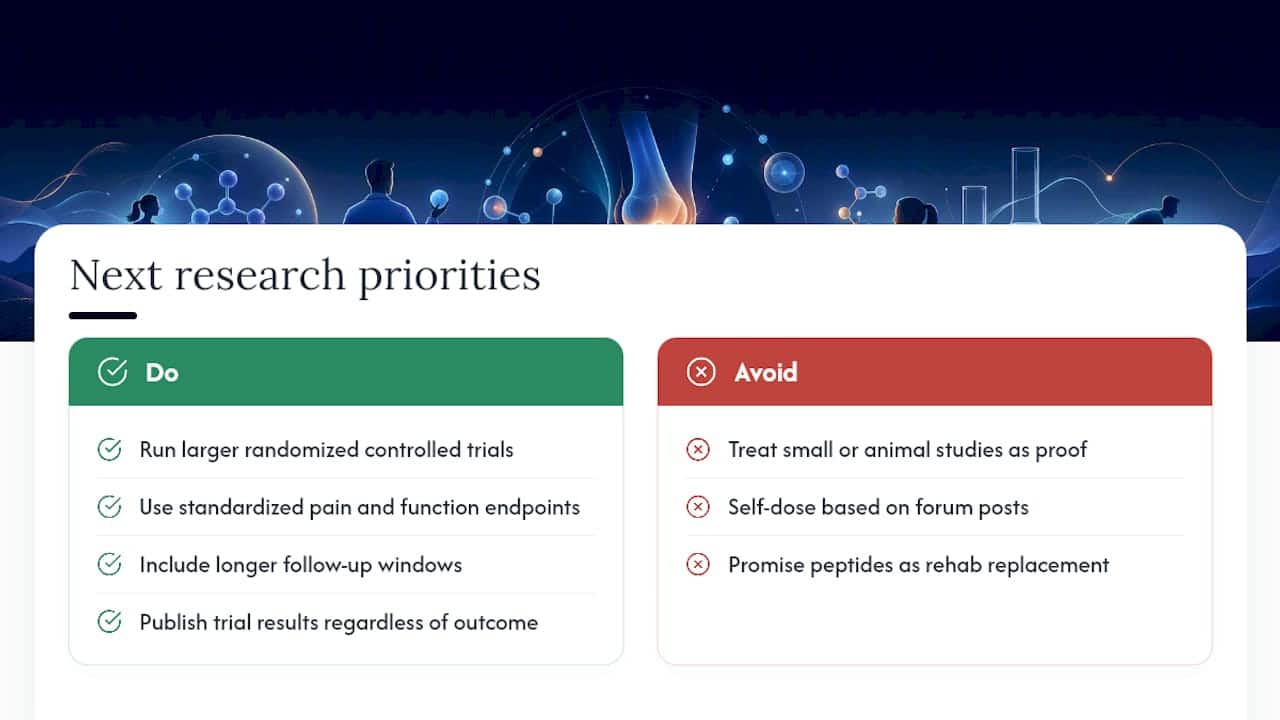
What actually needs to happen is unglamorous: larger randomized controlled trials with standardized pain and function endpoints, follow-up windows long enough to catch effects that take months to show up, and publication of that data regardless of whether the results are flattering. Alongside that, the industry needs transparent COA publication and sterility verification as a baseline expectation, not a premium feature, plus clinician-led protocols for anyone using injectable peptides rather than self-directed dosing based on forum posts.
The most useful role for peptides right now is as a supplement to established rehabilitation, not a replacement for it. Anyone promising otherwise is selling you a conclusion the trials have not reached yet.
— Soma Peptide
Where to find quality-tested peptides if you and your clinician decide to move forward
If you and your clinician land on a peptide approach worth trying, sourcing quality becomes the deciding factor between something worth taking and something that puts you at unnecessary risk. A muscle and recovery peptide category often includes compounds formulated to documented purity standards above 99%, with batch testing information available for anyone who wants to verify what they are actually getting, including clinicians requesting documentation on a patient’s behalf.
Reconstitution matters as much as the peptide itself, since improper mixing or storage can undo any purity advantage before the first dose. Guidance on handling and storage is often provided alongside product listings so buyers are not left guessing.
Have the clinician conversation first. Once you know what you are looking for, browse Soma Peptide’s full product range to compare purity documentation and find the specific compound your plan calls for.
Sources
- Efficacy of specific bioactive collagen peptides in the management of osteoarthritis and activity-related joint pain — PMC / OARSI-related review
- Can collagen supplements help arthritis? — Arthritis Foundation
- Peptides: Doctors explain the benefits, risks and FDA concerns — UCHealth Today
- Peptides: what they are, potential benefits and safety concerns — Harvard Health
FAQ
What is the best peptide for joints?
Oral collagen peptides have the most consistent human trial support for joint pain, with undenatured type II collagen (UC-II) also backed by a controlled trial at 40 mg per day. Injectable peptides like BPC-157 have far weaker human evidence by comparison.
Will BPC-157 help with joint pain?
BPC-157 shows strong effects in animal studies, but human evidence is limited to a small retrospective case series of 12 patients with no control group. That makes it an unproven option for joint pain rather than a validated one.
Do peptides help with joint pain?
Some do, based on actual human trials: oral collagen peptides and UC-II have shown measurable reductions in pain and stiffness over 12 to 24 weeks. Most injectable peptides remain in animal and cell-based research stages for joint-specific use.
What is the peptide that heals joints?
No peptide has been proven in humans to heal joint damage outright. Collagen peptides show the clearest evidence for reducing pain and improving function, while compounds like BPC-157 and TB-500 are studied for tissue repair mechanisms mainly in animal models.
Can peptides cure joint pain?
No peptide currently has human trial evidence supporting a cure for joint pain or arthritis. The strongest data shows symptom improvement with collagen peptides, not reversal or cure of the underlying joint condition.