

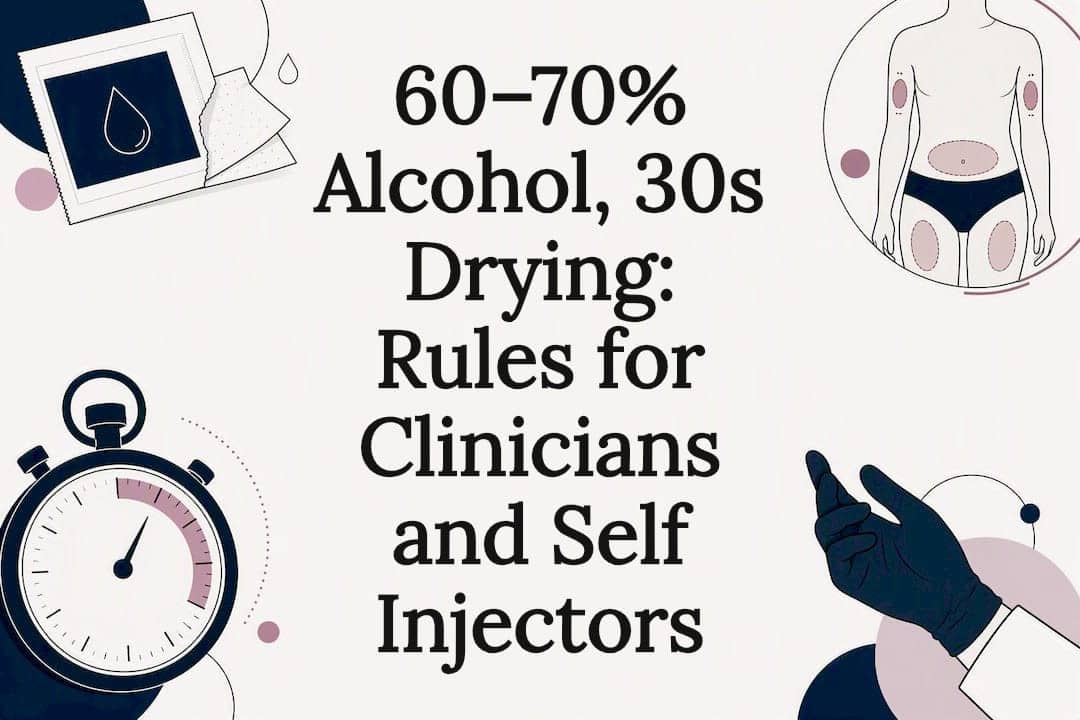
For most routine injections into visibly clean skin, alcohol swabbing is not strictly required. The WHO says soap and water is enough, while the Canadian Immunization Guide recommends antiseptic cleaning as standard practice. When you do use a swab, reach for one saturated with 60–70% isopropyl alcohol or ethanol, and let the site air dry for at least 30 seconds before the needle goes in. When you’re unsure which rule applies, defer to your clinic’s written policy or the specific product’s instructions.
TL;DR:
- Routine injections into visibly clean skin generally do not require alcohol swabbing, as evidence shows no consistent reduction in infection rates.
- Large studies struggle to detect rare infections from injections, leading guidelines to rely on risk assessment rather than definitive proof.
- When skin is dirty or the patient is immunocompromised, using 60–70% alcohol and allowing proper drying remains the recommended practice.
- Proper antiseptic technique involves single-use sterile pads, wiping in a circular motion from the center outward, and waiting at least 30 seconds to air dry.
- Vial disinfection and hand hygiene are crucial steps that complement site antisepsis, reducing contamination risks during medication preparation.
Table of Contents
- What the research actually says about alcohol wipes and infection risk
- When to swab, when to just wash, and when antisepsis matters more
- The technique that actually matters more than the debate itself
- Where alcohol swabs can backfire
- Don’t forget the vial: disinfecting your prep surface matters too
- Where these guidelines come from and how Soma Peptide supports safe practice
- A clinician’s honest take on the swab debate
- Getting the right supplies for safe, at-home injection prep
- Sources
- FAQ
What the research actually says about alcohol wipes and infection risk
The honest answer is that the evidence is thinner than most clinical routines suggest. Randomized controlled trials and systematic reviews looking at skin preparation before injections have found no consistent drop in infection rates when alcohol swabbing is used for routine vaccinations on skin that’s already visibly clean. Some trials even reported more short-term pain in the alcohol-swab group, likely from the stinging of injecting before the site fully dried.
There’s a structural problem baked into this research: injection-site infections are rare events, and most trials simply don’t enrol enough participants to detect a rare outcome reliably. A trial with a few hundred participants can tell you plenty about local skin reactions or discomfort. It tells you almost nothing about an infection that happens once in every few thousand injections.
That gap in statistical power is exactly why guidelines diverge instead of converging.
- The WHO’s position, drawn from its injection best practices toolkit, treats soap-and-water cleaning as acceptable when skin is visibly clean, and doesn’t mandate alcohol-based antisepsis for routine intradermal, subcutaneous, or intramuscular injections.
- The Canadian Immunization Guide takes the more conservative route, advising a suitable antiseptic solution before vaccination and specifying the 60–70% alcohol concentration and drying step.
- A comparative analysis of washing versus alcohol antisepsis found the two methods produced similar reductions in skin bacterial counts in several trial settings, with alcohol earning its place mainly through convenience rather than superior microbial kill.
Baseline infection rates from routine injections are already low, which is part of why trials struggle to show a measurable difference between methods. Large observational datasets on self-injecting insulin users back this up: infections per million injections are minimal whether or not a swab was used, and a few analyses even reported paradoxically higher minor-infection reporting among swab users, a pattern more consistent with confounding and self-report bias than with any real harm from alcohol.
None of this means alcohol wipes are pointless. It means the guideline split you see between the WHO and national bodies like Canada’s reflects a genuine judgment call, not a case where one authority is right and the other is behind the times. Trials are underpowered for rare infections, so guidance ends up balancing pragmatism, resource access, and risk tolerance rather than resting on airtight proof either way.
When to swab, when to just wash, and when antisepsis matters more
Clinicians and self-injectors both benefit from a simple decision tree rather than a blanket rule. Here’s how to work through it in practice:
- Skin looks clean, no special risk factors. Antisepsis is often optional under WHO guidance, so follow whatever your institution’s written protocol specifies, since local policy is what you’re accountable to day to day.
- Skin is visibly dirty or has been in contact with soil, sweat, or debris. Wash with soap and water first, dry the area completely, then proceed. Don’t layer alcohol over a dirty site and call it clean.
- The patient is immunocompromised, the injection site carries elevated infection risk, or the product being injected specifically calls for antisepsis. Use 60–70% isopropyl alcohol or ethanol and follow the full drying protocol. This is not the situation to skip a step to save fifteen seconds.
- You’re working from a manufacturer’s instructions or a specific vaccine monograph that names a required prep method. That instruction overrides the general guideline discussion here. Product-specific direction always wins.
Document whichever path you took. If a clinic’s policy leans toward routine swabbing for consistency and patient reassurance, that’s a defensible position given the guideline split, but it should be written down and applied evenly rather than left to individual judgment call to judgment call.
Pro Tip: If you’re self-injecting peptides at home and your skin looks clean, don’t assume you need to scrub the site raw with alcohol every single time; for guidance on this, see RF at home if you have hyaluronic acid filler: is it safe?. Check the product’s own instructions first; some peptide protocols specify antisepsis, and some leave it to your judgment based on the injection site you’re using.
The technique that actually matters more than the debate itself
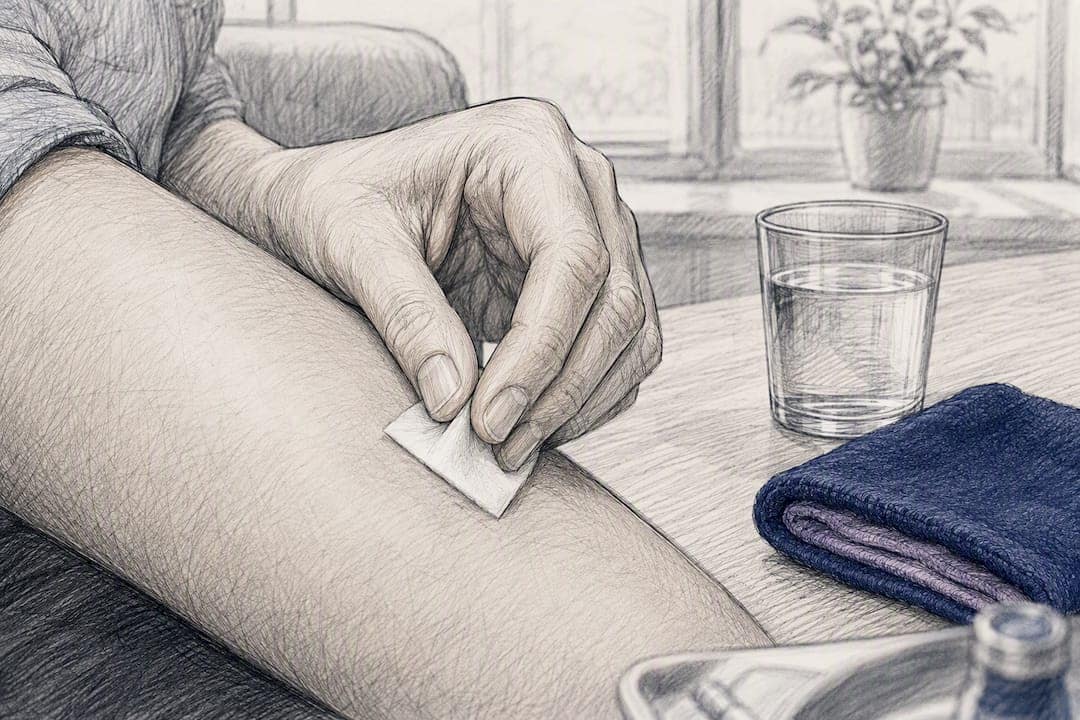
If you decide to use an antiseptic, doing it correctly matters more than the underlying philosophical debate about whether you needed to at all. Sloppy technique with the “right” product defeats the purpose.
Start with a single-use, sterile pad pre-saturated with 60–70% isopropyl alcohol or ethanol. Reusing a pad, or using a bottle-dipped cotton ball shared across patients, defeats the entire point of the exercise and introduces contamination risk of its own.
- Wipe an area roughly 2 inches (5 cm) in diameter, starting at the centre of the injection site and moving outward in a single circular motion.
- Never wipe back and forth. That motion drags skin flora from the outer ring back toward the centre, which is the exact opposite of what you’re trying to achieve.
- Let the site air dry for at least 30 seconds. Don’t blow on it, don’t fan it, don’t touch it to “check.”
That drying window isn’t a formality. Alcohol needs time on the skin to disrupt microbial cell membranes, and injecting into a wet site can push residual alcohol into the tissue, causing a sharper sting than the needle alone would produce. There’s also a theoretical concern with live or attenuated vaccines: alcohol that hasn’t fully evaporated could interact with the vaccine as it’s administered. The Canadian Immunization Guide is explicit on this drying step precisely because skipping it undermines both the antiseptic’s job and the patient’s comfort.
Where alcohol swabs can backfire
Antisepsis isn’t automatically harmless, and treating it as a default without thinking through the context can create its own problems.
- Live or attenuated vaccines need vaccine-specific handling. Because residual alcohol could theoretically compromise a live viral component before it’s absorbed, follow the exact guidance for that specific vaccine rather than defaulting to a standard swab-and-inject routine.
- Frequent self-injectors, including many people running peptide protocols, can develop dry, irritated, or cracked skin from repeated alcohol exposure at the same rotation of sites. If you’re injecting daily or near-daily, watch for this and consider spacing out sites more deliberately.
- Rare serious outcomes tied to injection-site infection do occasionally surface in case reports, but they’re exactly that: rare, and difficult to attribute cleanly to swabbing practice versus other factors given how thin the absolute risk data is. Don’t let an anecdote override a documented policy, but don’t dismiss a genuine pattern either if one turns up in your own practice.
Don’t forget the vial: disinfecting your prep surface matters too
Site antisepsis gets most of the attention, but vial and equipment hygiene often carries more practical weight in preventing contamination.
- Wipe the vial septum with 60–70% alcohol and let it air dry before piercing it with a needle, the same WHO best practices that inform site-cleaning guidance apply directly here.
- Wash your hands before preparing any injection, and wipe down your prep surface if it’s been in contact with anything other than clean, dry supplies.
- Treat site antisepsis and device antisepsis as two separate steps, not one interchangeable ritual. Skipping the vial wipe because you already swabbed the skin (or vice versa) leaves a real gap in the chain.
If you’re reconstituting a lyophilized peptide with bacteriostatic water, this vial-hygiene step is where most contamination risk actually lives, not at the skin surface.
Where these guidelines come from and how Soma Peptide supports safe practice
The recommendations here are drawn from WHO injection standards, Canadian federal immunization guidance, and peer-reviewed clinical reviews, not internal opinion. Soma Peptide applies that same evidence base across its own resources, including guides on injection routes and a broader peptide safety primer for anyone self-administering at home. These pages exist to back up the decision rules above with practical, site-specific detail, not to replace a clinician’s judgment or a product’s own labelling.
A clinician’s honest take on the swab debate
Most clinics keep alcohol swabs in the routine workflow, and that’s a reasonable choice even though the trial data is equivocal. Swabs are cheap, portable, and give staff and patients a visible, standardized action that signals care was taken. That psychological value is real, even when the microbiological value is debatable on visibly clean skin.
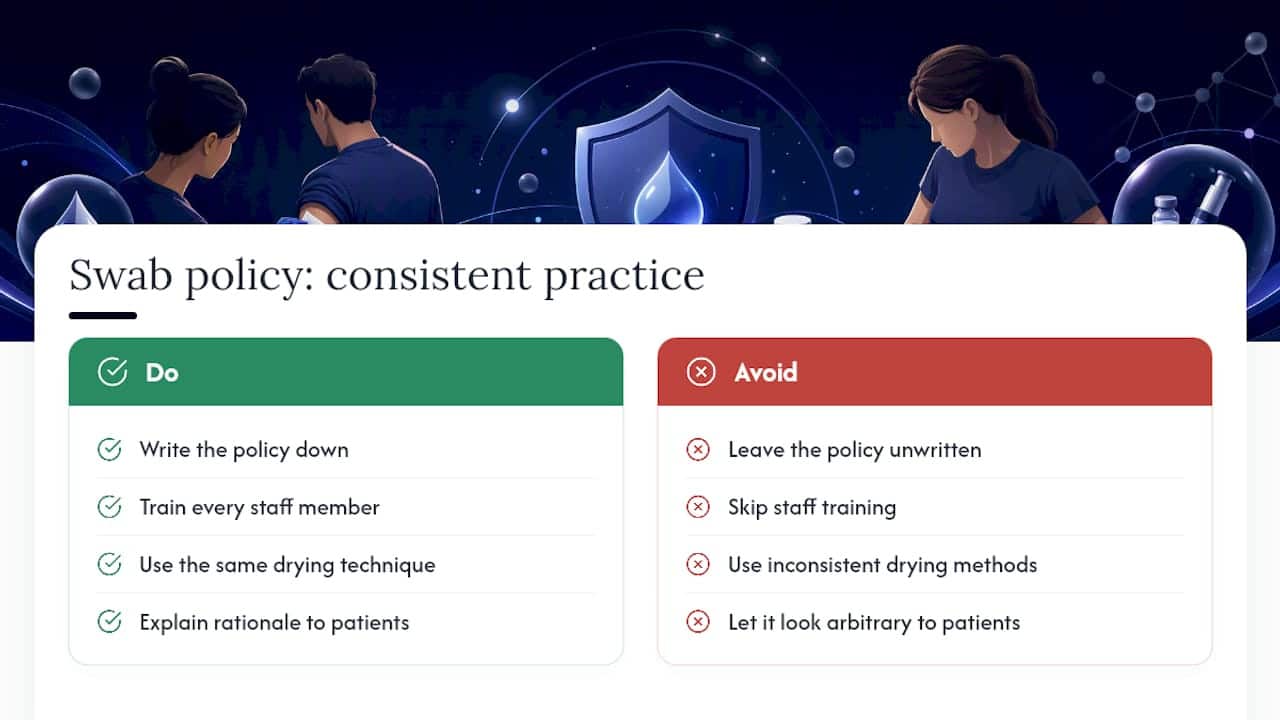
What matters more than which side of the WHO/Canada split your clinic lands on is consistency: write the policy down, train every staff member on the same drying technique, and explain the rationale to patients in plain terms rather than letting it look arbitrary. A line like “we clean the site and let it dry fully, that’s what actually matters” tells a patient more than the swab itself does.
— Soma Peptide
Getting the right supplies for safe, at-home injection prep
If you’re self-administering peptides, the antiseptic and reconstitution supplies you use matter as much as the technique. Ancillary supplies for at-home prep work include sterile alcohol pads, bacteriostatic water, and syringes, alongside evidence-based guides covering everything from site rotation to dosing. Having product specs and technique guidance from the same source cuts down the guesswork of matching the right concentration to the right protocol. Before you order, check the product specs against your specific protocol and confirm dosing or prep steps with a qualified clinician if you’re new to self-injection. Start by browsing Soma Peptide’s full catalogue or, if muscle growth and recovery are your focus, look directly at the peptides for muscle category to see what pairs with your current routine.
Sources
- Best practices for injection — WHO toolkit (NCBI Bookshelf)
- Canadian Immunization Guide — vaccine administration practices (Public Health Agency of Canada)
- Antisepsis before skin injections: does the WHO recommendation for washing, instead of alcohol-based antisepsis, achieve the same efficacy? (PMC)
FAQ
Should I use an alcohol wipe before an injection?
It depends on the setting: the WHO says soap and water is sufficient for visibly clean skin, while the Canadian Immunization Guide recommends antiseptic cleaning as standard. Follow your clinic’s policy or the product’s specific instructions when the two positions conflict.
Can I use isopropyl alcohol to clean my skin before an injection?
Yes, provided it’s 60–70% isopropyl alcohol on a single-use sterile pad, wiped in an outward circular motion and left to air dry for at least 30 seconds before the needle goes in.
Do I need alcohol wipes for Ozempic and similar injections?
Check the product’s own patient instructions first, since some specify antisepsis and others leave it optional on clean skin; when in doubt, a 60–70% alcohol swab with a full drying period is the safer default.
What wipes should I use before injecting?
Use a sterile, single-use pad saturated with 60–70% isopropyl alcohol or ethanol rather than a reused cotton ball or a non-sterile cloth, and discard it after one use.