


GHRP-2 (pralmorelin) is a ghrelin-receptor agonist that reliably triggers large, pulsatile growth hormone releases and increases short-term appetite in healthy adults. Human trials confirm both effects with real numbers attached. Most of what athletes want from it, fat metabolism, lean mass, faster recovery, runs through the GH/IGF-1 axis that this GH surge activates, but those downstream claims rest on physiology and small studies rather than long-term controlled trials. Treat it as clinically documented for two things and plausible, not proven, for the rest.
TL;DR:
- Its effects depend on dose, timing relative to sleep, and simultaneous use of GHRH analogs, with injections typically administered multiple times daily due to its short half-life of roughly 33 minutes.
- Long-term benefits such as fat loss, muscle growth, or anti-aging remain unproven, with data limited to physiological plausibility and small, short-term studies.
- Common side effects include increased hunger, water retention, injection site reactions, and brief surges in cortisol and prolactin, but long-term safety is not established.
- Ensuring peptide purity through third-party verification is crucial, as contaminated or degraded peptides cannot reliably produce the studied effects.
Table of Contents
- What is GHRP-2 and how does it trigger a GH pulse?
- GHRP-2 benefits backed by human data
- The core studies behind every GHRP-2 claim
- Dosing timing and why half-life shapes the protocol
- Side effects, hormonal trade-offs, and what remains unknown
- Why peptide quality changes what you’re actually taking
- Before you start: a short checklist
- Where the evidence comes from
- Our take: separate the pharmacology from the marketing
- Get research-grade GHRP-2 without guessing at what’s in the vial
- Sources
- FAQ
What is GHRP-2 and how does it trigger a GH pulse?
GHRP-2, also known as pralmorelin or pralmorelin hydrochloride, is a synthetic hexapeptide that mimics ghrelin, the hormone your stomach releases when it’s empty. That’s the whole story of what is GHRP-2 in one sentence: a ghrelin mimic that happens to be an extremely efficient growth hormone trigger.
The mechanism has two moving parts working together. First, GHRP-2 binds to the ghrelin receptor (GHS-R1a) in the hypothalamus and pituitary gland, directly stimulating somatotroph cells to release GH. Second, and this is the part most people miss, it suppresses somatostatin, the hormone that normally puts a ceiling on GH release. With that brake loosened, each pulse gets bigger than it would from ghrelin alone.
This is pulsatile, not sustained. GH rises sharply for roughly an hour or two after a dose, then falls back to baseline. That transient pattern matters for anyone designing a protocol, because it mimics how the body naturally secretes growth hormone in bursts, mostly during deep sleep, rather than as a constant drip. Flooding the system continuously isn’t how this axis is built to work, and it isn’t how GHRP-2 works either.
Combining GHRP-2 with a GHRH analog (like GHRH peptide protocols commonly discussed alongside it) produces a synergistic peak because the two compounds act through separate receptors. GHRH directly stimulates the pituitary while GHRP-2 removes the somatostatin brake, and research on this receptor interplay shows the combined GH peak exceeds what either compound produces alone.
Three things drive the size of a GH pulse:
- Dose administered, since human pharmacokinetic data confirm a dose-dependent response
- Whether somatostatin tone is already low (which is why timing near sleep matters)
- Whether a GHRH analog is stacked alongside it
Pro Tip: If you’re trying to understand why some protocols pair GHRP-2 with a GHRH analog instead of using either alone, think of it as one peptide releasing the brake and the other pressing the gas. Using just one still moves the car; using both moves it faster.
GHRP-2 benefits backed by human data
The strongest, most defensible GHRP-2 benefits fall into two categories: appetite and GH output. Everything past that gets murkier the further you get from the injection site.
Appetite increase is quantified, not anecdotal. A controlled infusion study in healthy men found GHRP-2 increased caloric intake by 35.9% ± 10.9% versus placebo, a statistically significant jump (p = 0.008), aligning well with insights from a protein leverage diet that explains appetite modulation and dietary strategies. This is the clearest, best-documented of all the GHRP-2 effects, and it’s also the one that trips people up: if you’re using GHRP-2 for muscle growth while trying to stay lean, the hunger surge can work against a calorie deficit. If you’re underweight or recovering from illness, that same effect becomes the point.
GH release magnitude is well-characterized. The same study measured a GH area-under-curve of 5,550 ± 1,090 µg/L over 240 minutes, compared to 412 ± 161 µg/L on placebo, a more than tenfold difference (p = 0.003). That’s not a subtle bump. It’s one of the larger acute GH responses documented for any secretagogue in human pharmacology literature.
Here’s where the evidence gets thinner:
- Body composition and fat metabolism: GH and IGF-1 are established drivers of lipolysis and protein synthesis, so a reliable GH pulse plausibly supports fat loss and lean tissue retention. No published trial has isolated GHRP-2 specifically and tracked body composition changes over months in healthy adults. This is physiology extrapolated forward, not a measured outcome.
- Recovery and subjective fatigue: Case reports and small studies describe improved energy and reduced fatigue in patients using GHRP-2 therapeutically, but these come from clinical populations with specific deficiencies, not athletes managing training load.
- Sleep quality: Since natural GH secretion peaks during slow-wave sleep, and GHRP-2 amplifies GH pulses, there’s a plausible two-way relationship. Better sleep architecture supports bigger natural GH pulses, and some users report deeper sleep on GHRP-2 taken before bed. Direct polysomnography data on GHRP-2 itself is limited.
- Neuroprotective effects: IGF-1 has documented roles in neuronal health in animal models, but human evidence connecting GHRP-2 specifically to any anti-aging benefit remains preclinical or indirect.
The 35.9% appetite increase and the tenfold GH AUC difference are the two figures with the most solid, replicated backing in the human pharmacology literature. Everything else discussed as a GHRP-2 benefit sits somewhere between “biologically plausible” and “reported in a handful of patients.”
If your goal is GHRP-2 for muscle growth specifically, know that the mechanism supports the claim (more GH and IGF-1 signalling generally favours protein synthesis) but no randomized trial has measured lean mass gains from GHRP-2 alone in healthy training adults. Compare that to the appetite data, which comes from a controlled, placebo-matched trial with a clear p-value. That’s the honest distinction between GHRP-2 results that are documented and GHRP-2 results that are inferred.
The core studies behind every GHRP-2 claim
Three papers do most of the heavy lifting in the GHRP-2 literature, and each one tells you something different.
- Laferrère et al. (2005) ran the infusion study cited above in healthy men, the source of both the 35.9% caloric intake increase and the GH AUC figures. This remains the most cited piece of evidence for GHRP-2 hunger and GH effects because it used a placebo control and measured actual food intake, not just self-reported appetite.
- Pihoker et al. conducted the phase I pharmacokinetic study establishing dose-dependent GH release and a terminal plasma half-life of approximately 33 minutes. This is the paper that tells you why GHRP-2 needs repeat dosing to sustain any effect: it clears the bloodstream fast.
- Haruta et al. (2015) published a peer-reviewed case report on a severely emaciated anorexia nervosa patient given intranasal GHRP-2 daily before meals for one year. The patient gained 6.7 kg over 14 months, with documented improvements in fatigue, muscle strength, and hypoglycaemia.
The limitations matter as much as the findings. Laferrère’s study measured acute, single-session effects, not what happens over months of repeated dosing. Pihoker’s pharmacokinetic data came from a small cohort and doesn’t address long-term outcomes at all. Haruta’s case report is exactly that, a single patient, not a trial, and the therapeutic context (severe emaciation from anorexia nervosa) is a world away from a healthy athlete chasing recovery gains. None of these papers were designed to answer “does GHRP-2 build muscle in healthy adults,” and none of them do.
Dosing timing and why half-life shapes the protocol
The 33 minute terminal half-life measured in Pihoker’s pharmacokinetic study explains almost every dosing pattern you’ll see discussed for GHRP-2. A compound that clears this fast can’t sustain a GH pulse on its own. It spikes, falls, and disappears within roughly two hours.
That kinetics profile drives a few practical realities:
- Multiple smaller doses spread through the day produce more distinct GH pulses than one large dose, since a single bolus still clears within a couple of hours regardless of size.
- Clinical studies have used intravenous and intranasal routes; community protocols typically use subcutaneous injection, which has a slower onset than IV but is more practical outside a clinical setting.
- Pre-sleep dosing is common in community use because it theoretically layers an exogenous pulse on top of the body’s own overnight GH surge, though this timing rationale comes from protocol logic rather than a dedicated trial.
- Dosing near training sessions follows similar reasoning, aligning the pulse with periods when GH-driven recovery processes are already active.
- Dosing away from meals is sometimes recommended because GHRP-2 raises blood glucose transiently, and food intake around that window can complicate glucose readings.
None of this constitutes a validated clinical protocol. Every specific dosing schedule discussed for performance or anti-aging use is off-label and unsupported by phase III trials. Anyone considering GHRP-2 should treat timing decisions as something to work through with a supervising clinician, not something to reverse-engineer from a forum post.
Side effects, hormonal trade-offs, and what remains unknown
GHRP-2’s side effect profile is well-documented for short-term use and essentially uncharted for long-term use, and that gap is the single most important thing to understand before starting.
The known, generally mild effects include:
- Increased hunger, the same appetite mechanism that produces the 35.9% caloric intake jump, which becomes a side effect rather than a benefit if you’re trying to stay in a calorie deficit
- Water retention, common with GH secretagogues generally
- Injection site reactions when administered subcutaneously
- Headache, reported in a subset of users
The hormonal cross-effects are the part worth taking seriously. GHRP-2 causes transient elevations in cortisol and prolactin alongside its GH release, and this is one of the traits that distinguishes it from cleaner secretagogues like GHRP-6 or ipamorelin. These elevations are generally described as dose-dependent and short-lived, returning toward baseline within an hour or two, but repeated daily elevation over months hasn’t been systematically studied outside the clinical populations in the existing case literature.
What’s genuinely unknown matters more than what’s known. There are no long-term safety trials of GHRP-2 for performance or anti-aging use in healthy adults. Its regulatory footing reflects that gap directly: pralmorelin is approved in Japan as a single-dose diagnostic agent for detecting growth hormone deficiency, not as an ongoing therapeutic. Any use beyond that diagnostic context is off-label, including the anorexia nervosa case report discussed above.
People with a history of hormone-sensitive conditions, uncontrolled diabetes, or active malignancy should discuss GHRP-2 with a physician before considering it at all, given its effects on IGF-1, cortisol, and glucose regulation.
Pro Tip: If a clinician suggests baseline bloodwork before starting anything in this category, that’s not caution for caution’s sake. It’s the only way to tell whether cortisol, prolactin, or glucose is drifting outside a normal range over time, since you won’t feel that happening day to day.
Why peptide quality changes what you’re actually taking
A peptide’s documented effects only apply to what was tested, and what was tested was a pure, correctly synthesized compound. Contaminated or degraded peptide doesn’t behave the same way, and there’s no way to know from the outside whether a vial contains what the label says.
A handful of things matter when you’re evaluating any peptide source:
- Third-party purity verification rather than a manufacturer’s unverified claim
- Clear sourcing of the peptide sequence and formulation details
- Product pages that explain mechanism and dosing context rather than just listing a price
Soma Peptide’s GHRH peptide and peptides growth hormone resources cover the broader mechanism landscape if you want context beyond GHRP-2 specifically. None of this replaces a conversation with a clinician. Product pages exist to inform purchasing decisions, not to substitute for individualized medical guidance about whether GHRP-2 fits your health situation.
Before you start: a short checklist
Walking into a clinician conversation prepared makes the difference between a useful appointment and a wasted one.
- Disclose full medical history, especially any hormone-sensitive condition, diabetes, or prior pituitary issues, since GHRP-2 affects cortisol, prolactin, and glucose.
- Ask about baseline testing, including IGF-1, a fasting glucose or metabolic panel, and relevant hormone markers, before starting anything.
- Discuss stacking honestly. Adding a GHRH analog increases the GH response, but it also increases the hormonal load your body has to manage, so more isn’t automatically better.
- Set a monitoring cadence with your clinician for repeat bloodwork rather than dosing indefinitely without rechecking.
- Separate curiosity from need. If your interest is body composition, review the best peptides for muscle growth landscape broadly before committing to one compound.
Where the evidence comes from
The claims in this guide rest on a small set of primary sources, not consensus guides or forum summaries.
- Laferrère et al., Journal of Clinical Endocrinology & Metabolism: the controlled infusion trial behind the appetite and GH AUC figures.
- Pihoker et al., phase I pharmacokinetic study: dose-response and half-life data.
- Haruta et al., PMC case report: the one-year intranasal case showing weight gain and symptom improvement.
- PMC review on GHRP-2 and GHRH synergy: mechanism data on combined dosing.
Our take: separate the pharmacology from the marketing
The honest read on GHRP-2 is that it does exactly two things with strong human evidence behind them: it drives a large GH pulse, and it makes you hungry. Everything past that point, muscle growth, fat loss, anti-aging, better sleep, is a reasonable inference from GH/IGF-1 physiology, not a documented outcome from a controlled trial.
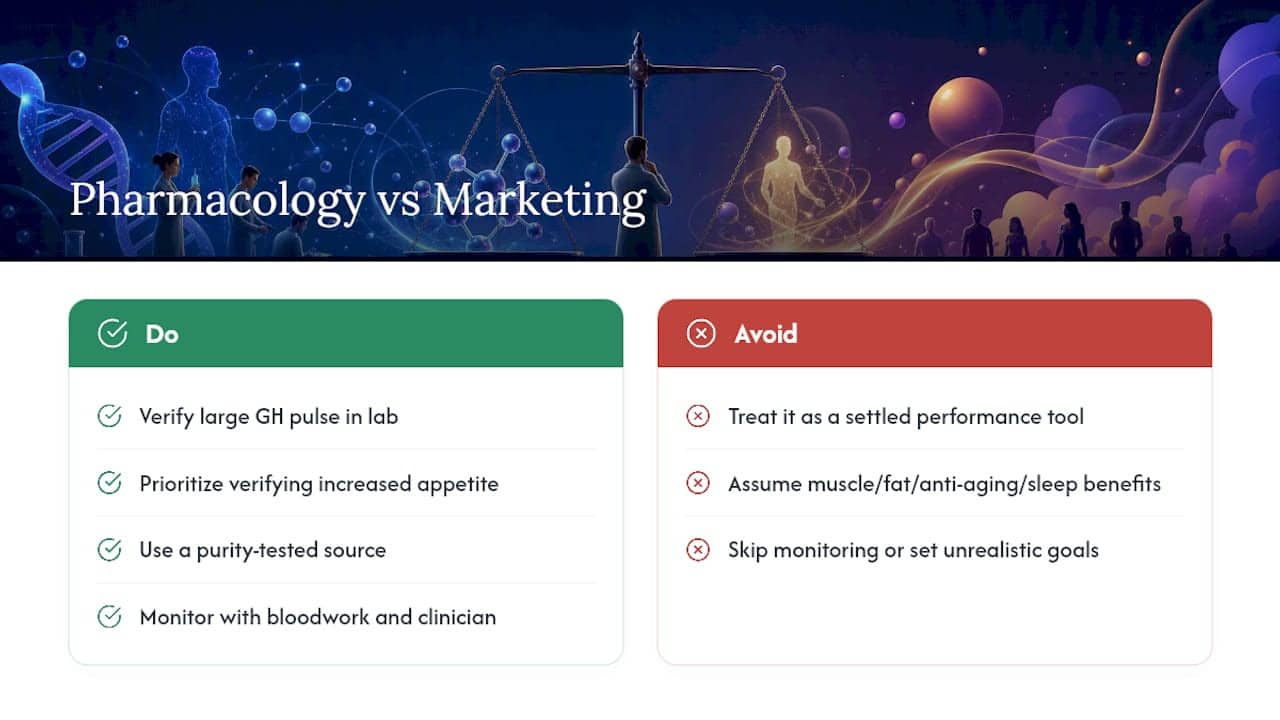
Where conventional advice falls short is treating GHRP-2 like a settled performance tool rather than what the pharmacology actually shows: a well-characterized diagnostic-grade compound being used off-label for goals it hasn’t been formally tested against. That doesn’t make it useless. It means the burden of monitoring, from bloodwork to realistic expectations, sits with the person using it and the clinician supervising them.
Prioritize the two things you can actually verify happened in a lab before chasing the five things you’re hoping will follow. If you’re going to use GHRP-2 at all, use a source that treats purity as seriously as the studies did.
— Soma Peptide
Get research-grade GHRP-2 without guessing at what’s in the vial
That’s the real gap in this category: plenty of sellers move product with no verifiable purity standard attached, which makes every dosing decision you make downstream unreliable no matter how carefully you plan it.
Reconstitution supplies like bacteriostatic water, syringes, and alcohol pads are commonly sourced alongside peptides to ensure proper preparation. If your interest runs toward the muscle and recovery angle discussed above, the peptides for muscle collection lays out the broader options worth comparing before you commit to a protocol. Start by reviewing product specifications and purity documentation on the Soma Peptide site before placing an order.
This article is general information, not a substitute for advice from a qualified doctor. Consult a qualified healthcare professional about your own circumstances before acting on anything here.
Sources
- Growth hormone releasing peptide-2 (GHRP-2) increases food intake in healthy men — Journal of Clinical Endocrinology & Metabolism (Laferrère et al.)
- One-year intranasal application of growth hormone releasing peptide-2 improves body weight and hypoglycaemia in a severely emaciated anorexia nervosa patient — PMC (Haruta et al.)
- Phase I pharmacokinetic/pharmacodynamic study of GHRP‑2 (Pihoker et al.)
FAQ
What is GHRP-2 peptide good for?
GHRP-2 is best documented for triggering large, pulsatile growth hormone releases and increasing short-term appetite. Body composition, recovery, and anti-aging effects are physiologically plausible through the GH/IGF-1 axis but lack dedicated long-term human trials.
Does GHRP-2 make you hungry?
Yes. A controlled human study found GHRP-2 increased caloric intake by 35.9% compared to placebo, making appetite stimulation one of its most reliably documented effects.
When should I take GHRP-2?
Community protocols often time doses before sleep or around training to align with the body’s natural GH pulse pattern, but no clinical trial has validated a specific timing schedule for performance use; this should be discussed with a supervising clinician.
What are the side effects of taking GHRP-2?
Commonly reported effects include increased hunger, water retention, injection site reactions, and headache, alongside transient increases in cortisol and prolactin that typically return to baseline within a couple of hours.