Short answer: peptides sold for weight loss, muscle growth, or anti-aging are only legal in Canada when they carry a Drug Identification Number or Natural Product Number from Health Canada. Most injectable performance peptides on the grey market do not have one. Do not inject anything without a DIN, and talk to a healthcare professional before you start any peptide protocol.
TL;DR:
- Most injectable peptides sold online without a Drug Identification Number are unauthorized and pose serious health risks, including contamination and organ strain.
- Canadian law classifies peptides as drugs based on intended use, route of administration, and marketing claims, making performance-enhancing peptides illegal if they lack market authorization.
- Importing peptides for personal use is strictly limited to narrow conditions, and unverified products can be seized at the border or during domestic enforcement actions.
- Legitimate, high-purity peptides are backed by third-party lab certificates, precise labeling, and should be purchased through licensed pharmacies or verified suppliers like Soma Peptide.
- Checking the product’s DIN or NPN against Health Canada’s databases is essential to verify legality; unlisted products are not authorized for human use in Canada.
Table of Contents
- Peptide legality in Canada: what the Food and Drugs Act actually says
- What are the real health risks of unauthorized peptides?
- Can I legally import peptides into Canada for personal use?
- How to buy peptides legally and safely in Canada
- What does a legitimate, high-purity peptide source look like?
- Do provincial rules on peptides differ across Canada?
- What happens if you’re caught with unauthorized peptides?
- How do you verify a peptide product beyond checking the label?
- Does the Canada Border Services Agency stop peptide shipments?
- What legal alternatives does Health Canada actually approve?
- The gap between demand and the law isn’t closing on its own
- Where to find lawful, high-purity peptide products
- Sources
- FAQ
Peptide legality in Canada: what the Food and Drugs Act actually says
Canadian law does not classify peptides by what a seller calls them. It classifies them by what they are meant to do, how they enter your body, and what claims accompany the sale. A peptide marketed to “boost recovery” or “burn fat” and injected into your body is functioning as a drug under the Food and Drugs Act, regardless of whether the label says “research chemical.”
Health Canada’s own advisory is blunt about this: most injectable peptides sold online for performance or anti-aging purposes are unauthorized, and authorized products must display an eight-digit DIN, an NPN, or a DIN-HM. That number is the entire ballgame. If it is not there, Health Canada has not assessed the product for safety, purity, or effectiveness, no matter what a certificate of analysis on the seller’s site claims.
The legal test for whether something counts as a drug comes down to three factors:
- Intended use — is it presented as something that treats, prevents, or alters a physiological function?
- Route of administration — injectables face far stricter scrutiny than topical or oral products.
- Marketing claims — words like “anti-aging,” “fat loss,” or “muscle building” tip a product into drug territory fast.
Enforcement has escalated to match the growing market. Legal analysis from Gowling WLG notes that Health Canada obtained a permanent injunction in Québec in 2026 against a Canadian retailer selling unauthorized injectable peptides, and “for research use only” labelling did not shield the seller. Health Canada also treats peptide products marketed under a research disclaimer the same way it treats one marketed openly, since the label does not change how the product is actually presented or sold.
What are the real health risks of unauthorized peptides?
Unauthorized injectable peptides skip every safety checkpoint a legitimate drug goes through before it reaches you. That gap shows up as real, sometimes serious harm.
The risks fall into a few predictable categories:
- Contamination from unsterile manufacturing, since these products are never inspected the way pharmaceutical-grade drugs are.
- Infection at injection sites, particularly with reused or improperly stored vials.
- Dosing errors, because concentration and purity are not independently verified.
- Hormonal imbalance, especially with peptides that act on growth hormone or insulin pathways.
- Organ strain, including kidney and liver stress reported with unregulated growth hormone secretagogues.
- Unknown impurities, since Health Canada has confirmed unauthorized peptides have not been assessed for safety, efficacy, or quality at all.
A “research use only” sticker does not neutralize any of that. It is a legal dodge, not a safety measure, and Health Canada has said as much directly. If you have already used an unauthorized injectable peptide, Health Canada’s advisory following a public seizure of injectable peptides recommends consulting a healthcare professional, particularly if you notice swelling, fever, or unusual symptoms at the injection site.
Pro Tip: Keep the original packaging and any batch numbers if you experience a reaction. That information helps a clinician and helps Health Canada track a bad batch back to its source.
Can I legally import peptides into Canada for personal use?
Not the way most people assume. Health Canada’s personal importation guidance, known as GUI-0116, sets out narrow conditions for bringing health products into the country, and prescription drugs face the tightest restrictions of all.
- The 90-day rule is not a green light. Canadian residents are generally not permitted to import prescription drugs by mail or courier at all, and the limited personal-use exceptions that exist typically cap supply at 90 days, tied to specific circumstances such as a valid existing prescription.
- Special routes exist, but they are not for casual buyers. A Special Access Program or clinical trial authorization can allow access to a therapeutic peptide unavailable in Canada, but these pathways require documentation and physician involvement that a website checkout simply cannot replicate.
- Domestic shipping fixes nothing. A seller shipping from a Canadian warehouse instead of overseas does not change the product’s legal status. Health Canada’s enforcement focus is the product itself and the seller’s conduct, not where the parcel started its journey, and border and customs risk applies either way.
How to buy peptides legally and safely in Canada
The lawful path is narrower than the marketing suggests, but it is not complicated once you know where to look.
Start with Health Canada’s Drug Product Database and Licensed Natural Health Products Database before you buy anything. Type in the DIN or NPN printed on the packaging. If it does not match a real, active listing, walk away.
From there, a few habits separate a safe purchase from a risky one:
- Buy prescription-only peptide medicines exclusively through a licensed pharmacy, never a direct-to-consumer website.
- Ask your doctor or nurse practitioner about clinically authorized options rather than sourcing performance peptides yourself; some GLP-1 receptor agonists and insulin analogues are legitimately approved peptide therapeutics in Canada, even though most peptides promoted for bodybuilding, such as BPC-157, TB-500, CJC-1295, and ipamorelin, currently lack market authorization.
- Understand that topical or cosmetic peptide products face a different bar than injectables. A skin cream with a peptide ingredient making no drug-like claim can sit in a lighter regulatory category, but the moment a product claims to reverse aging or rebuild tissue, it risks reclassification.
Here is a number worth sitting with: a Gowling WLG legal review found that the majority of peptides currently marketed to Canadian consumers for bodybuilding and anti-aging purposes have no market authorization at all, even as demand for them keeps climbing.
What does a legitimate, high-purity peptide source look like?
Purity claims mean nothing without verification behind them. This is where a reputable supplier separates itself from a grey-market seller hiding behind a disclaimer.
Soma Peptide formulates its research-grade peptides to exceed 99% purity using advanced purification methods, and backs that claim with third-party lab certificates of analysis rather than asking customers to take purity on faith. The scientifically-grounded approach targets specific, documented concerns such as fat reduction, muscle growth, and anti-aging, instead of making vague, catch-all promises.
Before you trust any peptide product, check for these markers:
- A third-party certificate of analysis you can actually view, not just a claim of “lab tested.”
- Clear, specific labelling that states concentration, batch number, and storage requirements.
- Clinician guidance available or recommended before use, rather than a checkout page that skips straight to “add to cart.”
Do provincial rules on peptides differ across Canada?
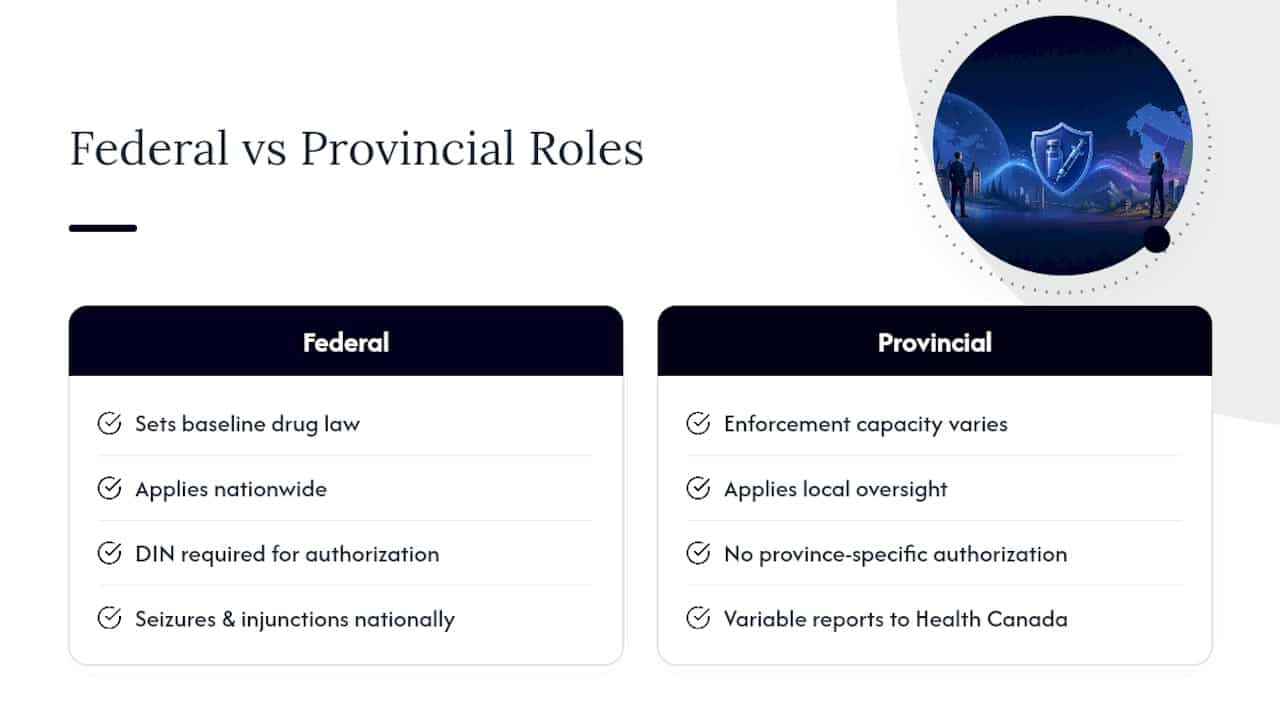
Federal law sets the baseline, and it applies everywhere. The Food and Drugs Act and Health Canada’s drug authorization framework do not change at provincial borders, so a peptide without a DIN is unauthorized in British Columbia exactly as it is in Nova Scotia.
Where provinces diverge is enforcement capacity and pharmacy oversight, not the underlying legal status of the product. Provincial colleges of pharmacists regulate how licensed pharmacies dispense prescription medications, including approved peptide therapeutics, and those rules govern who can dispense what and under which conditions. A pharmacist in Ontario and a pharmacist in Alberta both need a valid prescription to hand over an authorized peptide drug, but the professional oversight bodies enforcing pharmacy conduct are provincial.
Public health units and provincial consumer protection offices also vary in how actively they flag unauthorized online sellers to Health Canada, which is a federal enforcement matter regardless of where the seller or buyer is located. That means a product illegally sold in one province is just as illegal in another. The seizure and injunction actions Health Canada has already pursued, including the permanent injunction against a Québec-based retailer, show federal authorities acting nationally rather than deferring to provincial boundaries. Do not assume a product is safer or more legal because a seller operates out of a specific province with a reputation for looser enforcement. The federal rule follows the product everywhere in the country.
What happens if you’re caught with unauthorized peptides?
Consequences scale with role. Someone possessing a small personal supply faces a very different exposure than someone importing, manufacturing, or selling unauthorized peptides commercially.
For sellers and distributors, the Food and Drugs Act allows for significant penalties, including fines and potential imprisonment for knowingly selling unauthorized drugs, and Health Canada has shown it will pursue civil remedies like injunctions to shut operations down entirely. The permanent injunction obtained against a Canadian online retailer in 2026 is a clear signal that regulators are treating this market with the same seriousness as other unauthorized prescription drug sales, not as a grey-area hobby industry.
For individual buyers, the immediate practical risk is usually seizure at the border or during a domestic enforcement action, along with the health consequences already covered. Legal jeopardy for personal possession alone is lower than for distribution, but it is not zero, particularly if quantities suggest resale intent or if a product is linked to a broader investigation. Health Canada’s public advisories following seizures focus on consumer health warnings rather than prosecuting buyers, but that focus can shift as enforcement priorities evolve. The safest assumption is that any unauthorized peptide purchase carries both legal and health risk, and neither risk disappears just because a transaction went through smoothly once.
How do you verify a peptide product beyond checking the label?
A DIN check is the starting point, not the finish line. Labels can be faked, and databases can be searched incorrectly if you do not know what you are looking for.
Cross-reference the DIN or NPN directly against Health Canada’s official database entry, checking that the product name, dosage form, and manufacturer listed online match exactly what is printed on your packaging. A mismatch, even a minor one, is a red flag. Look for a batch-specific certificate of analysis rather than a generic purity statement that could apply to any batch a company has ever produced. Genuine third-party lab reports include a test date, a specific batch or lot number, and the testing laboratory’s name and accreditation, not just a purity percentage floating with no context.
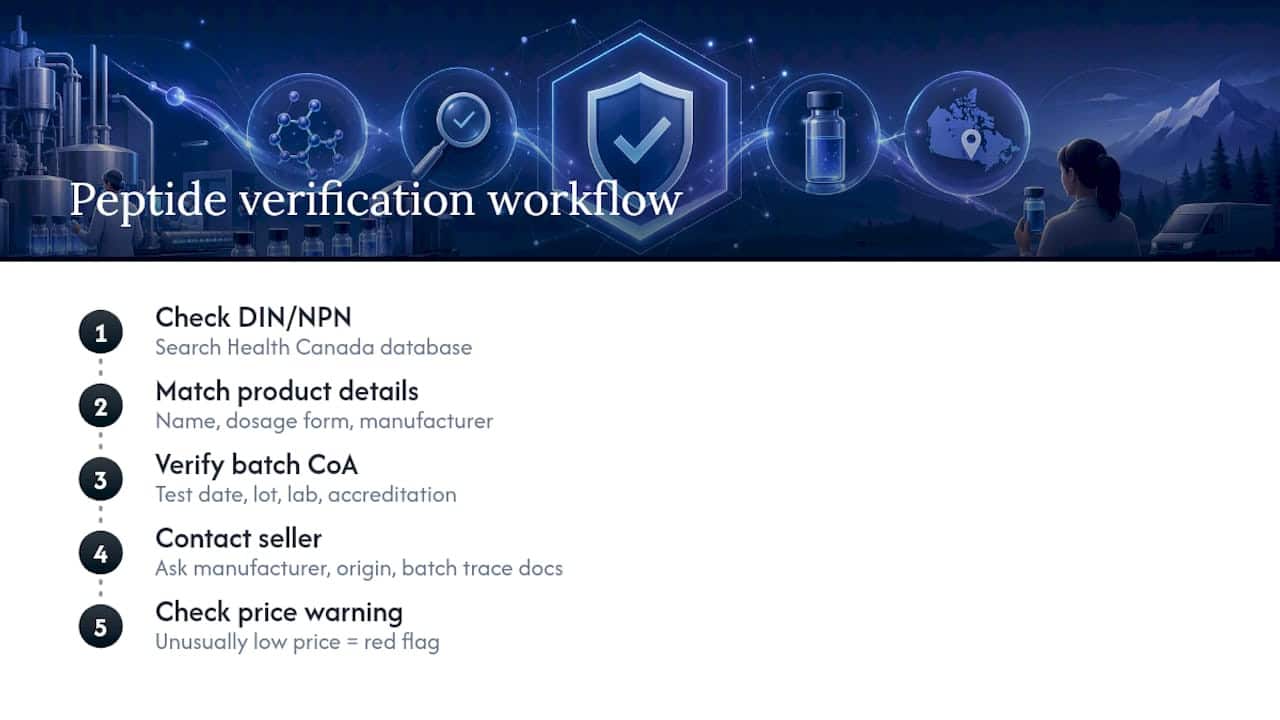
Contact the seller directly and ask pointed questions: who manufactures the product, where, and can they provide documentation tying a specific batch to a specific lab result. A legitimate supplier answers this without hesitation. A grey-market seller tends to deflect, stall, or offer a certificate that looks impressive but cannot be traced to an accredited lab. If a price looks dramatically lower than every other option for what claims to be the same purity and formulation, treat that as a warning sign rather than a bargain.
Does the Canada Border Services Agency stop peptide shipments?
Yes, and its role extends well past personal importation limits. The Canada Border Services Agency works alongside Health Canada to intercept shipments of unauthorized health products at the border, including commercial-scale imports intended for resale, not just individual parcels flagged under the personal-use exceptions in GUI-0116.
CBSA officers can detain, seize, or refuse entry to shipments they suspect contain unauthorized prescription drugs, and they routinely refer suspected import violations to Health Canada for further investigation and possible enforcement action. This applies whether the shipment is a single vial addressed to an individual or a bulk order destined for resale through a domestic website. Importers attempting to bring in larger quantities, or repeat importers flagged by prior seizures, face heightened scrutiny and a real possibility of the shipment being destroyed rather than returned.
The practical takeaway is that CBSA involvement is not limited to catching individual buyers trying to skirt the 90-day personal-use rule. It is one layer of a broader enforcement system working with Health Canada to keep unauthorized injectable peptides out of the Canadian market at the source, which is exactly why understanding the ordering process before you buy anything matters more than most buyers assume.
What legal alternatives does Health Canada actually approve?
Authorized options exist, and they cover more ground than most people realize. The gap is between what is legally available and what grey-market marketing has convinced people they need.
For weight management, certain GLP-1 receptor agonists carry full Health Canada authorization and are prescribed through licensed physicians and dispensed by licensed pharmacies, a completely different pathway from an unregulated injectable ordered online. For muscle growth and recovery, authorized options are more limited and typically involve prescription-only hormone therapies used under direct medical supervision for diagnosed conditions, rather than the broad performance-enhancement claims common in grey-market marketing. For anti-aging and skin concerns, some topical peptide-containing cosmetic products can be lawfully sold without a DIN, provided their claims stay within cosmetic rather than drug territory. The line matters: a cream claiming to “moisturize and improve skin texture” sits in a different category than one claiming to “reverse aging at the cellular level.”
The honest answer for performance peptides specifically is that legal options remain narrow, and most products marketed for bodybuilding are still unauthorized. That is precisely why sourcing documented, high-purity products and pairing them with clinician guidance matters more than chasing the most aggressive marketing claim you can find online.
The gap between demand and the law isn’t closing on its own
Interest in peptides for weight loss, recovery, and anti-aging is not going away, and pretending otherwise helps no one. What needs to change is how Canadians approach the purchase.
Health Canada has been consistent: most injectable peptides on the consumer market lack the market authorization that would make them legal to sell for human use, and that gap in oversight is exactly where contamination, dosing errors, and organ strain enter the picture. None of that means the underlying science behind peptides is bogus. It means the unregulated sales channel around them is the actual problem.
Before you buy anything, check the DIN, talk to a healthcare professional about what is actually appropriate for your goals, and report a seller who cannot produce real documentation. The peptides worth using are the ones you can verify.
— Soma Peptide
Where to find lawful, high-purity peptide products
There is no shortage of sellers online promising the purest peptides at the lowest price, and almost none of them will show you a real, batch-specific lab report. That gap is exactly what to check before you spend a dollar.
Soma Peptide backs its research-grade formulations with third-party certificates of analysis and purity that exceeds 99%, achieved through advanced purification methods rather than marketing language alone. The site organizes products by concern, whether that’s weight loss, muscle growth and recovery, or anti-aging support, so you’re not guessing which product matches your goal. Every listing is meant to be checked, not just trusted: review the documentation, then talk to a clinician about whether a given peptide fits your specific situation before you order. Browse the full product range to see documented purity standards and category options for your goals, and check the certificate of analysis on any product page before you buy.
This article is general information, not a substitute for advice from a qualified doctor. Consult a qualified healthcare professional about your own circumstances before acting on anything here.
Sources
- Think twice before injecting peptides bought online: unauthorized products can seriously harm you – Canada.ca
- Canada
- Peptides in Canada: regulatory reality is catching up with the hype – Gowling WLG
- Public advisory – Unauthorized injectable peptide drugs seized and sold by Canada Peptide may pose serious health risks – Newswire
FAQ
Is personal importation of peptides ever allowed in Canada?
Only in narrow circumstances. Health Canada’s GUI-0116 guidance generally restricts prescription drug importation by mail or courier, with limited personal-use exceptions tied to specific conditions like an existing prescription.
Does a “research use only” label make a peptide legal?
No. Health Canada has stated that disclaimers like “research use only” do not change how a product is regulated if it’s marketed or used for human purposes.
What should I do if I already used an unauthorized peptide?
Consult a healthcare professional, especially if you notice swelling, fever, or unusual symptoms at the injection site. Health Canada’s public advisory following a peptide seizure recommends this step directly and encourages reporting adverse reactions.
How do I check if a peptide product has a valid DIN?
Search the product name or DIN directly in Health Canada’s Drug Product Database or Licensed Natural Health Products Database and confirm the listing matches your packaging exactly. If there’s no match, the product is unauthorized.
Does Soma Peptide sell products with a DIN?
Soma Peptide sells research-grade peptides backed by third-party certificates of analysis confirming purity above 99%, positioned for documented, high-purity use rather than as authorized prescription drugs. Always verify a product’s authorization status independently and consult a clinician before use.