Accept a peptide as genuinely third-party tested only when four things are verifiable at once: a named, ISO/IEC 17025 accredited laboratory, a certificate of analysis (COA) whose lot number matches the vial in hand, purity confirmed by HPLC, and identity confirmed by LC‑MS. If a supplier can’t produce all four on request, treat the “third-party tested” label as unverified marketing copy, not proof.
Before you trust any batch for research use, run this checklist:
- Named lab, not a logo. The COA states the laboratory’s actual name, not just a badge or seal.
- Lot/batch match. The number on the COA matches the number printed on your vial or product page.
- Method disclosure. The report names HPLC for purity and LC‑MS for identity, not just a percentage.
- Contaminant screens where relevant. LAL endotoxin and heavy-metal results appear for anything touching cell culture or in vivo work.
- A working verification path. A QR code, report ID, or lab portal lets you pull the original document yourself.
If any one of those links is missing, request the underlying COA directly from the vendor or commission an independent test before you rely on the material for anything sensitive.
TL;DR:
- Verify that the laboratory issuing the COA is named and accredited for the specific methods used, with a lot number matching the vial before trusting the report.
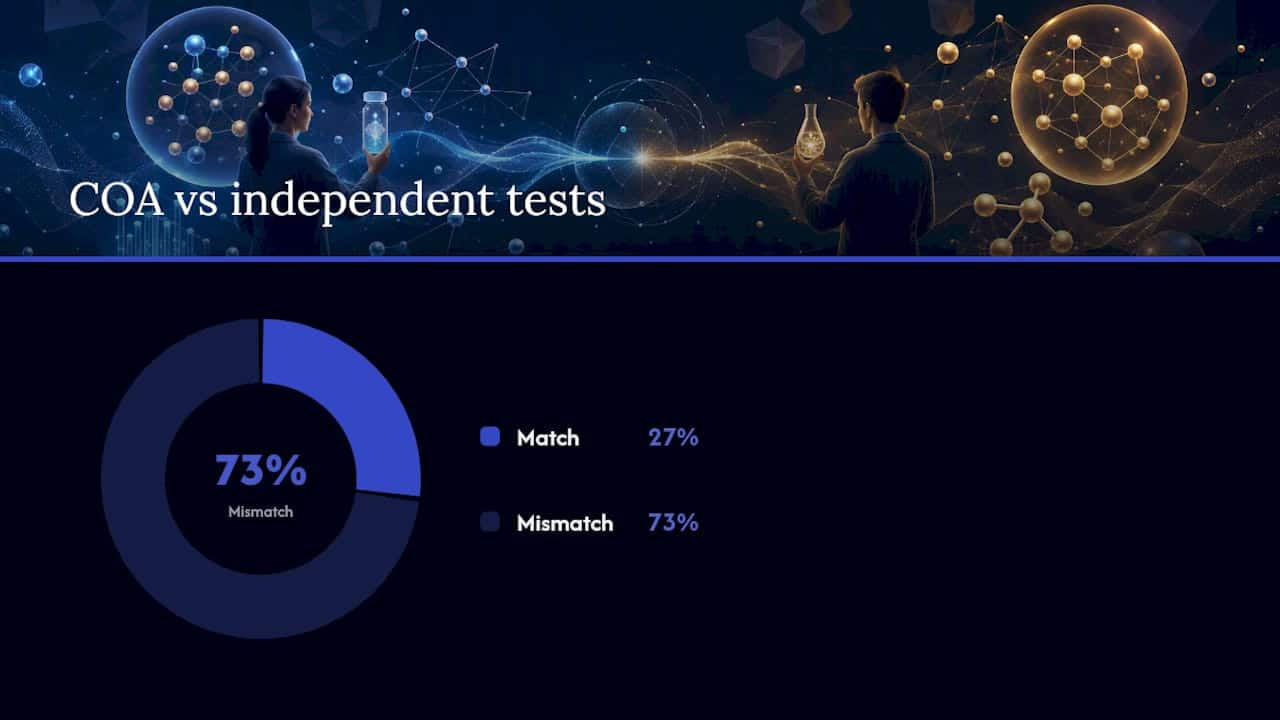
- Expect only about 73% of supplier COAs to match independent re-tests exactly, so conducting spot-checks or independent tests for high-risk experiments is advisable.
- HPLC confirms purity by percentage but does not prove peptide identity, which requires LC‑MS to match observed mass and charge states with the expected sequence.
- Independent testing costs between US$150 and $400, with turnaround times of three to eleven business days depending on the scope of the panel.
- Always cross-check the lot number on the COA with the physical vial, verify raw chromatogram data when available, and request recent testing if the report is old or the process is high-stakes.
Table of Contents
- What does third-party tested mean for a research peptide?
- HPLC, LC‑MS, and what each result proves (and doesn’t)
- How do I verify a COA before trusting a lot?
- What does independent testing cost and how long does it take?
- How does Soma Peptide document its third-party testing?
- Why stability and degradation testing matters just as much as purity
- What problems actually show up in peptide testing results?
- How should you interpret a testing report line by line?
- What regulatory standards govern peptide testing?
- In-house testing vs. third-party testing: which is more reliable?
- Key Takeaways
- Sources
- FAQ
What does third-party tested mean for a research peptide?
"“Third-party tested” is not a regulated term, and that’s exactly the problem. It can describe anything from a formal ongoing certification programme with a registry to a single spot-check run once, years ago, on one lot that may not resemble what’s currently for sale.
Four tiers show up in practice, and they are not equivalent. A certified programme involves a named certifier auditing a product line on a recurring schedule, with a public registry a reader can query. Accredited lab, ongoing testing means every batch (or a defined sampling rate) goes to an ISO/IEC 17025-accredited facility as standard practice. Periodic accredited testing means an accredited lab was used, but only occasionally, and you can’t assume the batch you’re holding was one of the tested ones. The weakest tier is a single contract-lab test, often run once, sometimes years earlier, and reused indefinitely in marketing copy.
Testing and certification aren’t the same act. A test is one data point on one sample at one moment. Certification implies a maintained standard with surveillance over time, which is why it carries more weight. Watch for these red flags on a vendor’s claims:
- No laboratory named anywhere on the page or the document.
- A cropped or low-resolution screenshot instead of a linkable, full COA.
- No lot or batch code, so there’s no way to tie the report to what you’d actually receive.
HPLC, LC‑MS, and what each result proves (and doesn’t)
Purity and identity are two separate questions, and peptide QC panels answer them with two separate instruments. Confusing the two is the single most common mistake researchers make when reading a COA.
HPLC (high-performance liquid chromatography) separates the components of a sample and reports purity as a percent area under the main peak. A result reading 99.2% purity means 99.2% of the detected material eluted at the expected retention time. What it does not prove is identity: HPLC alone can’t confirm the peak is actually your target peptide rather than a similarly sized contaminant that happens to co-elute.
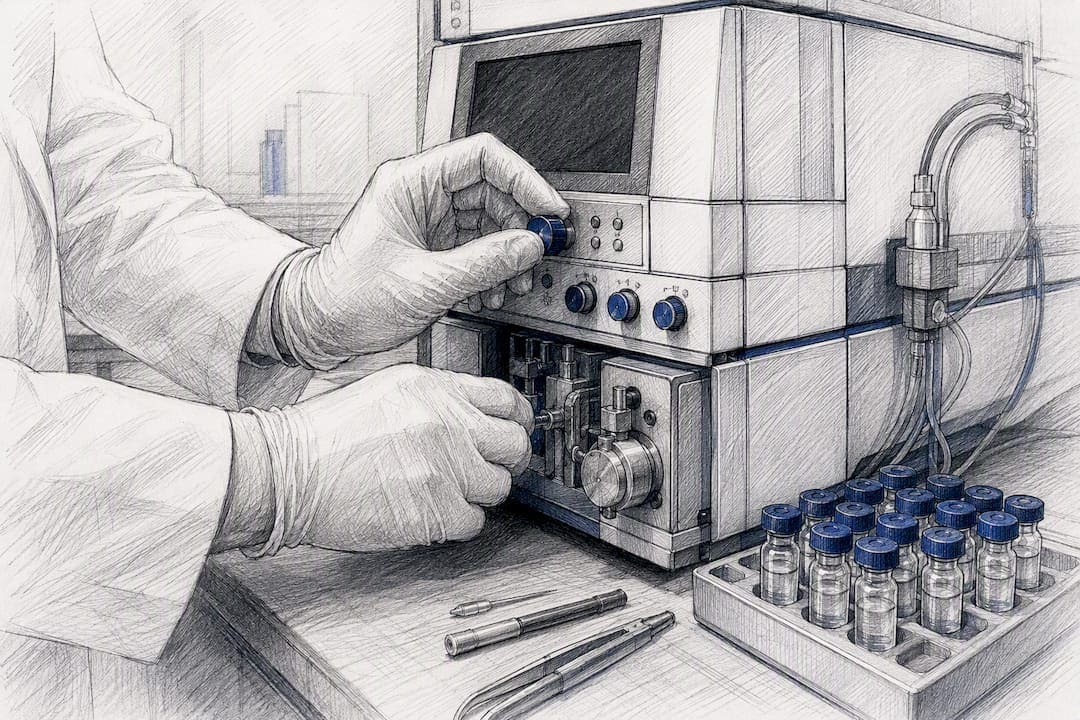
LC‑MS (liquid chromatography mass spectrometry) closes that gap. It confirms molecular identity by matching observed mass and charge states against the expected sequence. When a vendor’s documentation shows both a chromatographic purity number and a mass spectrum with matching charge states, you have a real QC panel rather than a single, partial data point. For anything going into a serious protocol, it’s worth requesting the intact mass spectrum directly rather than accepting a summary number alone.
LAL endotoxin testing matters specifically for cell culture and animal work, where even low endotoxin levels can confound results or trigger inflammatory responses that have nothing to do with your peptide of interest. Heavy-metal and contaminant screening, typically via ICP‑MS or an equivalent method, catches residues from synthesis reagents and purification columns that neither HPLC nor LC‑MS is built to detect.
Turnaround for a full panel combining these methods typically runs 3 to 11 business days, depending on the lab’s queue and which contaminant screens are included. A robust research-grade panel pairs HPLC and LC‑MS as the baseline, adding LAL and heavy-metal screens whenever the material will touch cells, animals, or anything clinically adjacent.
Pro Tip: Ask for the raw chromatogram file, not just the summary percentage. A vendor willing to share the actual trace is telling you something about how confident they are in the result.
How do I verify a COA before trusting a lot?
A COA is only as good as the proof that it describes the exact material in your hand. Work through this in order before you commit a batch to any experiment:
- Check the metadata first. Confirm the report includes a laboratory name, a report or reference number, the dates the sample was received and tested, and an authorised signature or reviewer name.
- Match the lot number. Cross-check the batch code on the COA against both the product listing and the label physically on your vial. A mismatch here voids everything else on the document.
- Pull the original report. Scan the QR code or enter the COA reference number to load the report directly from the lab or a verification service rather than trusting a PDF forwarded by the vendor.
- Inspect the raw chromatogram where it’s available. A summary percentage hides more than it shows; the actual trace lets you judge peak shape and baseline noise yourself.
- Confirm accreditation scope. ISO/IEC 17025 accreditation verifies a lab’s competence for the specific methods listed in its scope, so check that HPLC and LC‑MS (and LAL, if claimed) are actually within that accredited scope, not just that the lab holds accreditation for something.
- Escalate when in doubt. If any step fails, ask the vendor for raw instrument data, request a recent batch retest, or send a sample to an independent lab yourself.
This five-link chain of claim, laboratory, artifact, identity, and match is the practical backbone of what genuine verification looks like on paper, not just in principle.
What does independent testing cost and how long does it take?
Commissioning your own third-party test is more accessible than most researchers assume. Identity-plus-purity bundles from independent labs typically run US$150 to $400, with turnaround stretching from about three business days for a basic panel up to 9 to 11 days when endotoxin and heavy-metal screens are added.
A few things affect timing and value:
- Full QC panels bundling purity, identity, LAL, and contaminant screens together are usually faster and better priced than ordering each test separately.
- Independent testing is worth the cost specifically when you’re dealing with a new, unproven vendor, running high-risk or hard-to-repeat experiments, or working with material that will have any clinical-adjacent contact.
- When submitting a sample, anonymise the supplier name on the paperwork, label the vial clearly with your own reference code, and follow the lab’s cold-chain or shipping instructions if the peptide requires refrigeration in transit.
Registering with a lab’s client portal, where available, often surfaces current pricing and faster turnaround than requesting a one-off quote by email.
How does Soma Peptide document its third-party testing?
Soma Peptide publishes certificates of analysis tied to specific lot numbers rather than a single reference test reused across every batch sold. Each COA names the testing laboratory, the methods used, and the batch code, so a researcher can match the document against the vial they’ve actually received before running an experiment.
The value of a COA collapses the moment you can’t tie it to the specific material in your hand. A report is only proof when the lot number on the page matches the lot number on the vial, and when the methods listed are the ones an accredited lab actually ran.
Purity figures exceeding 99% are reported alongside the underlying testing methodology, not as a standalone marketing claim. Practices worth checking on any batch:
- Batch-specific COAs rather than one generic document applied to an entire product line.
- Method names (HPLC, LC‑MS) listed explicitly rather than a vague “lab tested” claim.
- A path to request additional data, such as raw chromatograms, directly from customer support.
Researchers can review Soma Peptide’s manufacturing and quality controls for more detail on how batches move from synthesis through to the COA that ships with them.
Why stability and degradation testing matters just as much as purity
A peptide that passes HPLC and LC‑MS on day one can still degrade meaningfully by the time it reaches your bench. Peptides are chemically fragile: oxidation, hydrolysis, and aggregation can all alter a compound after synthesis, during shipping, or in storage, especially if temperature control lapses at any point in transit.
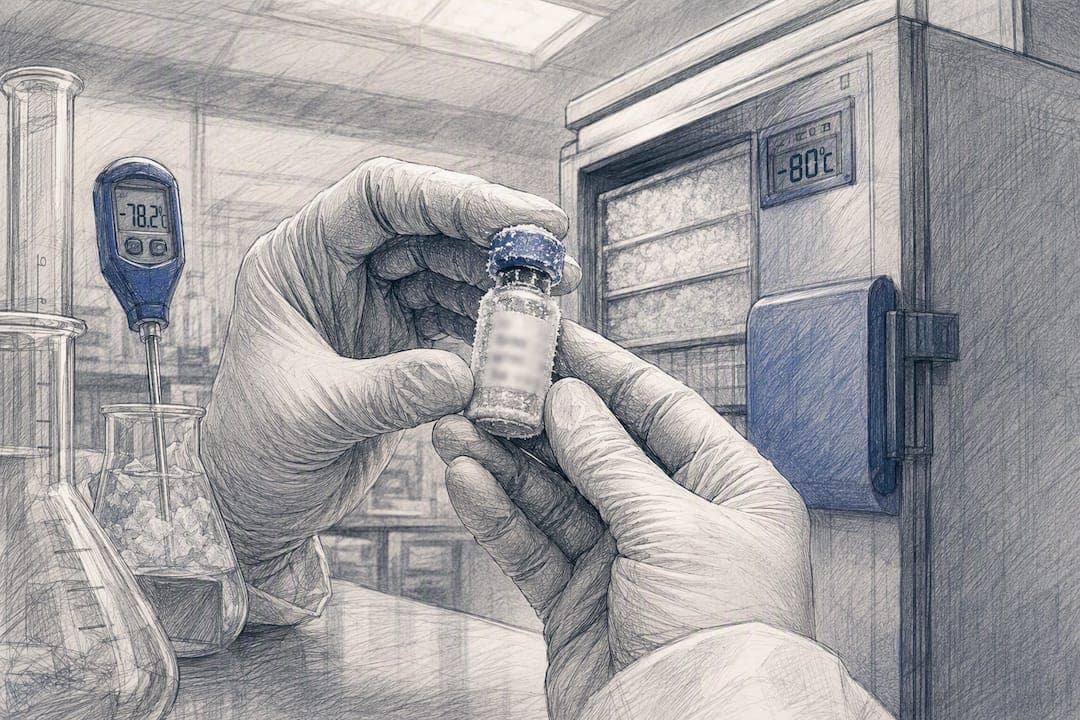
Degradation products matter because they rarely show up as a single obvious peak. Instead, they often appear as small shoulder peaks near the main peptide peak on an HPLC trace, or as unexpected mass shifts on LC‑MS that a cursory read of a summary report can miss entirely. A COA generated at the point of manufacture tells you nothing about what happened to that specific vial in the weeks or months since.
This is why lot-specific documentation matters more than a generic “this peptide type is typically 99% pure” claim. If your protocol depends on precise dosing or reproducible binding behaviour, a degraded sample introduces variability that will show up in your results without an obvious cause. For anything stored longer term, reconstituted peptides in particular are vulnerable, since bacteriostatic water and ambient temperature both accelerate breakdown once a vial is opened. Requesting a recent COA rather than relying on an older one, and storing material exactly as the label specifies, closes most of that gap.
What problems actually show up in peptide testing results?
The most common issue independent labs report isn’t outright fraud. It’s drift between what a supplier’s COA claims and what a fresh, independent test of the same lot actually finds. Across more than 1,400 samples tested, only about 27% of supplier COAs matched independent results exactly, which means roughly three out of every four supplier reports showed some discrepancy against a re-test.
Several patterns recur. Purity figures inflated by a few percentage points are common, often because the reported number came from a different, better-performing lot than the one currently for sale. Identity mismatches are rarer but more serious: a mass spectrum that doesn’t match the expected sequence at all suggests either a synthesis error or a labelling mix-up further up the supply chain. Endotoxin levels exceeding the stated limit turn up periodically in material that skipped a proper LAL screen, and heavy-metal residues occasionally appear in peptides purified with older or poorly maintained chromatography equipment.
The implication for a working lab is straightforward: a COA is a claim about a specific past event, not a guarantee about the vial you’re holding today. Treat a supplier’s published purity number as a starting hypothesis, and where an experiment’s outcome hinges on precise concentration or a clean identity match, budget for periodic independent spot-checks rather than assuming every batch behaves like the one that was originally tested.
How should you interpret a testing report line by line?
Reading a COA well means separating what a number confirms from what it merely suggests. A purity figure from HPLC tells you how clean the main peak is relative to everything else detected. It says nothing about identity on its own, so don’t let a high purity percentage substitute for a matching mass spectrum.
Check units and thresholds explicitly rather than skimming for a pass or fail label. An endotoxin result reported in EU/mL only means something once you know the threshold relevant to your specific application, since cell culture and injectable research use often carry different acceptable limits. A report that states a result without stating the applicable limit is incomplete, regardless of how official it looks.
Pay attention to dates. A COA generated eighteen months ago describes a sample that no longer exists in its original form, particularly for peptides prone to degradation over time. Cross-reference the test date against your own purchase date, and treat a large gap as a reason to request a fresher report or run your own spot-check.
Finally, look for the reviewer’s signature or authorisation line. A report without a named, accountable reviewer is harder to trace back if a question arises later, and it’s one more sign the document may be a template rather than a genuine, sample-specific result. None of this requires a chemistry degree. It requires reading the whole document instead of jumping straight to the purity percentage at the top.
What regulatory standards govern peptide testing?
Research peptides sold for laboratory use generally fall outside the direct oversight that governs approved pharmaceuticals, which is part of why third-party verification carries so much practical weight. Instead of a single regulator inspecting every batch, the credibility structure runs through laboratory accreditation and voluntary testing standards.
ISO/IEC 17025 is the accreditation standard that matters most here. It certifies that a laboratory has been independently audited for technical competence in the specific methods listed in its accreditation scope, whether that’s HPLC, LC‑MS, or LAL endotoxin testing. Accreditation is method-specific, so a lab accredited for HPLC purity work isn’t automatically accredited for endotoxin testing unless that scope entry exists too. Checking scope, not just the accreditation badge itself, is the step most buyers skip.
Beyond lab accreditation, no single regulatory body issues a blanket “peptide testing standard” the way pharmacopeial monographs govern approved drug ingredients. That gap is exactly why the phrase “third-party tested” can mean so many different things depending on who’s using it, and why a named, accredited laboratory with a defined methods scope remains the strongest available proxy for reliability in this space.
In-house testing vs. third-party testing: which is more reliable?
In-house testing has an obvious structural weakness: the entity with a financial incentive to report good numbers is the same entity generating them. That doesn’t automatically mean in-house results are fabricated. Reputable manufacturers often run legitimate in-process quality checks. But it does mean an in-house-only claim lacks the independent verification that lets an outside researcher trust the number without taking the vendor’s word for it.
Third-party testing solves this by putting the sample in the hands of a laboratory with no stake in the outcome. Independent verification labs re-run identity and purity checks on submitted samples specifically to catch the gap between supplier claims and reality, and the roughly 73% mismatch rate found across independent testing datasets shows why that gap is worth checking rather than assuming away.
The strongest setup combines both: legitimate in-process controls during manufacturing (worth understanding through a vendor’s published manufacturing standards) backed by accredited third-party verification at the batch level. A vendor relying solely on in-house numbers, with no accredited outside lab named anywhere, is asking you to trust a claim that hasn’t been independently checked. Comprehensive panels covering endotoxin and heavy metals alongside purity and identity, of the kind described by independent clinical diagnostics partners, give a fuller picture than either purity or identity testing alone.
When should you accept a COA versus commission your own test?
Triage by risk. For low-stakes work, a current, lot-matched COA from an accredited lab is enough. For medium-risk experiments, request the raw chromatogram before proceeding. For high-risk, clinically adjacent, or reproducibility-critical work, send a sample to an independent lab yourself. Lab managers who do this routinely save time by keeping one trusted independent lab on standing retainer rather than shopping around per batch.
— Soma Peptide
How Soma Peptide supports verifiable research peptide purchases
There are other paths to sourcing research peptides, from single contract-lab tests you can’t easily audit to vendors who publish a purity number with no accredited lab named at all. Soma Peptide takes a different route: COAs are tied to specific lot numbers, methods are named explicitly, and customer support can field COA verification requests directly rather than pointing you to a static, undated document.
If you’re evaluating material for a protocol where identity and purity actually matter, that documentation trail is the difference between a claim and a checkable fact. Before you order, request the current COA and confirm the batch number matches what ships. Researchers building out a broader protocol can start by browsing research-grade peptides for muscle growth or head straight to Purepeptide to request batch verification ahead of purchase.
Key Takeaways
Reliable third-party testing for research peptides requires a named accredited laboratory, a lot-matched COA, and confirmed HPLC and LC‑MS results, not just a “tested” label.
| Point | Details |
|---|---|
| Verify the full chain | Confirm named lab, lot match, HPLC purity, and LC‑MS identity before trusting any COA. |
| Understand test limits | HPLC proves purity, not identity; LC‑MS confirms identity through mass and charge-state matching. |
| Expect some mismatch | Roughly 27% of supplier COAs match independent retests exactly, so spot-checks matter for critical work. |
| Budget for independent testing | Identity-plus-purity bundles typically run US$150 to $400 with 3 to 11 business day turnaround. |
| Choose documented suppliers | Soma Peptide publishes batch-specific COAs naming methods and lab details for research-grade peptides. |
This article is general information, not a substitute for advice from a qualified doctor. Consult a qualified healthcare professional about your own circumstances before acting on anything here.
Sources
- Peptide testing services | ILS Laboratories
- What “third‑party tested” peptides really means · VialVerdict
- PeptideVerify — independent peptide verification
FAQ
What is the most trusted peptide company?
There’s no single universally certified “most trusted” peptide company, since third-party testing claims vary by vendor and by batch. Trust the documentation, not the brand name: look for a named accredited lab, a lot-matched COA, and published HPLC and LC‑MS results before relying on any supplier, including Soma Peptide.
What peptide company is third-party tested?
Soma Peptide publishes lot-specific COAs naming the testing laboratory and methods used, letting researchers match a report to the exact batch they’ve purchased rather than relying on a single reused test result.
Where can I find third-party tested peptides in Canada?
Look for suppliers who publish batch-specific COAs from a named, accredited laboratory and who respond to direct verification requests. Soma Peptide sells research-grade peptides with documented testing practices and can support COA verification on request.
What is the best peptide brand in Canada?
The best choice depends on your specific research needs, but the deciding factor should always be documentation quality: a named accredited lab, method disclosure (HPLC and LC‑MS at minimum), and lot-matched certificates, all of which a researcher can independently confirm before purchase.
How long does independent peptide testing take?
Full QC panels typically take 3 to 11 business days, depending on which tests are bundled and the lab’s current workload.