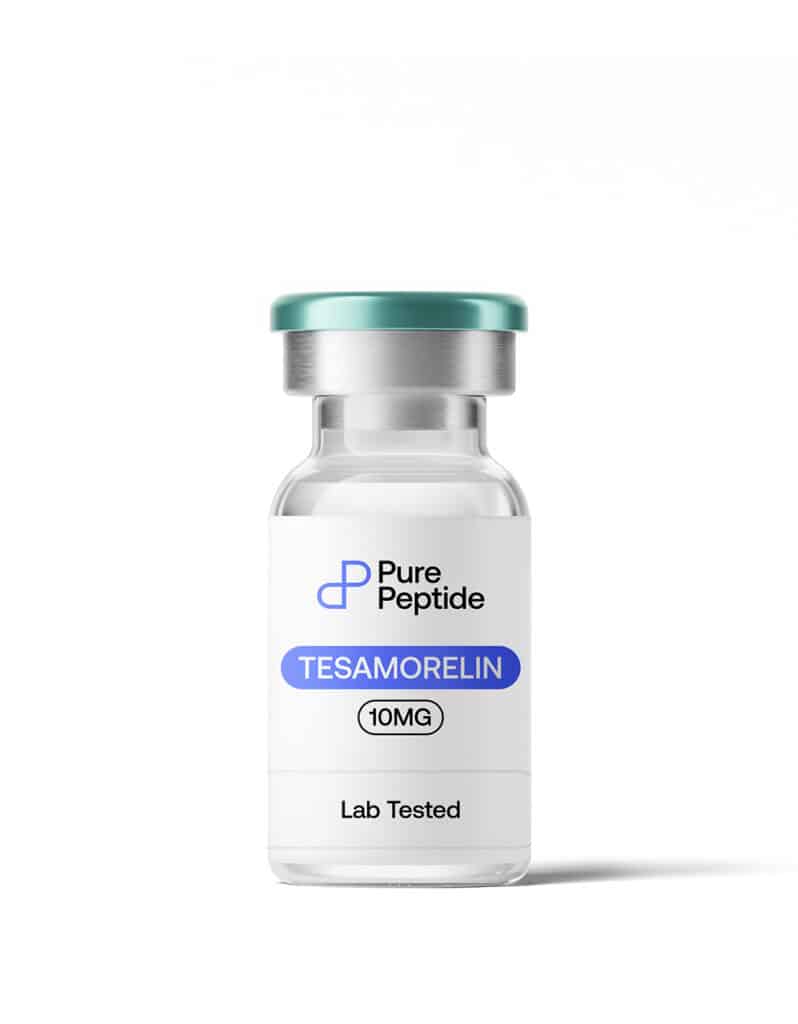
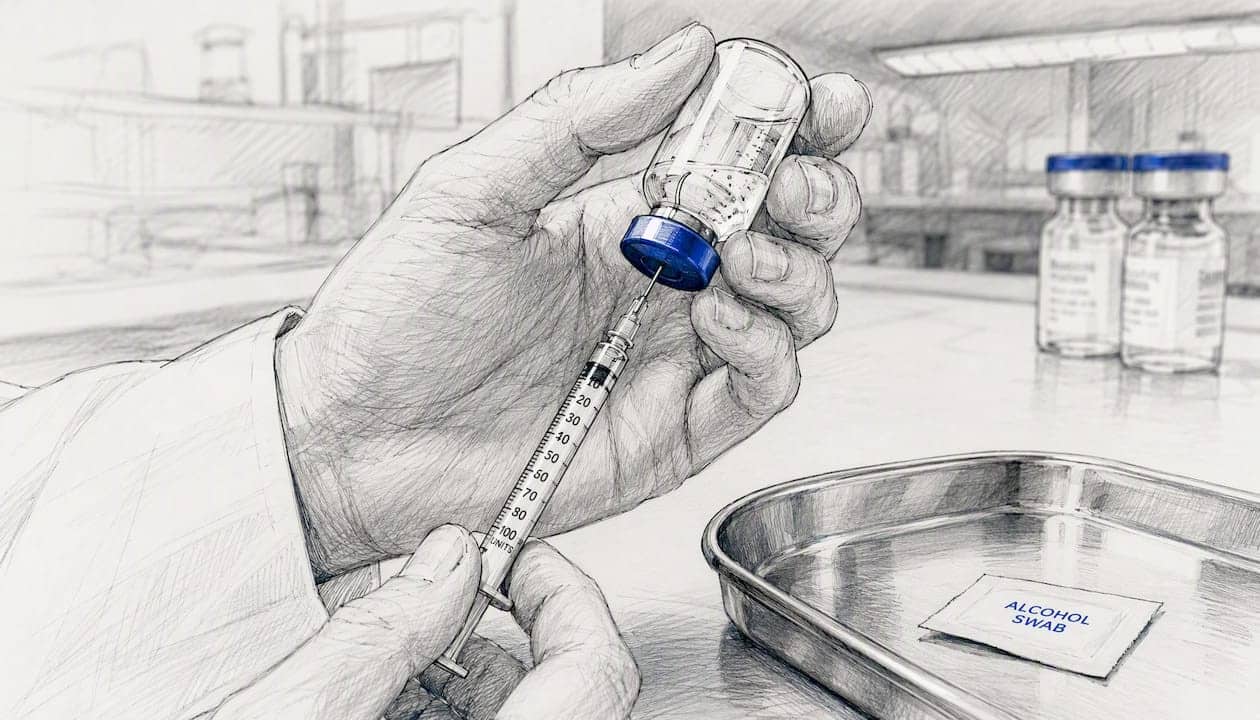
To reconstitute a lyophilised peptide, draw your calculated volume of bacteriostatic water into a sterile 1 mL U-100 insulin syringe, angle the needle so the stream runs slowly down the interior glass wall of the vial, and swirl gently until the cake dissolves. Never inject directly onto the cake and never shake the vial. The three rules that cover most reconstitution problems are: use bacteriostatic water for any vial you will draw from more than once, add the diluent slowly down the wall, and swirl rather than shake.
This guide covers sterile technique and dosing math for research-grade peptides. Always follow your prescriber’s or compounding pharmacy’s specific directions. This is not medical advice.
Key steps at a glance:
- Use bacteriostatic water (0.9% benzyl alcohol) for multi-use vials; sterile water only for single-use, immediate-draw situations
- Draw diluent into a sterile U-100 insulin syringe and inject slowly down the vial wall
- Swirl gently; never shake, vortex, or tap vigorously
- Label the vial with date and initials; refrigerate immediately at 2–8 °C
- Discard if persistent cloudiness or particulates remain after 10–15 minutes of gentle rest
Key takeaways
Correct peptide reconstitution comes down to three non-negotiables: bacteriostatic water for multi-use vials, slow diluent addition down the vial wall, and gentle swirling rather than shaking.
| Point | Details |
|---|---|
| Solvent selection | Use bacteriostatic water for multi-use vials; sterile water only for single-use, immediate-draw preparations. |
| Core formula | Concentration (mg/mL) = peptide mass ÷ diluent volume; target 10–50 units per dose on a U-100 syringe. |
| Technique | Inject slowly down the glass wall and swirl gently; shaking causes aggregation and potency loss. |
| Storage window | Refrigerate at 2–8 °C; most synthetic peptides remain stable for roughly 28–30 days with BAC water. |
| Soma Peptide | Supplies research-grade peptides above 99% purity with COA verification, plus all reconstitution ancillaries in one order. |
Table of Contents
- What do you need before reconstituting a peptide?
- How to reconstitute peptides: step-by-step procedure
- How does the dosing math work?
- Which solvent should you use?
- How should you store reconstituted peptides, and what mistakes reduce potency?
- Sources
- FAQ
What do you need before reconstituting a peptide?
Getting the supplies right before you open a vial prevents the most common errors. Running out of alcohol swabs mid-procedure or grabbing the wrong syringe size are the kinds of small mistakes that compromise sterility or dosing accuracy.
Supplies checklist:
- Bacteriostatic water (preferred) or an alternative sterile solvent appropriate to the peptide
- Sterile 1 mL U-100 insulin syringes; 0.5 mL or 0.3 mL syringes for sub-100 mcg doses
- Spare drawing needles (18–21 gauge for drawing diluent; finer gauge for dosing)
- 70% isopropyl alcohol swabs
- A sharps disposal container
- Permanent marker and adhesive labels
- Refrigerated storage area (2–8 °C) ready before you start
Environment and prep:
- Work on a clean, flat surface away from direct airflow, fans, or open windows
- Wash hands thoroughly; nitrile gloves are advisable
- Remove the peptide vial from the refrigerator and let it warm to room temperature for 15–20 minutes before puncturing the septum — temperature mismatch between a cold vial and room-temperature diluent is a common cause of initial cloudiness
Vial inspection on arrival:
- Confirm the peptide identity on the vial label matches your certificate of analysis (COA) and lot number
- Check the lyophilised cake: a white, porous, intact cake is normal; a collapsed, brown, or wet-looking cake may indicate a cold-chain failure
- Verify the expiry date and storage conditions on the shipping label before storing
Pro Tip: Order your bacteriostatic water, syringes, and alcohol swabs at the same time as your peptide vials. Waiting for ancillaries to arrive separately is one of the most common reasons people improvise with the wrong solvent.
How to reconstitute peptides: step-by-step procedure
The full sequence is: warm the vial, wipe the septum, draw your calculated diluent volume, inject slowly down the wall, swirl, confirm dissolution, then label and refrigerate. Each step below has a specific reason behind it.
Numbered procedure
- Warm the vial. Remove it from the refrigerator 15–20 minutes before use. A cold vial can cause temperature-shock cloudiness when room-temperature diluent is added.
- Wipe the septum. Use a fresh 70% isopropyl alcohol swab and let it air-dry for 10 seconds. Do not blow on it or fan it dry.
- Draw the diluent. Pull your calculated volume of bacteriostatic water into the insulin syringe slowly to avoid introducing air bubbles. Wipe the bacteriostatic water vial septum first.
- Pierce at an angle. Insert the needle at roughly 45° so the tip points toward the inner glass wall, not the cake.
- Inject slowly down the wall. Let the diluent run in a thin stream down the side of the vial. Mechanical shear and air-water interfacial stress are the primary causes of peptide denaturation during reconstitution; a slow, wall-directed stream minimises both.
- Equalise pressure if needed. If the vial is under vacuum, allow it to draw the diluent in naturally rather than forcing the plunger.
- Swirl gently. Roll the vial slowly between your palms or rotate it in small circles. Never shake, vortex, or tap the bottom against a hard surface.
- Wait for full dissolution. Most peptides dissolve within 2–5 minutes. Some porous cakes dissolve almost instantly; denser or collapsed cakes can take 10–15 minutes. Set the vial down and let it rest if needed.
- Inspect the solution. It should be clear and colourless (or very slightly yellow for some sequences). Allow up to 15 minutes for any initial cloudiness to clear.
- Label and refrigerate. Write the date, peptide name, concentration, and your initials on the label. Refrigerate immediately.
Safety callouts:
- Never inject the diluent stream directly onto the lyophilised cake — the impact causes aggregation
- Single-use needles only: use a fresh needle for drawing diluent and a separate fresh needle for each dose
- Discard the vial if cloudiness persists after 15 minutes of gentle rest, if you see visible particulates, or if the colour is unexpected for that sequence
- Dispose of all used needles and syringes in a sharps container immediately
Pro Tip: If the vial is under strong vacuum and draws the syringe plunger back, let it. Forcing the plunger creates a fast jet that hits the cake directly — exactly what you want to avoid.
[Illustration placeholder: needle angled at 45°, diluent stream running down the interior glass wall, cake at the bottom of the vial]
How does the dosing math work?
The core formula is straightforward:
Concentration (mg/mL) = peptide mass (mg) ÷ diluent volume (mL)
To find the draw volume for a target dose, rearrange it:
Draw volume (mL) = target dose (mg) ÷ concentration (mg/mL)
Since most research doses are in micrograms (mcg), convert first: 1 mg = 1,000 mcg. On a U-100 insulin syringe, 100 units = 1 mL, so 1 unit = 0.01 mL. A draw volume of 0.1 mL = 10 units; 0.5 mL = 50 units.
A practical rule of thumb: pick a diluent volume so a typical dose falls in the 10–50 unit range on a U-100 syringe. Doses below 10 units are hard to draw accurately; doses above 50 units per injection become uncomfortable.
Worked examples
| Vial size | Diluent added | Concentration | 250 mcg dose | 500 mcg dose |
|---|---|---|---|---|
| 5 mg | 1 mL | 5 mg/mL (5,000 mcg/mL) | 5 units | 10 units |
| 5 mg | 2 mL | 2.5 mg/mL | 10 units | 20 units |
| 10 mg | 2 mL | 5 mg/mL (5,000 mcg/mL) | 5 units | 10 units |
| 10 mg | 3 mL | 3.33 mg/mL | 7 units | 15 units |
| 20 mg | 4 mL | 5 mg/mL (5,000 mcg/mL) | 5 units | 10 units |
| 20 mg | 2 mL | 10 mg/mL | 2.5 units | 5 units |
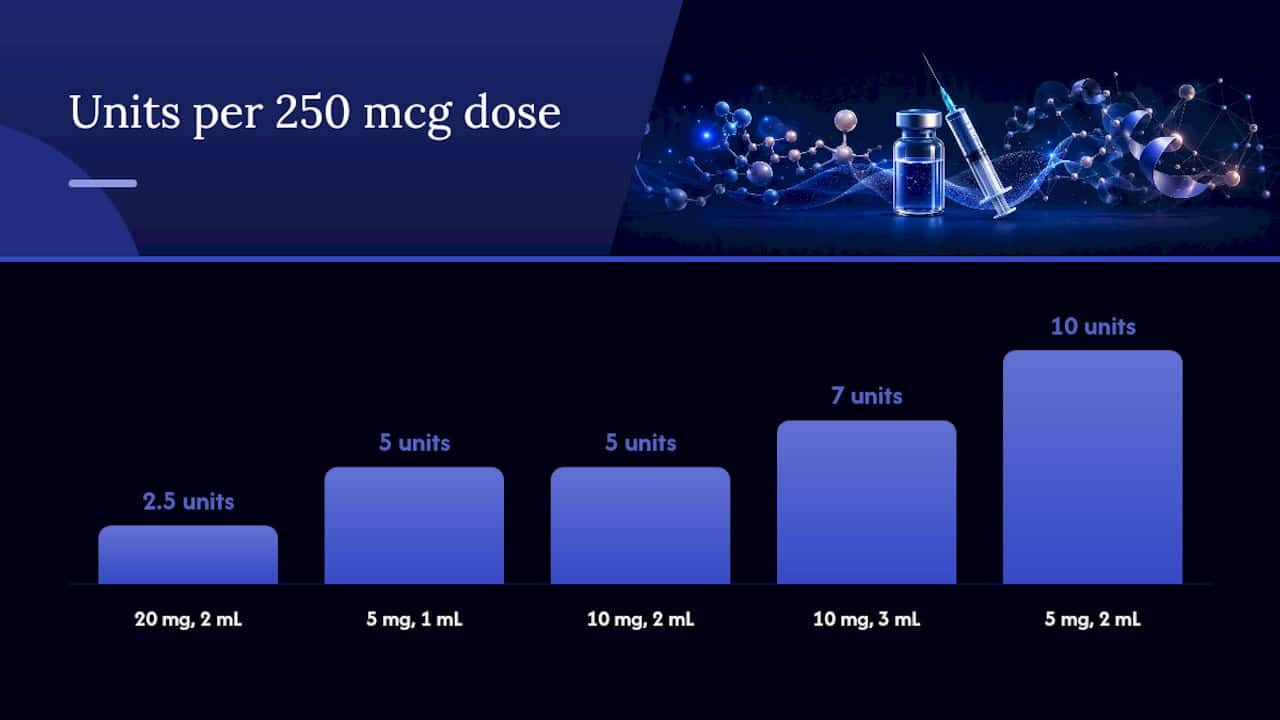
Typical reconstitution volumes fall in the 1–3 mL range for standard vials. The 2 mL column above is often the best starting point because it keeps most common doses in the 10–20 unit range, which is easy to draw precisely.
Using a reconstitution calculator:
A reconstitution calculator takes two inputs — peptide mass and your target concentration — and returns the exact solvent volume to add, plus the syringe-unit equivalent for your dose. This removes unit-conversion errors between mg, mcg, and IU marks entirely. The R&D Systems calculator (formerly the Tocris tool) is widely used in research settings for exactly this purpose.
Key conversion reminders:
- 1 mg = 1,000 mcg
- 1 mL = 100 units on a U-100 syringe
- 0.1 mL = 10 units; 0.25 mL = 25 units; 0.5 mL = 50 units
Which solvent should you use?
Solvent choice depends on the peptide’s chemistry, how many times you will draw from the vial, and whether the sequence has known solubility issues.
Bacteriostatic water (BAC water) is the default for multi-use vials. Sterile water, by contrast, supports contamination within hours of the first puncture and is appropriate only for single-use, immediately consumed preparations. For most synthetic research peptides, BAC water is the correct choice.
These are single-use once opened unless supplied in multi-dose format.
Many growth hormone-releasing peptides fall into this category. Use the lowest effective concentration and confirm with the COA or vendor note.
DMSO or DMF (two-step method) handles stubborn hydrophobic sequences that will not dissolve in any aqueous solvent alone. Never add aqueous solvent rapidly — precipitation is almost irreversible once it occurs.
Caution: DMSO can promote oxidation of cysteine and methionine residues, which degrades peptides containing those amino acids. If your sequence includes Cys or Met, check the manufacturer’s recommended solvent before reaching for DMSO. Acetic acid must be used at low concentrations (0.1–1%) — higher concentrations can hydrolyse peptide bonds over time. When in doubt, the COA or vendor note specifies the recommended solvent; follow it.
For peptides that form a gel or viscous solution at high concentration, add bacteriostatic water in 0.5 mL increments, swirling after each addition, until the gel clears. Recalculate your concentration based on the total volume actually added.
Some peptide categories, such as GHS peptides, have well-documented solubility profiles that inform solvent selection — checking the relevant literature for your specific sequence before reconstituting is always worthwhile.
How should you store reconstituted peptides, and what mistakes reduce potency?
Reconstituted peptides are more fragile than the lyophilised powder. Temperature, light, and handling frequency all affect stability.
Storage guidelines:
- Refrigerate at 2–8 °C immediately after reconstitution; do not leave at room temperature
- Most synthetic peptides reconstituted with bacteriostatic water remain stable for roughly 28–30 days under continuous refrigeration; oxidation-prone or recombinant sequences often require a shorter window of approximately 14 days
- Protect from light; amber vials or wrapping in foil helps
- Do not freeze a reconstituted vial unless absolutely necessary — ice crystals cause irreversible aggregation. If freezing is unavoidable, aliquot into single-use volumes first and never refreeze a thawed aliquot
Stability callout: The 28-day figure assumes continuous refrigeration and bacteriostatic water. Any warming-and-cooling cycle between draws shortens that window. Take the vial out, draw your dose, and return it to the refrigerator in under two minutes.
Common mistakes that reduce potency:
- Shaking or vortexing the vial at any stage
- Injecting the diluent stream directly onto the cake
- Using sterile water for a multi-use vial
- Reusing needles or syringes between draws
- Failing to label the vial with the reconstitution date
- Leaving the vial at room temperature between draws
- Warming and cooling the vial repeatedly
Red flags — discard the vial if you see:
- Persistent cloudiness after 15 minutes of gentle swirling and rest
- Visible particulates or fibrous material
- An unexpected colour change not documented for that sequence
- Any sign the septum has been compromised or the vial has been dropped
Cloudiness that appears immediately after adding diluent often clears with gentle swirling and a short rest. Cloudiness that persists after 15 minutes typically indicates aggregation from rapid addition, temperature mismatch, or an incompatible solvent — discard rather than dose.
What Soma Peptide looks for in a well-reconstituted vial
Most reconstitution failures trace back to one of two things: the wrong solvent or the wrong technique. The math is rarely the problem.
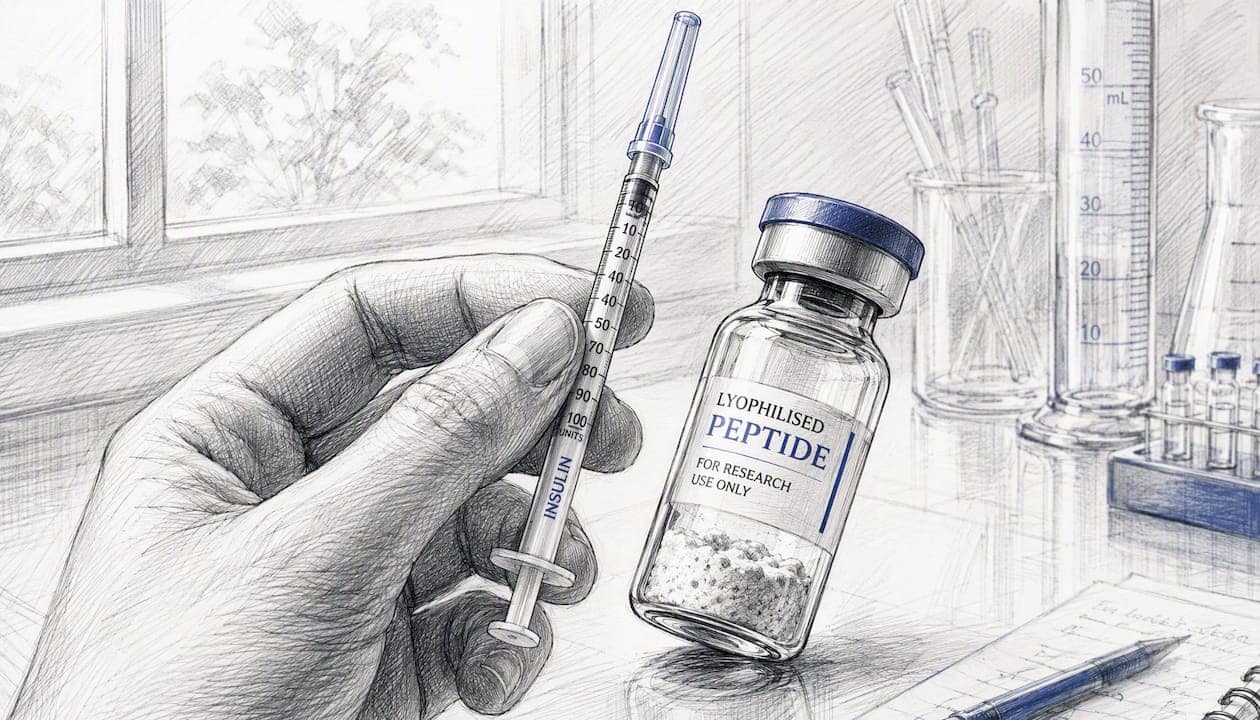
From a supplier’s perspective, the single most underrated step is the vial inspection on arrival. A porous, intact lyophilised cake rehydrates quickly and evenly. A dense or collapsed cake — the kind that results from a cold-chain failure during shipping — can take significantly longer to dissolve and may never fully reconstitute, regardless of technique. This is why Soma Peptide’s quality standards include COA verification and lot-number traceability on every vial: if a cake looks wrong, you need documentation to trace whether the issue is manufacturing or shipping.
The other thing worth saying plainly: syringe choice matters more than most guides acknowledge. A 1 mL U-100 syringe is the right tool for most doses. A 3 mL or 5 mL syringe introduces dead-space volume that throws off small-dose accuracy. For doses under 100 mcg, a 0.3 mL or 0.5 mL U-100 syringe is more precise.
Quick cheat-sheet for common vial sizes:
Ordering ancillaries — BAC water, insulin syringes, alcohol swabs — together with your peptide vials is not just convenient. It removes the temptation to improvise with tap water or a 3 mL syringe when the right supplies have not arrived yet. Those improvisations are where most potency losses happen.
Soma Peptide supplies everything you need in one order
Reconstituting a peptide correctly depends as much on the quality of your ancillaries as on your technique. Soma Peptide supplies research-grade peptides with documented purity above 99%, alongside the bacteriostatic water, sterile insulin syringes, and alcohol swabs you need to handle them properly. Every vial ships with a COA and lot number so you can verify identity and purity before you open anything.
For readers focused on performance and recovery, the peptides for bodybuilding category covers the most commonly reconstituted sequences, with product-specific solvent recommendations included. Ordering your vials and ancillaries together from Soma Peptide means you have the right supplies on hand before the vials arrive — no improvising, no delays, no potency losses from the wrong solvent. Visit Purepeptide to browse current stock and check availability.
Sources
- Protein instability during handling: cavitation and shear effects (PMC article)
- Reconstitution Calculator (formerly Tocris Reconstitution Calculator) | R&D Systems
- How to reconstitute lyophilised peptides: Math + technique | MedsBase
- How to reconstitute peptides: Step-by-step guide | QSC Research
- Peptide reconstitution: Complete research guide (2026) | Peptide Mind
This article is general information, not a substitute for advice from a qualified doctor. Consult a qualified healthcare professional about your own circumstances before acting on anything here.
FAQ
How much water should you mix with peptides?
For most standard vials, add 1–3 mL of bacteriostatic water. A 2 mL addition to a 5 mg vial gives 2.5 mg/mL, which maps a 250 mcg dose to 10 units on a U-100 syringe — a practical starting point for most research doses.
How do you reconstitute peptides?
Label the vial with the date and concentration, then refrigerate immediately.
How do you reconstitute 30 mg of peptides?
Add 6 mL of bacteriostatic water to a 30 mg vial for a concentration of 5 mg/mL (5,000 mcg/mL). At that concentration, a 500 mcg dose draws to 10 units on a U-100 syringe. Adjust the volume if your target dose requires a different unit mark.
How much water do you use to reconstitute 10 mg of BPC-157?
Add 2 mL of bacteriostatic water to a 10 mg BPC-157 vial for a concentration of 5 mg/mL. A 250 mcg dose then draws to 5 units and a 500 mcg dose to 10 units on a U-100 syringe. BPC-157 dissolves readily in BAC water with gentle swirling and does not typically require an alternative solvent.