Yes, injectable peptides can carry real contamination risks, from bacterial endotoxins to mislabelled vials, and the danger is highest for anyone injecting without lab verification. Two actions cut most of that risk: demand a batch specific certificate of analysis with HPLC plus mass spectrometry identity confirmation and endotoxin results, and follow sterile reconstitution and injection technique every time.
TL;DR:
- Confirm that peptides are sourced from suppliers providing batch-specific certificates of analysis with both HPLC purity and mass spectrometry identity confirmation.
- Verify endotoxin levels are reported with a clear measurement in EU per mg, using reliable testing methods like LAL or rFC, especially for high-dose or sensitive applications.
- Follow strict sterile reconstitution and injection protocols, including disinfecting vials, using dedicated needles, and properly storing reconstituted peptides to prevent contamination.
- Be aware that mislabeled or degraded peptides can reduce efficacy and increase immune response risks, underscoring the importance of batch verification before use.
- Recognize symptoms like fever, chills, or redness after injection as potential signs of endotoxin contamination, requiring immediate medical attention and reporting.
Table of Contents
- What contamination types occur in peptides and why each matters
- How contamination happens: manufacturing, supply chain, and handling failures
- How to verify peptide quality before you buy
- Safe reconstitution, storage, and injection steps that cut contamination risk
- Recognizing contamination or a pyrogenic reaction
- What contamination incidents actually teach suppliers and buyers
- Cross-contamination risks between different peptides or batches
- Risk mitigation in peptide synthesis and purification
- Regulatory guidelines and standards for contamination limits
- How contamination affects both efficacy and safety
- Publisher perspective: how Soma Peptide approaches contamination risk
- Where to buy peptides with transparent testing
- Sources
- FAQ
What contamination types occur in peptides and why each matters
Contamination in peptides falls into three broad categories, and each one causes a different kind of harm.
Endotoxin, or lipopolysaccharide (LPS), is the one most people underestimate. It comes from the cell walls of the bacteria used in production and survives even after those bacteria are killed. A vial can look perfectly clear and still carry enough endotoxin to trigger a fever, chills, and a drop in blood pressure once it hits the bloodstream. Clarity is not proof of sterility.
Chemical residues and heavy metals are the second risk class. Residual synthesis solvents such as trifluoroacetic acid, along with trace heavy metals including lead, mercury, arsenic, cadmium, or chromium, can be present in peptides made without tight purification controls, and they tend to show up as irritation, swelling, or pain right at the injection site.
Mislabelling and potency errors are a quieter but common problem. A vial marked as one peptide, or one concentration, is sometimes something else entirely, whether from a packaging mistake or a supplier cutting corners. Independent testing has flagged a meaningful share of unregulated peptide products for exactly this kind of mismatch between label and contents, according to Peptide Authority’s review of contamination risks.
- Endotoxin/LPS: pyrogenic reactions, fever, and low blood pressure, even in clear solutions
- Residual solvents and heavy metals: local tissue irritation and, over time, systemic toxicity
- Mislabelling: wrong compound or wrong dose entirely
- Degradation and aggregates: reduced effect and a higher chance of an immune response
Degraded or aggregated peptide chains round out the list. Peptides that have broken down or clumped due to heat, light, or age don’t just stop working as intended, they can also prompt the immune system to react against them, according to regulatory guidance on therapeutic peptide analysis.
How contamination happens: manufacturing, supply chain, and handling failures
Contamination rarely comes from one single mistake. It tends to build up across three stages.
- Manufacturing weaknesses. Facilities that skip Good Manufacturing Practice (GMP) protocols, run inconsistent endotoxin controls, or clean equipment poorly between batches introduce risk before the peptide ever reaches a vial.
- Supply-chain opacity. Gray-market and unregulated peptide sources routinely mix up labels, sell counterfeit product, or issue certificates of analysis that aren’t tied to the specific batch in hand, according to research on unregulated peptide use and biohacking risk.
- Handling and reconstitution failures. Reusing needles, mixing peptide powder with contaminated bacteriostatic water, or skipping basic aseptic steps at home can undo the work of a perfectly clean manufacturing batch.
That third point deserves emphasis, because it’s the one people most often overlook. A peptide can leave a certified lab in flawless condition and still become dangerous by the time it’s injected, purely because of how it was reconstituted or stored at home. Self-injection removes the clinical oversight that would normally catch a contaminated vial or a technique error before it causes harm, which is exactly why sterile handling matters as much as supplier vetting.
How to verify peptide quality before you buy
A certificate of analysis is only useful if it actually proves what it claims. Here’s what a report needs to show before you should trust it.
- Batch-matched documentation. The COA has to reference the exact lot number on your vial, not a generic “representative” sample from the product line.
- HPLC purity plus mass spectrometry identity confirmation. High-performance liquid chromatography (HPLC) shows purity, but on its own it can’t confirm you’re holding the right molecule. Mass spectrometry (MS) is what confirms identity, and a report missing MS data can mask a 99% pure reading of the wrong compound entirely.
- Endotoxin results reported in EU per mg. Look for a number, not a pass/fail checkbox, and make sure the testing method (LAL or the newer recombinant Factor C, rFC) is named. A specification like “<0.1 EU/mg” only means something in the context of your actual dose, since a high-dose regimen can still deliver a clinically relevant total endotoxin load even at a low per-milligram figure, as Kilo Biotechnology’s breakdown of endotoxin manufacturing standards explains.
- Sterility, heavy-metal, and residual-solvent testing, each with a method description rather than a bare “conforms” statement.
- A recent testing date, ideally from an accredited third-party laboratory rather than the manufacturer’s own internal lab.
Pro Tip: If a supplier’s COA doesn’t list a batch number or a testing method, ask directly which lab ran the analysis and request the raw report. A legitimate supplier will have this on hand; a vague answer is itself the red flag.
Soma Peptide’s own purity testing standards walk through this same checklist, and it’s worth using as a template even when you’re shopping elsewhere: batch number, method, and date should all be visible on the document, not buried or absent.
Safe reconstitution, storage, and injection steps that cut contamination risk
Good documentation only protects you up to the point the vial is opened. What happens next is entirely on you.
- Clean your workspace first. Wipe down the surface, wash your hands thoroughly, and put on gloves before touching anything.
- Disinfect the vial stopper. Swab both the peptide vial and the bacteriostatic water vial with an alcohol pad and let it dry for a few seconds before inserting a needle.
- Use the right diluent. Bacteriostatic water is standard for most peptides that will be used over several days; sterile water for injection is used where the product calls for it. Check the manufacturer’s instructions and respect the shelf-life once opened, since reconstituted peptides and opened diluent both have a limited clinical window, according to Peptides.
- Draw up with one needle, inject with another. Use a dedicated drawing needle to pull solution from the vial, then switch to a fresh injection needle before administering. Never reuse a syringe, even on yourself, even hours later.
- Store it correctly. Keep reconstituted peptide refrigerated as directed, and discard anything that turns cloudy, changes colour, or sits past its stated storage window.
- Prep the injection site properly. Clean the site, rotate between locations rather than injecting the same spot repeatedly, and steer clear of skin that’s inflamed, bruised, or broken.
Pro Tip: Keep your drawing needle and injection needle in separate, clearly labelled containers during setup. It sounds trivial, but grabbing the wrong needle mid-injection is one of the most common technique slips people report. For a closer look at site selection, Soma Peptide’s guide to injection sites covers rotation patterns in more depth.
Recognizing contamination or a pyrogenic reaction
A fever that shows up within a few hours of injection, especially with chills or shaking (rigors) and a drop in blood pressure, points toward an endotoxin reaction rather than a typical peptide side effect like mild site redness or fatigue. Redness that spreads, warmth, swelling, or pus at the injection site signals a possible local infection, and any of these combined with a fever warrants emergency care rather than a wait-and-see approach.
- Fever with chills or rigors starting within hours of injection
- Spreading redness, warmth, or discharge at the injection site
- Dizziness or a noticeable drop in blood pressure after injecting
If you do seek care, bring the vial, its packaging, and the certificate of analysis if you have one, along with the exact dose and injection time. That same information, plus the supplier’s name, is what you’d report to your national health authority and to the supplier directly if you suspect a contaminated product reached you.
What contamination incidents actually teach suppliers and buyers
Peptide contamination rarely makes headlines the way a contaminated food product does, largely because the market operates outside routine regulatory surveillance. That absence of reporting is itself a lesson: unregulated and gray-market peptide use has been linked to a wider set of harms, including mislabelling, inaccurate potency, and non-sterile products, precisely because there’s no equivalent of a food recall system tracking these incidents in real time, according to research on the public health risks of unregulated peptide use.
The pattern that does emerge from clinical case reports and forum-level accounts is consistent. Reactions traced back to contaminated peptides tend to cluster around two failure points: a supplier that skipped endotoxin testing entirely, or a buyer who reconstituted the product with poor aseptic technique at home. Rarely is it one dramatic manufacturing failure; it’s usually a chain of smaller shortcuts.
The practical lesson isn’t really about any single incident. It’s about what a verifiable paper trail would have caught. A batch-matched COA with endotoxin results in EU/mg, paired with basic sterile handling at home, addresses both failure points at once. That’s the entire logic behind treating documentation and technique as a package deal rather than two separate concerns.
Cross-contamination risks between different peptides or batches
Cross-contamination happens when residue from one peptide, or from one production run, ends up in a different product, and it’s a distinct risk from the contamination types already covered because it can occur even at facilities that otherwise run clean.
At the manufacturing level, this usually traces back to shared equipment. If purification columns, mixing vessels, or vial-filling lines aren’t fully cleaned and validated between runs, trace amounts of one peptide can end up in the next batch produced on the same line. This matters clinically because someone with a sensitivity or allergy to one compound could have an unexpected reaction to a product they believe contains something else entirely.
At the consumer level, cross-contamination is a handling problem more than a manufacturing one. Using the same syringe, needle, or even the same bacteriostatic water vial across two different peptides is a direct route for one product to end up mixed into another. Storing multiple reconstituted peptides side by side without clear, permanent labelling compounds the risk, particularly when vials look visually similar.
The fix on both ends is procedural rather than technical: dedicated equipment or thorough validated cleaning between manufacturing runs, and on the consumer side, one syringe, one needle, and one clearly labelled vial per compound, every single time.
Risk mitigation in peptide synthesis and purification
The manufacturing side of this problem is addressed through a specific set of controls, and knowing what they are helps you evaluate whether a supplier is actually applying them or just claiming to.
Purification is the first line of defence. Techniques built around HPLC don’t just measure purity, they actively separate the target peptide from synthesis byproducts, unreacted reagents, and truncated sequences that formed during production. A poorly purified batch carries more of these byproducts, which is part of why purity percentage alone doesn’t tell the whole story without a matching identity test.
Endotoxin control requires its own validated process, and it’s more complicated than a single pass/fail check. Because peptide matrices can interfere with standard Limerulus Amebocyte Lysate (LAL) assays, labs need to run inhibition and enhancement controls to confirm the test itself is working correctly on that specific product, rather than returning a false negative, as Kilo Biotechnology’s manufacturing guidance details. A lab that skips method suitability testing can report a clean result on a contaminated batch without ever knowing it.
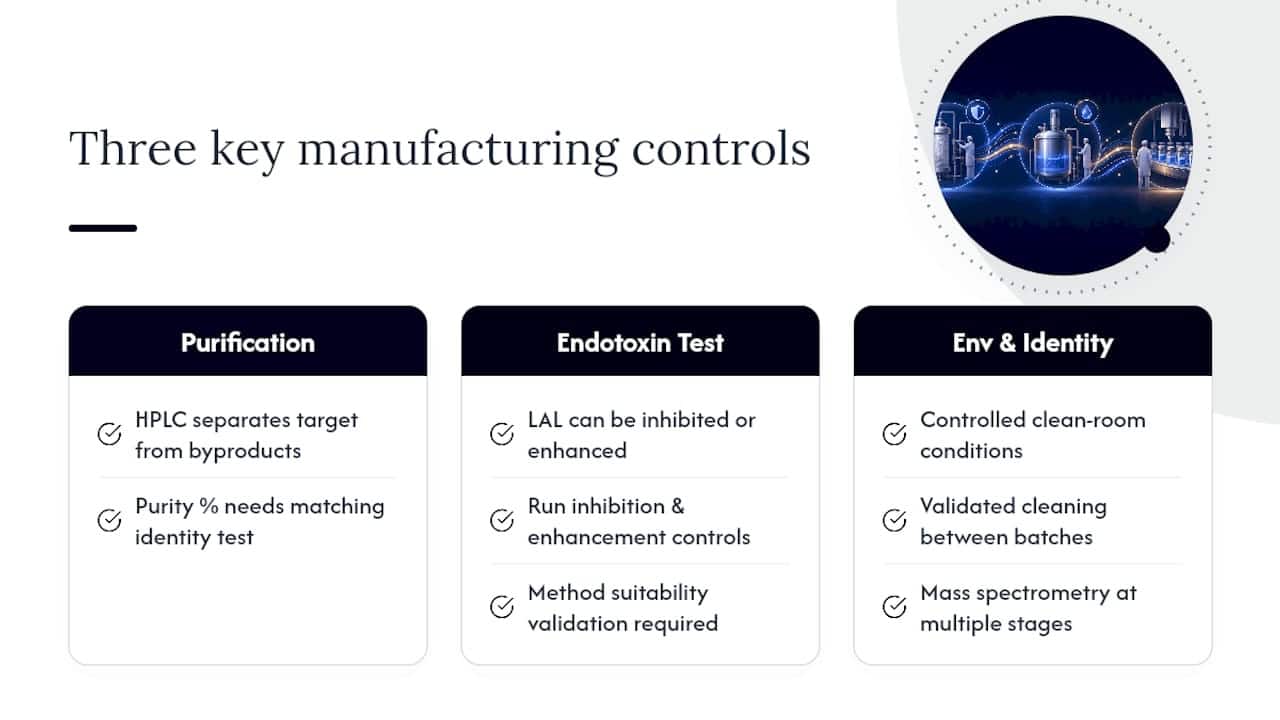
Environmental controls round out the picture: controlled clean room conditions, validated cleaning between batches, and consistent identity testing via mass spectrometry at multiple production stages rather than just at the final release step. None of this is visible to a buyer, which is precisely why the paper trail, the COA, matters as a proxy for practices you can’t observe directly.
Regulatory guidelines and standards for contamination limits
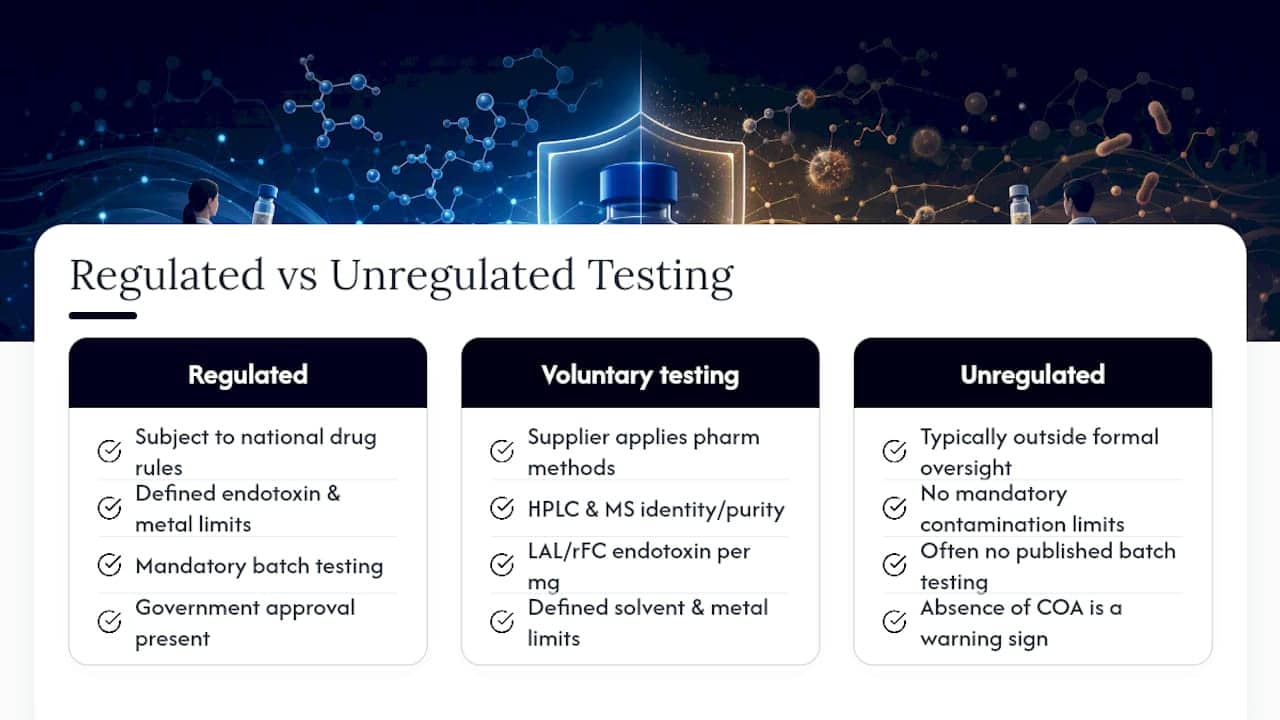
There’s no single global regulator setting one universal contamination threshold for peptides sold outside a pharmaceutical or clinical framework, and that gap is a big part of why buyer verification carries so much weight. Peptides manufactured for approved pharmaceutical use fall under strict national drug regulations with defined endotoxin, heavy-metal, and impurity limits. Research-grade or unregulated peptides, the kind most consumers actually encounter, typically fall outside that same oversight entirely.
What does exist are analytical standards that legitimate manufacturers voluntarily apply, drawn from the same validated methodology used in pharmaceutical testing: HPLC and mass spectrometry for identity and purity, LAL or rFC assays for endotoxin reported in EU per mg, and defined limits for residual solvents and heavy metals, all outlined in regulatory guidance for therapeutic peptide and protein analysis. A supplier applying these voluntarily, and publishing the results, is doing the work that mandatory regulation would otherwise require.
That distinction between “regulated” and “unregulated but rigorously tested” is worth holding onto. It means the presence of a formal government approval isn’t the only signal of safety in this category, but the absence of any published, batch-specific, method-described testing absolutely is a warning sign.
How contamination affects both efficacy and safety
Contamination doesn’t just introduce new risks, it often cancels out the reason someone bought the peptide in the first place. A degraded or aggregated peptide chain has typically lost some of its intended biological activity, meaning a buyer paying for a specific effect may be injecting something that partially or fully fails to deliver it. Worse, aggregated peptide fragments carry a higher chance of triggering an unwanted immune response precisely because they no longer resemble the molecule the body expects.
Mislabelling compounds this in a more direct way. A peptide sold at the wrong concentration means every dosing calculation built around the label is wrong too, which can mean under-dosing into ineffectiveness or over-dosing into a higher risk of side effects, without the buyer ever realizing which one happened.
The safety and efficacy questions are not actually separate problems. A contaminated or misidentified peptide is simultaneously less likely to work as intended and more likely to cause harm, which is exactly why a batch-specific COA with both purity and identity data functions as protection for the outcome you’re trying to get, not just protection against an adverse reaction. Verification isn’t a hurdle standing between you and the product working, it’s the thing that determines whether it can work at all.
Publisher perspective: how Soma Peptide approaches contamination risk
The goal is straightforward: a buyer shouldn’t have to take a purity claim on faith. Soma Peptide also maintains educational resources on reading a COA correctly and on safe injection practice, because a clean product still depends on the person using it applying sterile technique at home.
None of this replaces individual judgment. Even the most rigorously tested peptide requires the buyer to verify the batch documentation matches the vial in hand and to follow sterile handling every time, not just the first time.
— Soma Peptide
Where to buy peptides with transparent testing
Soma Peptide supplies research-grade peptides across weight loss, muscle growth, recovery, anti-aging, and libido categories, and every batch ships with documentation covering identity and purity testing rather than a generic purity claim with no lab report attached. That’s the practical difference this article has been building toward: a supplier that shows you the batch-matched COA before you ask twice for it, instead of one that answers a testing question with a vague reassurance.
If you’re weighing a specific compound, Soma Peptide’s laboratory standards and testing guide breaks down exactly what methods back each product listing. For anyone still finalizing sterile handling habits before a first purchase, the peptide safety guide covers reconstitution and storage in more detail than a single article can. Start there, confirm the documentation on the product page matches what this article outlined, and you’re buying with the verification step already done rather than skipped.
This article is general information, not a substitute for advice from a qualified doctor. Consult a qualified healthcare professional about your own circumstances before acting on anything here.
Sources
- Regulatory guidelines for the analysis of therapeutic peptides and proteins (PMC)
- Low endotoxin peptide manufacturing: what ‘<0.1 EU/mg’ really means (Kilo Biotechnology)
FAQ
Can contaminated peptides really cause a fever or serious illness?
Yes. Endotoxin contamination can trigger a pyrogenic reaction, including fever, chills, and a drop in blood pressure, within hours of an injection, even when the solution looked completely clear beforehand.
What’s the difference between HPLC testing and mass spectrometry on a COA?
HPLC measures how pure a sample is by separating it from other substances, while mass spectrometry confirms the molecule’s actual identity.
How should endotoxin results be reported on a certificate of analysis?
Endotoxin should be reported as endotoxin units per milligram (EU/mg), with the testing method (LAL or rFC) named, because the same per-mg number can carry different clinical significance depending on dose and route.
Does Soma Peptide test every batch for contamination?
Soma Peptide documents purity above 99% with third-party testing and publishes batch-level results rather than a general purity claim, so buyers can check identity and endotoxin data before use.
What should I do if I suspect a peptide vial is contaminated?
Stop using it, keep the vial and any packaging or COA, and seek medical care if you develop fever, chills, or injection-site infection signs; report the product to the supplier and to your national health authority.