


Peptide purity testing, on the seller’s side, means verifying and documenting that a specific batch of peptide actually contains the labelled molecule at the stated purity level, not just printing a number on a label. A meaningful claim comes with proof, not a percentage in isolation. Before trusting any “99% pure” claim, expect to find:
- A Certificate of Analysis (COA) tied to the exact batch or lot number on your vial
- An HPLC chromatogram showing a dominant peak and an integration table
- Mass spectrometry (MS) data confirming the molecule’s actual identity, not just its purity
- The name of the testing lab that ran the analysis, with a date that makes sense against your order
Brands like Soma Peptide build their purity claims around this documentation rather than a headline number alone. If a seller can’t produce these four things on request, treat the purity percentage as unverified.
Key Takeaways
A purity percentage only means something when it comes with a batch-matched COA, an HPLC chromatogram, and mass spectrometry identity confirmation from a named lab with verifiable documentation.
| Point | Details |
|---|---|
| HPLC and MS answer different questions | HPLC measures how clean a sample is; MS confirms it’s actually the labelled peptide. |
| Demand batch-matched documentation | A COA only counts as proof if its lot number matches the vial you received. |
| Watch chromatogram shape, not just the number | Shoulders or clustered peaks near the main peak often signal oxidation or synthesis byproducts. |
| Treat reused COAs as a hard stop | Blanked lot numbers or identical reports across batches mean the claim isn’t verifiable. |
| Soma Peptide pairs HPLC with MS identity | Its COAs tie batch numbers, chromatograms, and mass spec data to the specific product on each page. |
Table of Contents
- Peptide purity testing relies on HPLC and mass spectrometry together
- What a complete Certificate of Analysis (COA) needs to include
- How to read a chromatogram and MS spectrum without a chemistry degree
- Why a purity percentage alone can mislead you
- A short checklist before you buy
- How Soma Peptide documents purity, batch by batch
- Transparency in testing isn’t optional, it’s the whole point
- Ready to check a batch before you buy?
- Sources
- FAQ
Peptide purity testing relies on HPLC and mass spectrometry together
HPLC and mass spectrometry answer two different questions, and a trustworthy purity claim needs both. HPLC (high-performance liquid chromatography) tells you how clean the sample is. Mass spectrometry tells you what the sample actually is. A batch can post a stellar HPLC purity number and still be the wrong peptide entirely if nobody ran an identity check.
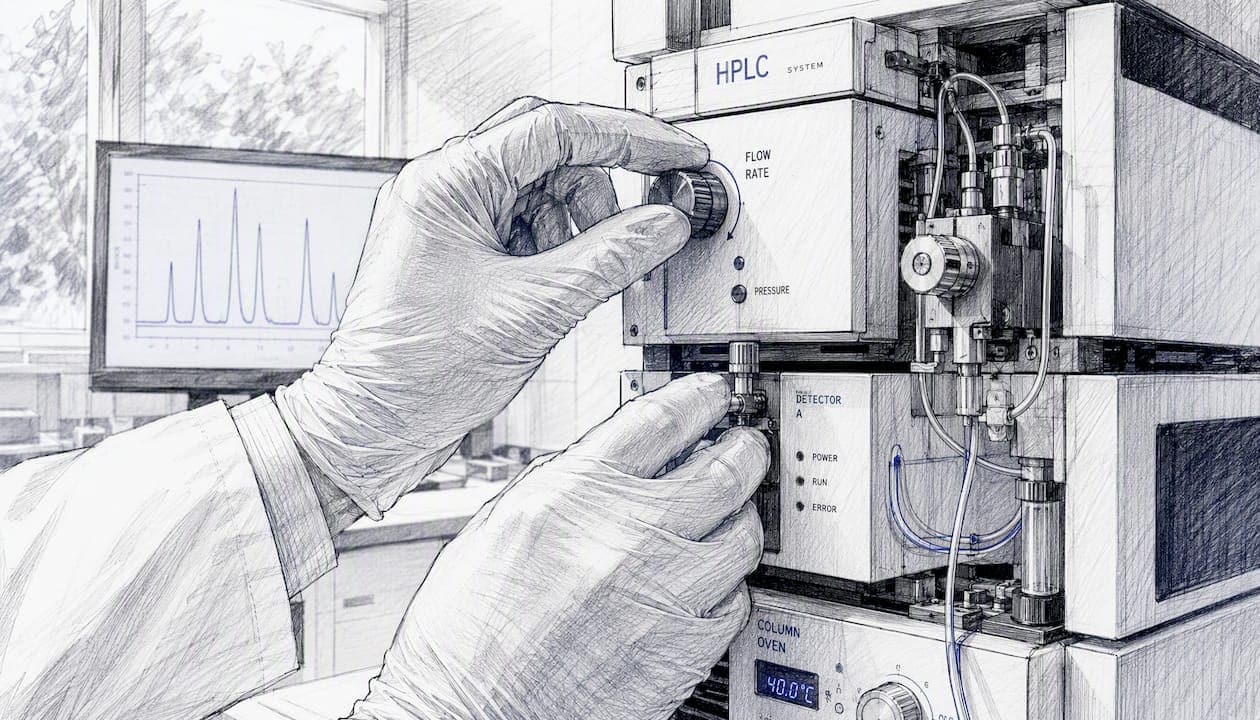
Reversed-phase HPLC works by pushing a dissolved sample through a column that separates molecules by how they interact with the column’s coating. Each component exits at a different time and shows up as a peak on the chromatogram. The main peak’s share of the total peak area, calculated against the other peaks present, becomes the reported purity percentage.
Mass spectrometry takes a different approach. Techniques like LC-MS, ESI-MS, or MALDI measure a sample’s mass-to-charge ratio and compare the result to the peptide’s theoretical molecular weight. If the observed mass matches what the sequence predicts, identity is confirmed. Many labs run LC-MS specifically because the same liquid chromatography separation step feeds both the UV detector for purity and the mass detector for identity, in one pass.
Pro Tip: If a COA shows an HPLC chromatogram but no MS spectrum, the seller has proven the sample is clean. They haven’t proven it’s the peptide you paid for.
What a complete Certificate of Analysis (COA) needs to include
A COA is only useful if it’s traceable back to the exact vial in your hand. That means the batch number on the document has to match the batch number on the product, not a “representative” or generic sample run months earlier. A complete COA typically lists the compound name and sequence, batch and lot number, test date, the testing lab’s name and contact information, HPLC purity with an attached chromatogram, MS identity with observed versus expected molecular weight, and the specific method parameters used to generate the data.
Each field earns its place for a reason:
- Batch/lot number ties the report to your actual vial, not a different production run
- Method parameters (column type, mobile phases, gradient, detection wavelength) let anyone judge whether the test was fit for that particular peptide
- Test date versus stock date flags whether the documentation is current or stale
- Lab name and contact makes the claim checkable rather than anonymous
There’s also a real difference between a manufacturer’s in-house COA and an independent third-party COA. In-house testing isn’t automatically dishonest, but a named outside lab with no financial stake in the sale carries more weight.
| COA field | What to check |
|---|---|
| Batch/lot number | Matches the number printed on your vial exactly |
| HPLC chromatogram | One dominant peak, visible integration table with % area |
| MS spectrum | Observed mass matches theoretical weight for the peptide |
| Method parameters | Column, mobile phase, gradient, and detection wavelength listed |
| Lab name | Identifiable, contactable, ideally independent of the seller |
| Test date | Recent relative to your order, not months or years old |
How to read a chromatogram and MS spectrum without a chemistry degree
You don’t need lab training to catch the obvious problems. A quick scan can tell you whether a report deserves further trust or a hard pass.
On the chromatogram, look for one clearly dominant peak sitting on a flat, quiet baseline. There should be a visible integration table listing each peak by retention time and percentage area, and the biggest peak’s retention time should sit in a plausible range for that class of peptide. A jagged baseline, an unlabelled table, or a peak that arrives suspiciously fast or slow is worth questioning.
On the MS readout, the observed mass-to-charge ratio should land close to the peptide’s known molecular weight, and the expected charge states should be present. A major unexplained peak elsewhere on the spectrum is a problem, not a footnote.
- Shoulder next to the main peak: often signals oxidation or a closely related synthesis byproduct riding alongside the target molecule, rather than a clean single compound
- Multiple small peaks clustered near retention time: can indicate incomplete separation or leftover synthesis intermediates
- Mass mismatch on MS: the sample may not be the labelled peptide at all
A five-second scan catches the obvious red flags, but it can’t replace an actual method review. If something looks off, or looks too clean, ask for the full method parameters or consider an independent retest.
Why a purity percentage alone can mislead you
A high HPLC purity number by itself proves almost nothing about whether the vial contains the peptide you ordered. It only tells you the sample was relatively clean by that particular method, on that particular day, using whatever baseline and integration rules the lab applied. Purity without method disclosure is a claim you can’t actually verify.
Watch for these patterns:
- A purity percentage advertised with no COA attached at all
- A COA that omits method parameters like column type or detection wavelength
- HPLC data with no accompanying MS identity confirmation
- The same COA image reused across multiple batches, or a blanked-out lot number
- Suspiciously round purity figures (a flat “99%” with no decimal, batch after batch)
Synthesis also leaves behind predictable impurities: deletion sequences where an amino acid failed to couple, oxidation products (particularly methionine oxidation), dimers formed from two peptide chains linking together, and residual solvents from the purification process. A well-run report shows these as small peaks accounted for in the integration table, not hidden behind a single suspiciously perfect number.
A COA without a matching batch number or a named testing lab isn’t incomplete documentation. It’s not verifiable at all, and it should be treated as a hard stop rather than a minor gap.
A short checklist before you buy
Run through this before you commit to a purchase, especially with a new supplier, and consider learning about top peptides in skincare: proven anti-aging picks to understand the broader uses of peptides.
- Request a batch-matched COA for the exact lot number on the product you’re buying, not a generic sample.
- Ask for the chromatogram and MS spectrum images, not just a summary percentage.
- Confirm the testing lab’s name and check whether testing was done in-house or by an independent third party.
- Compare the report date against your stock date. A COA from a year ago tells you little about the batch shipping today.
- Ask about additional testing like net peptide content, endotoxin levels, or residual solvents if you’re working with anything requiring higher scrutiny.
Independent verification isn’t free. A basic HPLC run sits at the low end of the cost range, while adding MS identity or endotoxin testing raises the price accordingly. For most buyers, that added cost only makes sense when a specific batch looks questionable.
Pro Tip: Save every COA against its order number as you buy, and compare successive batches side by side. A supplier whose chromatograms look identical run after run, down to the pixel, is a bigger red flag than one whose reports vary slightly the way real lab data actually does.
How Soma Peptide documents purity, batch by batch
Soma Peptide’s approach follows the same standard laid out above: batch-specific COAs, HPLC purity paired with MS identity confirmation, and documentation you can check against the vial in front of you rather than a generic average. The company builds its purity claims around that pairing specifically because an HPLC number without identity confirmation leaves too much unproven.
The trust signals to look for on a Soma Peptide product page mirror the checklist above:
- Batch number on the COA matches the number on the vial
- Chromatogram and MS spectrum both included, not just a summary line
- Named testing lab, not an anonymous internal reference
- Report date that lines up with current stock, not an outdated file
Buyers can review the testing methods and quality standards behind a given product page directly, and cross-check the batch number before completing an order.
Transparency in testing isn’t optional, it’s the whole point
Buyers deserve documentation they can actually check, not a purity claim they have to take on faith. A COA that doesn’t tie back to your specific batch, or skips MS identity entirely, isn’t a minor oversight. It’s the difference between evidence and marketing copy.
Transparency here does real work: it lets you catch a bad batch before you inject it, and it lets a supplier prove they have nothing to hide. That’s the whole reason documentation like this exists in the first place.
Ready to check a batch before you buy?
Most peptide purity testing complaints trace back to one thing: no traceable documentation. You can browse Soma Peptide’s peptide catalogue and check the COA tied to a specific product before you order, comparing batch numbers, chromatograms, and MS identity data the same way this guide walks through. If you’re shopping for a specific use case, like muscle growth or fat loss, the product pages link directly to the relevant purity documentation for that peptide. Have a question about a batch number or need a full report sent over? Contact support through Purepeptide and ask for the COA tied to your order number directly. That’s the fastest way to confirm what’s actually in the vial before it ships.
Sources
- How to read a peptide COA & HPLC report — 9-point checklist · VialVerdict
- Peptide characterization service in Canada | ResolveMass
FAQ
What does peptide purity testing actually verify?
It verifies that a specific batch of peptide contains the labelled molecule and meets a stated chromatographic purity, confirmed through HPLC for purity and mass spectrometry for identity.
Why isn’t a high HPLC purity percentage enough on its own?
HPLC only shows how clean a sample is by that method’s baseline and integration rules. It doesn’t confirm the sample is actually the labelled peptide, which is why MS identity data matters just as much.
What’s the biggest red flag on a peptide COA?
A missing or mismatched batch/lot number is the strongest sign a purity claim can’t be verified, especially if the testing lab isn’t named either.
Does Soma Peptide publish batch-specific COAs?
Yes. Soma Peptide ties its purity documentation to specific batch numbers, pairing HPLC chromatograms with mass spectrometry identity data rather than reporting a single purity figure.
What does a shoulder peak near the main peak usually mean?
It often points to oxidation or a closely related synthesis byproduct, rather than a fully clean single compound, even when the overall purity number still looks high.